There's been a huge reaction to a film about Joseph Kony, leader of the LRA in Northern Uganda, now operating in the killing fields of Eastern Congo. It's an amazing film that has garnered a quite mind-boggling response from the facebookers and tweeters.
A mate of mine, Jonathan Langley, has written this superb reflection on the film and the phenomenon. Jonathan knows what he's talking about and his piece is worth reflecting on. You can read it here
Showing posts with label campaigns. Show all posts
Showing posts with label campaigns. Show all posts
Monday, March 12, 2012

Monday, March 26, 2007
stopping the traffik
We had an excellent Freedom Day yesterday. A group of us marched from Wilberforce's oak in Keston in chains to the High street in Bromley where another group of us were manning a stall highlighting the issue of children being traffiked into the cocoa harvest.
As well as selling fair trade chocolate, we were giving away free and getting people to sign the Stop the Traffik petition.
All in all, it went really well. But I am absolutely cream-crackered this morning (I also preached yesterday morning and led the worship at church yesterday evening, so it was a pretty full day).
Still finding Tobias Jones' book on Utopia's fascinating and jammed full of insights into community and the shape of contemporary culture. In particular his observations about Christians and Christian teaching are provocative (in a good way). I'll blog properly about it later in the week.
As well as selling fair trade chocolate, we were giving away free and getting people to sign the Stop the Traffik petition.
All in all, it went really well. But I am absolutely cream-crackered this morning (I also preached yesterday morning and led the worship at church yesterday evening, so it was a pretty full day).
Still finding Tobias Jones' book on Utopia's fascinating and jammed full of insights into community and the shape of contemporary culture. In particular his observations about Christians and Christian teaching are provocative (in a good way). I'll blog properly about it later in the week.
Friday, March 02, 2007
Relations with the powers that be
As our group of churches staggers into a partnership with our local authority, I've been reflecting on Paul's relationship with power.
We're used to thinking of him being arrested for causing a breach of the peace - in Thessalonica, for example (Acts 17:1-9) - but what about him using a relationship with the powers-that-be to further his mission.
This Sunday I'm preaching on the first missionary journey in particular homing in on Paul and the proconsul Sergius Paullinus (Acts 13:4-12). It seems that there's good evidence that this Roman official had strong links not only on Cyprus where Paul meets him but more particularly in Pisidian Antioch and its environs. Certain inscriptions have been found that suggest a pretty firm and significant link over a number of generations (look at Rainer Riesner's thorough examination of the evidence in Paul's early Period: Chronology, Mission Strategy, Theology [Eerdmanns 1998] - I really hope he's working on a follow up on Paul's later period!)
So when we ask the question why did Paul go to Pisidian Antioch and the not the towns and cities nearer to Cyprus on his first missionary journey, one answer that many scholars suggest is that Sergius Paullus sent him on his way with letters of introduction from him to family members and others (including officials) in that city. It's possible that this accounts for the favourable reception from the Gentiles after Paul and Barnabas are rejected by the synagogue community.
It could account for why, when the Jewish community rejected them, Paul and Barnabas were not immediately arrested by the secular authorities for causing trouble, introducing foreign gods, disturbing the peace, etc. Does this and other experiences along the way also account for Paul's relatively sanguine attitude to the Empire in Romans 13? Though he believes unequivocally that Jesus is Lord, not Caesar, that the only empire that will last is Christ's not Nero's, he does seem to think that the secular authorities can hold the ring in a sinful world in a way that can be advantageous for the gospel.
So, can we find a model for our seeking partnership with local and national government in Paul? It's a nice thought. Perhaps all you biblical scholars can put me right!
We're used to thinking of him being arrested for causing a breach of the peace - in Thessalonica, for example (Acts 17:1-9) - but what about him using a relationship with the powers-that-be to further his mission.
This Sunday I'm preaching on the first missionary journey in particular homing in on Paul and the proconsul Sergius Paullinus (Acts 13:4-12). It seems that there's good evidence that this Roman official had strong links not only on Cyprus where Paul meets him but more particularly in Pisidian Antioch and its environs. Certain inscriptions have been found that suggest a pretty firm and significant link over a number of generations (look at Rainer Riesner's thorough examination of the evidence in Paul's early Period: Chronology, Mission Strategy, Theology [Eerdmanns 1998] - I really hope he's working on a follow up on Paul's later period!)
So when we ask the question why did Paul go to Pisidian Antioch and the not the towns and cities nearer to Cyprus on his first missionary journey, one answer that many scholars suggest is that Sergius Paullus sent him on his way with letters of introduction from him to family members and others (including officials) in that city. It's possible that this accounts for the favourable reception from the Gentiles after Paul and Barnabas are rejected by the synagogue community.
It could account for why, when the Jewish community rejected them, Paul and Barnabas were not immediately arrested by the secular authorities for causing trouble, introducing foreign gods, disturbing the peace, etc. Does this and other experiences along the way also account for Paul's relatively sanguine attitude to the Empire in Romans 13? Though he believes unequivocally that Jesus is Lord, not Caesar, that the only empire that will last is Christ's not Nero's, he does seem to think that the secular authorities can hold the ring in a sinful world in a way that can be advantageous for the gospel.
So, can we find a model for our seeking partnership with local and national government in Paul? It's a nice thought. Perhaps all you biblical scholars can put me right!
Monday, February 12, 2007
A pin-prick for justice
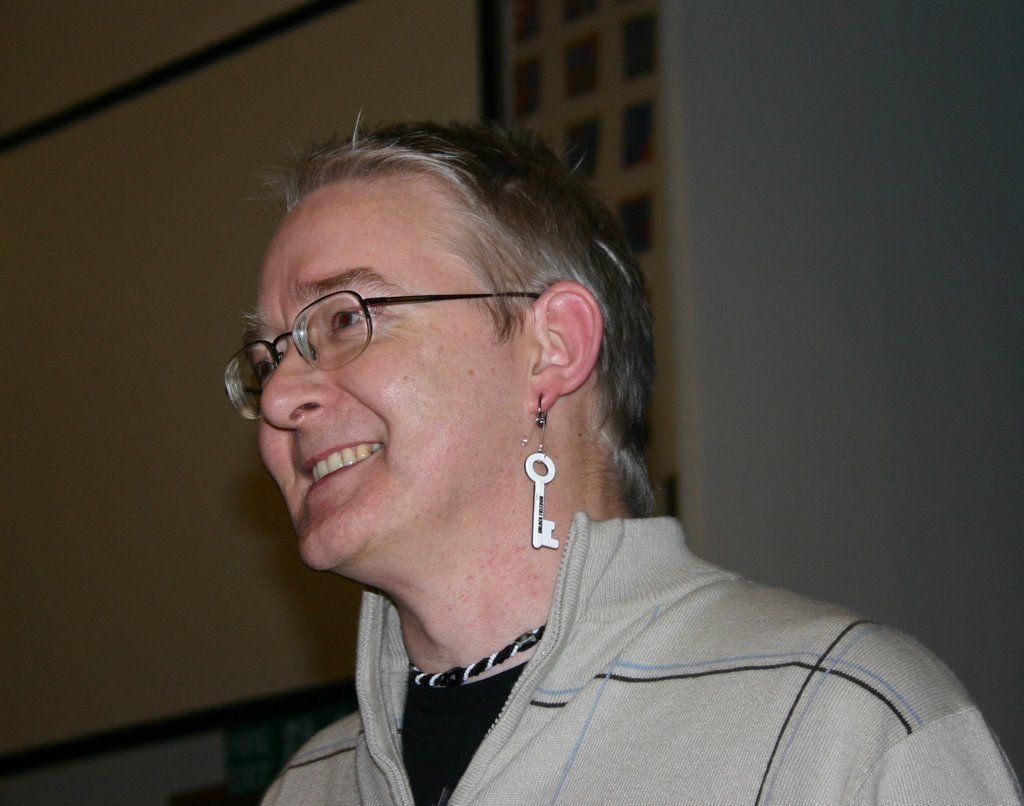
Last night we attached the keys to our earrings to complete the look destined to take the fashion world by storm.....
It felt odd and gets caught on my scarf. But over a quarter a million children are trafficked into West African cocoa production areas to harvest the raw material for our lunchtime chocolate treat.
According to the US State department
many of these children are under 12 years-of-age, sold into indentured servitude for $140 and
work 12-hour days for $135 to $189 per year.
Like the flow of migrants across our planet, these statistics show how desperate families are to scrape a living in some parts of the world. Stop the Traffik is lifting the lid on this in a way that might get people changing their behaviour in the west to make a token difference for some of those lives and put pressure on governments to make real and substantial changes in the terms of trade between rich and poor nations.
I think my ear can stand a little discomfort for that (not wanting to sound too po-faced and juster-than-thou about it!)
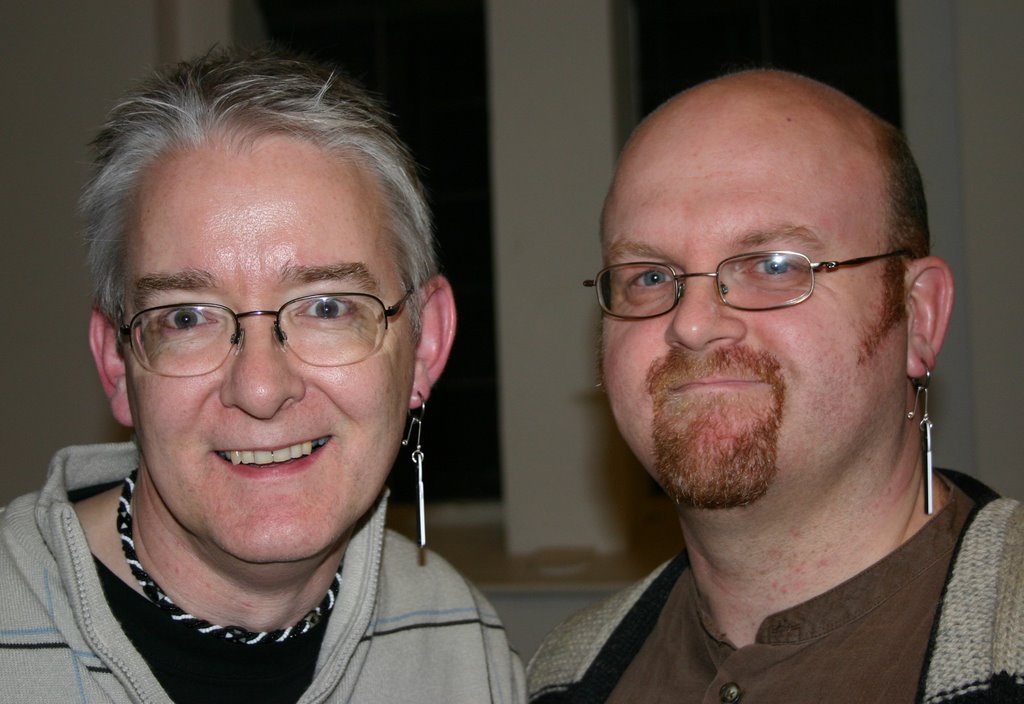
Oh and here's me and Jonathan together:
Sunday, February 11, 2007
Photographic evidence
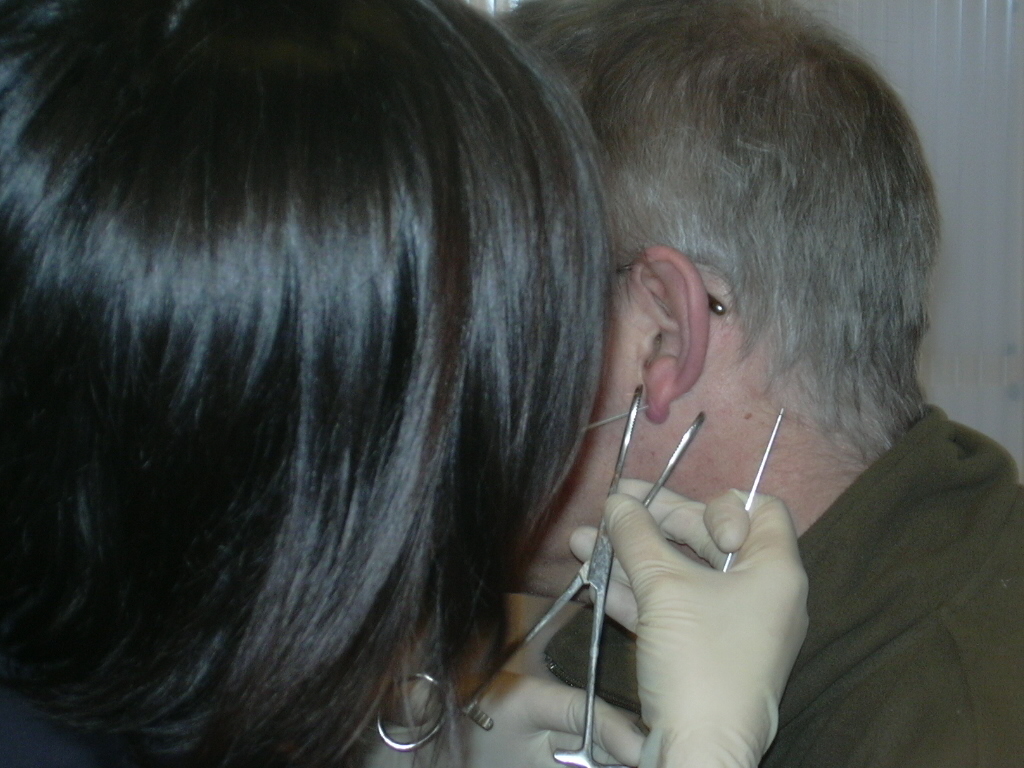
Stuart asked for a picture of my piercing...
Here's one of the needle being run through my left lobe - surprisingly, no pain was felt at this point!
The idea for this came from seeing 58 year old Ken Raynard, minister of Belper Baptist getting it done. Thanks Ken.
And below is my new left profile - what a dash i cut! This morning it doesn't feel sore at all so I'm pretty confident that we'll be hanging the Unlock Freedom keys this evening. Watch this space!

Friday, February 09, 2007
Stop the traffik
Over the weekend I'll respond to some of the comments on my previous post which are stimulating all sorts of thoughts.
Today Jonathan (our minister for youth and young adults) and I had our ears pierced as a prelude to launching our Stop the Traffik Freedom Day activities. Having had a ring inserted by a highly competent young lady piercer, we hope to attach the Stop the Traffik keys to them on Sunday at our evening service.
We'll then wear them to advertise the fact that on 25 March we'll be celebrating the end 200 years ago of the transatlantic slave trade, lamenting the fact that we still benefit from this iniquitous trade and drawing attention to the fact that more people are trafficked today than were transported at the height of the trade that Wilberforce opposed and attempted to stop by Parliamentary action.
On 25 March we'll be on the High Street in Bromley drawing attention to the use of trafficked children in the production of chocolate, giving away fair trade bars and selling others. We'll be playing music, giving out leaflets, talking to people and welcoming a group walking from Keston - where the oak tree that Wilberforce sat under to seek inspiration - to our stand in the High Street. We're hoping that this small group will walk chained together for the four and half miles and hand out information explaining why they're doing it.
If you want to find out more about Stop the Traffik, visit their website at www.stopthetraffik.org
Today Jonathan (our minister for youth and young adults) and I had our ears pierced as a prelude to launching our Stop the Traffik Freedom Day activities. Having had a ring inserted by a highly competent young lady piercer, we hope to attach the Stop the Traffik keys to them on Sunday at our evening service.
We'll then wear them to advertise the fact that on 25 March we'll be celebrating the end 200 years ago of the transatlantic slave trade, lamenting the fact that we still benefit from this iniquitous trade and drawing attention to the fact that more people are trafficked today than were transported at the height of the trade that Wilberforce opposed and attempted to stop by Parliamentary action.
On 25 March we'll be on the High Street in Bromley drawing attention to the use of trafficked children in the production of chocolate, giving away fair trade bars and selling others. We'll be playing music, giving out leaflets, talking to people and welcoming a group walking from Keston - where the oak tree that Wilberforce sat under to seek inspiration - to our stand in the High Street. We're hoping that this small group will walk chained together for the four and half miles and hand out information explaining why they're doing it.
If you want to find out more about Stop the Traffik, visit their website at www.stopthetraffik.org
Thursday, January 11, 2007
Campaigning irony
Stuart Blythe in a quite brilliant post over at word at the barricades (www.thewordatthebarricades.typepad.com/ look for the entry called 'perplexed'), has put his finger on why I have misgivings about the current campaign by some Christians against the sexual orientation regulations. And it has to do with my reading of acts 3 - i love it when things look joined up!
Stuart suggests that it is somewhat weird for Christians to be campaigning for the right not to serve people. Read that sentence again if you haven't picked up the irony. We're called to serve everyone, just as God does, so why should we be looking for exemptions on the basis of our disapproval of certain people's lifestyles?
Remember that Luke's first readers would almost certainly have assumed that the man at the gate of the temple (Acts 3:1-10) was morally deficient as well as disabled. They would have seen his disability as evidence that his lifestyle did not measure up to their high standards, that he did not have a good character.
Peter and John did not look for a reason not to serve him. Rather, despite knowing precious little about him - except that he couldn't walk - Peter swept the man up into the story of God's saving activity in the world.
Shouldn't it be our joy to serve all people of all kinds in the hope that through our service they catch a glimpse of the God who causes his sun to shine on all?
Stuart suggests that it is somewhat weird for Christians to be campaigning for the right not to serve people. Read that sentence again if you haven't picked up the irony. We're called to serve everyone, just as God does, so why should we be looking for exemptions on the basis of our disapproval of certain people's lifestyles?
Remember that Luke's first readers would almost certainly have assumed that the man at the gate of the temple (Acts 3:1-10) was morally deficient as well as disabled. They would have seen his disability as evidence that his lifestyle did not measure up to their high standards, that he did not have a good character.
Peter and John did not look for a reason not to serve him. Rather, despite knowing precious little about him - except that he couldn't walk - Peter swept the man up into the story of God's saving activity in the world.
Shouldn't it be our joy to serve all people of all kinds in the hope that through our service they catch a glimpse of the God who causes his sun to shine on all?
Subscribe to:
Posts (Atom)

