There's a great story in today's G2 about Hannah Atkins and her husband offering a failed asylum seeker a place to eat and sleep for a few months. It's a great story about how hospitality - a key Christian virtue - can make a real difference in a world of injustice.
Check it out at the Guardian's website.
And then go to Hannah's website. She is a singer-songwriter with a wonderful voice and a neat line in catchy folk-tronica. Clearly committed to some great causes, she writes with a disarming honesty and the production is first rate.
Showing posts with label justice. Show all posts
Showing posts with label justice. Show all posts
Friday, June 25, 2010

Tuesday, May 25, 2010
Cutting the future to pay for the past
So the first round of spending cuts were announced yesterday and it looks like they'll do exactly what many feared they would. With Russell Crowe filling our screens as the latest incarnation of Robin Hood, maybe it's time to see his tax ideas enacted across the globe.
Owen Tudor, a spokesperson from the Robin Hood Tax campaign, put his finger on the issue when he said: “The spending cuts spelled out by George Osborne represent a profound sign of injustice. Those who bear no responsibility for the global recession will have to pay the price, while the financial sector, whose reckless behaviour has largely contributed to the mess which we are in, can continue business as usual.
The banks in the UK have been bailed out to the tune of £850bn and yet it is probably young people in my neighbourhood who will pay the price for their casino activities. Bonuses show no sign of abating but local authority spending had been slashed by more than £1bn. This means that a lot of projects offering front line support to some of our society's most vulnerable young and old people will be axed.
Something feels wrong about that. It's hard to see how a slash and burn approach to public finances fits with all the talk of a big society. The thing about a big society is that communities and churches can rise to the challenge of meeting real social need more efficiently than government can. But they can't do it for nothing. They rely on statutory funding as well as charitable giving to pay for their activities. Perhaps Goldman Sachs executives could make a start by donating their entire bonus pot (a smidgen over $16bn) to projects working with the poor and vulnerable in our communities.
“Cuts will not only affect a significant portion of public sector workers who will lose their jobs or see their pay frozen,' says Tudor, 'but also the general public who will no longer be able to rely on essential public services. One way of avoiding these large-scale cuts would be to introduce a Robin Hood Tax on the financial sector, which would raise at least £20 billion a year in the UK alone. Such a tax would be fair as it would target a sector that played a pivotal role in the economic crisis and that has the financial resources to cope with a levy.”
Robin Hood Tax campaigners say that the revenue raised would help reduce the public deficit, protect public service jobs, tackle poverty at home and abroad, as well as fight climate change. You can find out more about Robin Hood here
Owen Tudor, a spokesperson from the Robin Hood Tax campaign, put his finger on the issue when he said: “The spending cuts spelled out by George Osborne represent a profound sign of injustice. Those who bear no responsibility for the global recession will have to pay the price, while the financial sector, whose reckless behaviour has largely contributed to the mess which we are in, can continue business as usual.
The banks in the UK have been bailed out to the tune of £850bn and yet it is probably young people in my neighbourhood who will pay the price for their casino activities. Bonuses show no sign of abating but local authority spending had been slashed by more than £1bn. This means that a lot of projects offering front line support to some of our society's most vulnerable young and old people will be axed.
Something feels wrong about that. It's hard to see how a slash and burn approach to public finances fits with all the talk of a big society. The thing about a big society is that communities and churches can rise to the challenge of meeting real social need more efficiently than government can. But they can't do it for nothing. They rely on statutory funding as well as charitable giving to pay for their activities. Perhaps Goldman Sachs executives could make a start by donating their entire bonus pot (a smidgen over $16bn) to projects working with the poor and vulnerable in our communities.
“Cuts will not only affect a significant portion of public sector workers who will lose their jobs or see their pay frozen,' says Tudor, 'but also the general public who will no longer be able to rely on essential public services. One way of avoiding these large-scale cuts would be to introduce a Robin Hood Tax on the financial sector, which would raise at least £20 billion a year in the UK alone. Such a tax would be fair as it would target a sector that played a pivotal role in the economic crisis and that has the financial resources to cope with a levy.”
Robin Hood Tax campaigners say that the revenue raised would help reduce the public deficit, protect public service jobs, tackle poverty at home and abroad, as well as fight climate change. You can find out more about Robin Hood here
Thursday, April 22, 2010
Putting fire into the campaign
The lacklustre election campaign pitched into farce yesterday with Ken Clark ranting against those who might vote in such a way that we end up with a hung or balanced parliament. With his apocalyptic talk of IMF bureacrats touching down in London the day after the election, it's the first time I can recall a candidate threatening armageddon if you don't vote for his party.
Still, it's good to have a titter among the tedium! The thing is that with the prospect of a balanced parliament and a real chance for radical reform of our broken political institutions, the election camapign should be rivetting. Candidates and leaders should be engaging with the real issues of how we can refresh and renew our democracy. Instead they seem to be arguing over who can be trusted least to manage our present less-than-adequate way of doing things.
Back in the real world, it's 100 days since the Haiti earthquake but the suffering of a nation seems to have dropped off the radar - you really have to search hard to find anything on the BBC news site (though the Today programme featured a report on the continuing relief effort that contained the good news that immunisation of children has prevented epidemics of water-borne disease).
And Obama is making a speech about banking regulation in New York later today. Let's hope there are some radical proposals to regulate the excesses and even support for the Robin Hood Tax. Such a tax on every transaction of every financial institution across the globe could raise more than $300 billion for poverty-relief and front-line services in every nation where banks operate.
As Alexandr, the meerkat, would say 'schimple'
I wonder if it will feature in the prime ministerial debate this evening....
Still, it's good to have a titter among the tedium! The thing is that with the prospect of a balanced parliament and a real chance for radical reform of our broken political institutions, the election camapign should be rivetting. Candidates and leaders should be engaging with the real issues of how we can refresh and renew our democracy. Instead they seem to be arguing over who can be trusted least to manage our present less-than-adequate way of doing things.
Back in the real world, it's 100 days since the Haiti earthquake but the suffering of a nation seems to have dropped off the radar - you really have to search hard to find anything on the BBC news site (though the Today programme featured a report on the continuing relief effort that contained the good news that immunisation of children has prevented epidemics of water-borne disease).
And Obama is making a speech about banking regulation in New York later today. Let's hope there are some radical proposals to regulate the excesses and even support for the Robin Hood Tax. Such a tax on every transaction of every financial institution across the globe could raise more than $300 billion for poverty-relief and front-line services in every nation where banks operate.
As Alexandr, the meerkat, would say 'schimple'
I wonder if it will feature in the prime ministerial debate this evening....
Wednesday, May 23, 2007
Stipe on doing something about it
Came across a nice quote from Michael Stipe (he of REM and the heavy blue eyeliner) on Faithnet. He was talking about his reactions to Katrina's devastation of New Orleans. He said:
The most godly way to respond to something like this is to put everything aside and say, "You are my brother and sister, and I am here. I have not forgotten. I have not turned my back. I've not allowed the news cycle to dictate whether I am paying attention to the circumstance you found yourself in or not. I am here."
He went on to speak warmly of his Methodist parents and the fact that he came from a long line of Methodist ministers. You can read it at www.beliefnet.com/story/187/story_18748_1.html. It puts Losing My Religion (one of the most incredible songs of the 1990s) into an interesting perspective. I just hope he and his band can capture the spirit that produced that song on their next album.
The most godly way to respond to something like this is to put everything aside and say, "You are my brother and sister, and I am here. I have not forgotten. I have not turned my back. I've not allowed the news cycle to dictate whether I am paying attention to the circumstance you found yourself in or not. I am here."
He went on to speak warmly of his Methodist parents and the fact that he came from a long line of Methodist ministers. You can read it at www.beliefnet.com/story/187/story_18748_1.html. It puts Losing My Religion (one of the most incredible songs of the 1990s) into an interesting perspective. I just hope he and his band can capture the spirit that produced that song on their next album.
Tuesday, May 01, 2007
Breakfast chat
I've just had breakfast with Les Issac - founder of Street Pastors, prolific traveller and one of those people who regularly sits with senior politicians and police officers and yet seems entirely untainted by it. I should add that I wasn't alone; there were 15 or so of us gathered at a regular inter-church breakfast.
He spoke briefly about a prayer event he's organising to seek God in relation to the recent spate of gun and knife crimes in south London. He asked whether anyone had a word from the Lord to share on that occasion. That always sets me thinking - is God going to say something new and startlingly original or is he going to remind us of our calling as his people in this great city?
I felt him reminding me that we are called to be a people of peace, shalom; in a world of violence we are to be a people who live together in peace and make peace in the communities in which we live.
Peace is an essential building block of community. At it's most basic, it's knowing that I will be safe in the company of my brothers and sisters in church, that if I share difficult things, I'll not be shouted at, bullied or put down. Sadly, of course, that isn't always the case. All too often churches are places where those with the loudest voices and biggest personalities get their way, wielding unhelpful influence over the lives of those around them.
So maybe our first calling in the light of these terrible events in our city is to recommit ourselves to living at peace with one another.
Peace, of course, in the bible is more than just the absence of conflict - though that's an essential first step - it's also about the presence of wholeness and well-being, right relationships with God and one another. And, most crucially, it's about seeking the blessing of that shalom for our neighbours, working for their good, for their shalom, ensuring that the widest numbers possible get a taste of God's agenda for them.
So in communities wracked by violence, it's about being a peace-making presence, a people who offer different options for young people, support for parents, a place of safety and belonging for all. It's also about using our resources to create social capital in our neighbourhoods through skills training, job creation, offering second, third and fourth chances to those who've messed up and want a shot at starting their lives over.
Where are the churches who are doing this?
He spoke briefly about a prayer event he's organising to seek God in relation to the recent spate of gun and knife crimes in south London. He asked whether anyone had a word from the Lord to share on that occasion. That always sets me thinking - is God going to say something new and startlingly original or is he going to remind us of our calling as his people in this great city?
I felt him reminding me that we are called to be a people of peace, shalom; in a world of violence we are to be a people who live together in peace and make peace in the communities in which we live.
Peace is an essential building block of community. At it's most basic, it's knowing that I will be safe in the company of my brothers and sisters in church, that if I share difficult things, I'll not be shouted at, bullied or put down. Sadly, of course, that isn't always the case. All too often churches are places where those with the loudest voices and biggest personalities get their way, wielding unhelpful influence over the lives of those around them.
So maybe our first calling in the light of these terrible events in our city is to recommit ourselves to living at peace with one another.
Peace, of course, in the bible is more than just the absence of conflict - though that's an essential first step - it's also about the presence of wholeness and well-being, right relationships with God and one another. And, most crucially, it's about seeking the blessing of that shalom for our neighbours, working for their good, for their shalom, ensuring that the widest numbers possible get a taste of God's agenda for them.
So in communities wracked by violence, it's about being a peace-making presence, a people who offer different options for young people, support for parents, a place of safety and belonging for all. It's also about using our resources to create social capital in our neighbourhoods through skills training, job creation, offering second, third and fourth chances to those who've messed up and want a shot at starting their lives over.
Where are the churches who are doing this?
Thursday, April 19, 2007
Preach it Bono
There's a great youTube clip over on Sean Winter's blog (http://seanthebaptist.typepad.com/) featuring Bono's acceptance speech at the NAACP awards ceremony earlier this year.
It's vintage Bono.
'True religion will not let us fall asleep in the comfort of our freedom,' he says. 'Love your neighbour is not a piece of advice, it's a command. That means in the global village we're going to have to love a whole lot more people - that's what that means.'
Earlier, he'd described Martin Luther King as 'a man who refused to hate because he knew love would do a better job.'
Once he hits his stride, he says: 'the poor are where God lives...God is with the poor and he is with us if we are with them. This is not a burden, it's an adventure.' The words have a liturgical as well as rhetorical rhythm. And I love that last sentence. Our lives with God in mission among the poor, in sharing what we have, in pooling resources and energy, insights and hard labour is an adventure not a burden.
Check it out - it's great.
It's vintage Bono.
'True religion will not let us fall asleep in the comfort of our freedom,' he says. 'Love your neighbour is not a piece of advice, it's a command. That means in the global village we're going to have to love a whole lot more people - that's what that means.'
Earlier, he'd described Martin Luther King as 'a man who refused to hate because he knew love would do a better job.'
Once he hits his stride, he says: 'the poor are where God lives...God is with the poor and he is with us if we are with them. This is not a burden, it's an adventure.' The words have a liturgical as well as rhetorical rhythm. And I love that last sentence. Our lives with God in mission among the poor, in sharing what we have, in pooling resources and energy, insights and hard labour is an adventure not a burden.
Check it out - it's great.
Monday, March 26, 2007
stopping the traffik
We had an excellent Freedom Day yesterday. A group of us marched from Wilberforce's oak in Keston in chains to the High street in Bromley where another group of us were manning a stall highlighting the issue of children being traffiked into the cocoa harvest.
As well as selling fair trade chocolate, we were giving away free and getting people to sign the Stop the Traffik petition.
All in all, it went really well. But I am absolutely cream-crackered this morning (I also preached yesterday morning and led the worship at church yesterday evening, so it was a pretty full day).
Still finding Tobias Jones' book on Utopia's fascinating and jammed full of insights into community and the shape of contemporary culture. In particular his observations about Christians and Christian teaching are provocative (in a good way). I'll blog properly about it later in the week.
As well as selling fair trade chocolate, we were giving away free and getting people to sign the Stop the Traffik petition.
All in all, it went really well. But I am absolutely cream-crackered this morning (I also preached yesterday morning and led the worship at church yesterday evening, so it was a pretty full day).
Still finding Tobias Jones' book on Utopia's fascinating and jammed full of insights into community and the shape of contemporary culture. In particular his observations about Christians and Christian teaching are provocative (in a good way). I'll blog properly about it later in the week.
Friday, March 02, 2007
Relations with the powers that be
As our group of churches staggers into a partnership with our local authority, I've been reflecting on Paul's relationship with power.
We're used to thinking of him being arrested for causing a breach of the peace - in Thessalonica, for example (Acts 17:1-9) - but what about him using a relationship with the powers-that-be to further his mission.
This Sunday I'm preaching on the first missionary journey in particular homing in on Paul and the proconsul Sergius Paullinus (Acts 13:4-12). It seems that there's good evidence that this Roman official had strong links not only on Cyprus where Paul meets him but more particularly in Pisidian Antioch and its environs. Certain inscriptions have been found that suggest a pretty firm and significant link over a number of generations (look at Rainer Riesner's thorough examination of the evidence in Paul's early Period: Chronology, Mission Strategy, Theology [Eerdmanns 1998] - I really hope he's working on a follow up on Paul's later period!)
So when we ask the question why did Paul go to Pisidian Antioch and the not the towns and cities nearer to Cyprus on his first missionary journey, one answer that many scholars suggest is that Sergius Paullus sent him on his way with letters of introduction from him to family members and others (including officials) in that city. It's possible that this accounts for the favourable reception from the Gentiles after Paul and Barnabas are rejected by the synagogue community.
It could account for why, when the Jewish community rejected them, Paul and Barnabas were not immediately arrested by the secular authorities for causing trouble, introducing foreign gods, disturbing the peace, etc. Does this and other experiences along the way also account for Paul's relatively sanguine attitude to the Empire in Romans 13? Though he believes unequivocally that Jesus is Lord, not Caesar, that the only empire that will last is Christ's not Nero's, he does seem to think that the secular authorities can hold the ring in a sinful world in a way that can be advantageous for the gospel.
So, can we find a model for our seeking partnership with local and national government in Paul? It's a nice thought. Perhaps all you biblical scholars can put me right!
We're used to thinking of him being arrested for causing a breach of the peace - in Thessalonica, for example (Acts 17:1-9) - but what about him using a relationship with the powers-that-be to further his mission.
This Sunday I'm preaching on the first missionary journey in particular homing in on Paul and the proconsul Sergius Paullinus (Acts 13:4-12). It seems that there's good evidence that this Roman official had strong links not only on Cyprus where Paul meets him but more particularly in Pisidian Antioch and its environs. Certain inscriptions have been found that suggest a pretty firm and significant link over a number of generations (look at Rainer Riesner's thorough examination of the evidence in Paul's early Period: Chronology, Mission Strategy, Theology [Eerdmanns 1998] - I really hope he's working on a follow up on Paul's later period!)
So when we ask the question why did Paul go to Pisidian Antioch and the not the towns and cities nearer to Cyprus on his first missionary journey, one answer that many scholars suggest is that Sergius Paullus sent him on his way with letters of introduction from him to family members and others (including officials) in that city. It's possible that this accounts for the favourable reception from the Gentiles after Paul and Barnabas are rejected by the synagogue community.
It could account for why, when the Jewish community rejected them, Paul and Barnabas were not immediately arrested by the secular authorities for causing trouble, introducing foreign gods, disturbing the peace, etc. Does this and other experiences along the way also account for Paul's relatively sanguine attitude to the Empire in Romans 13? Though he believes unequivocally that Jesus is Lord, not Caesar, that the only empire that will last is Christ's not Nero's, he does seem to think that the secular authorities can hold the ring in a sinful world in a way that can be advantageous for the gospel.
So, can we find a model for our seeking partnership with local and national government in Paul? It's a nice thought. Perhaps all you biblical scholars can put me right!
Monday, February 12, 2007
A pin-prick for justice
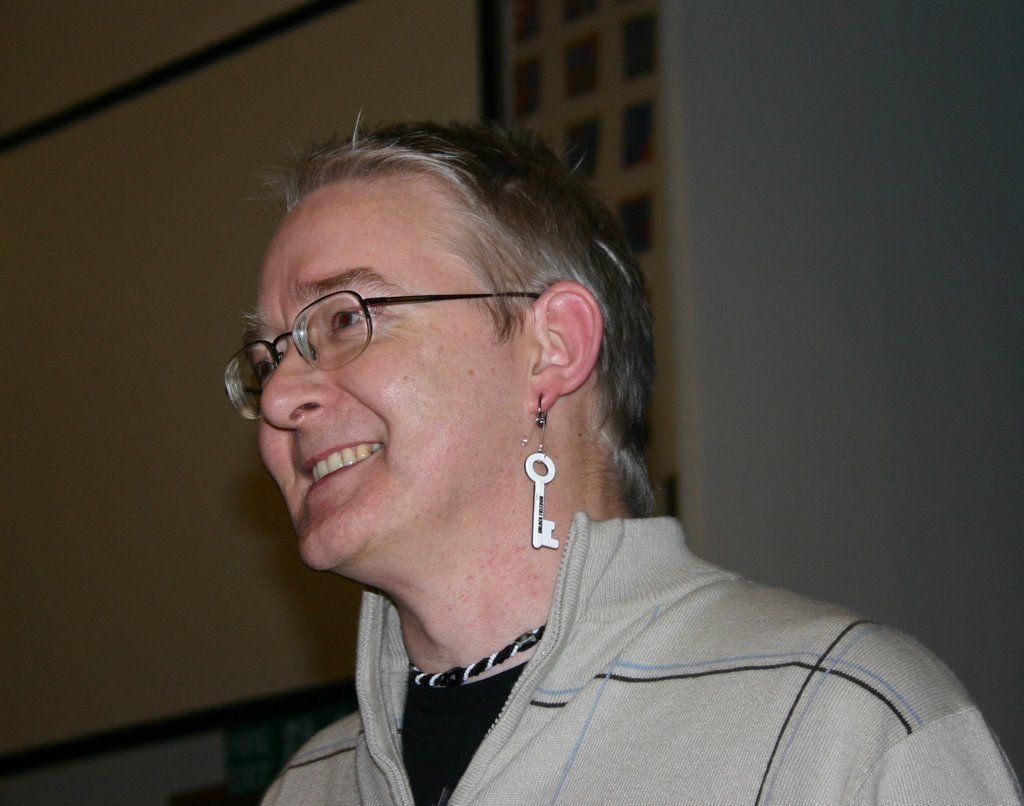
Last night we attached the keys to our earrings to complete the look destined to take the fashion world by storm.....
It felt odd and gets caught on my scarf. But over a quarter a million children are trafficked into West African cocoa production areas to harvest the raw material for our lunchtime chocolate treat.
According to the US State department
many of these children are under 12 years-of-age, sold into indentured servitude for $140 and
work 12-hour days for $135 to $189 per year.
Like the flow of migrants across our planet, these statistics show how desperate families are to scrape a living in some parts of the world. Stop the Traffik is lifting the lid on this in a way that might get people changing their behaviour in the west to make a token difference for some of those lives and put pressure on governments to make real and substantial changes in the terms of trade between rich and poor nations.
I think my ear can stand a little discomfort for that (not wanting to sound too po-faced and juster-than-thou about it!)
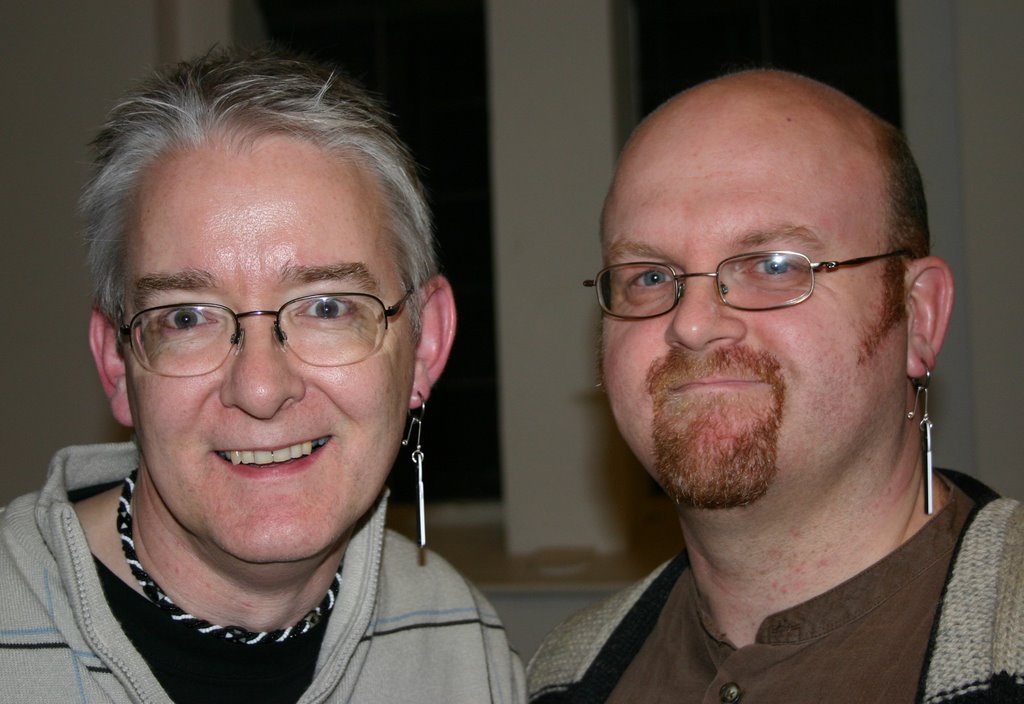
Oh and here's me and Jonathan together:
Sunday, February 11, 2007
Photographic evidence
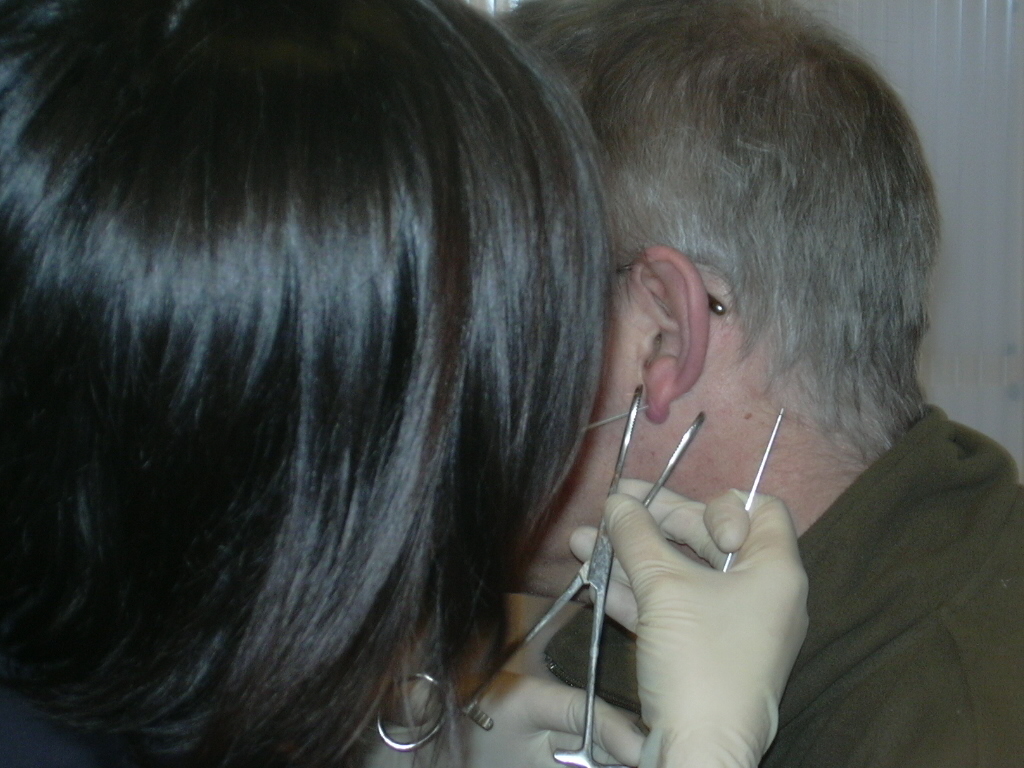
Stuart asked for a picture of my piercing...
Here's one of the needle being run through my left lobe - surprisingly, no pain was felt at this point!
The idea for this came from seeing 58 year old Ken Raynard, minister of Belper Baptist getting it done. Thanks Ken.
And below is my new left profile - what a dash i cut! This morning it doesn't feel sore at all so I'm pretty confident that we'll be hanging the Unlock Freedom keys this evening. Watch this space!

Friday, February 09, 2007
Stop the traffik
Over the weekend I'll respond to some of the comments on my previous post which are stimulating all sorts of thoughts.
Today Jonathan (our minister for youth and young adults) and I had our ears pierced as a prelude to launching our Stop the Traffik Freedom Day activities. Having had a ring inserted by a highly competent young lady piercer, we hope to attach the Stop the Traffik keys to them on Sunday at our evening service.
We'll then wear them to advertise the fact that on 25 March we'll be celebrating the end 200 years ago of the transatlantic slave trade, lamenting the fact that we still benefit from this iniquitous trade and drawing attention to the fact that more people are trafficked today than were transported at the height of the trade that Wilberforce opposed and attempted to stop by Parliamentary action.
On 25 March we'll be on the High Street in Bromley drawing attention to the use of trafficked children in the production of chocolate, giving away fair trade bars and selling others. We'll be playing music, giving out leaflets, talking to people and welcoming a group walking from Keston - where the oak tree that Wilberforce sat under to seek inspiration - to our stand in the High Street. We're hoping that this small group will walk chained together for the four and half miles and hand out information explaining why they're doing it.
If you want to find out more about Stop the Traffik, visit their website at www.stopthetraffik.org
Today Jonathan (our minister for youth and young adults) and I had our ears pierced as a prelude to launching our Stop the Traffik Freedom Day activities. Having had a ring inserted by a highly competent young lady piercer, we hope to attach the Stop the Traffik keys to them on Sunday at our evening service.
We'll then wear them to advertise the fact that on 25 March we'll be celebrating the end 200 years ago of the transatlantic slave trade, lamenting the fact that we still benefit from this iniquitous trade and drawing attention to the fact that more people are trafficked today than were transported at the height of the trade that Wilberforce opposed and attempted to stop by Parliamentary action.
On 25 March we'll be on the High Street in Bromley drawing attention to the use of trafficked children in the production of chocolate, giving away fair trade bars and selling others. We'll be playing music, giving out leaflets, talking to people and welcoming a group walking from Keston - where the oak tree that Wilberforce sat under to seek inspiration - to our stand in the High Street. We're hoping that this small group will walk chained together for the four and half miles and hand out information explaining why they're doing it.
If you want to find out more about Stop the Traffik, visit their website at www.stopthetraffik.org
Thursday, January 11, 2007
Campaigning irony
Stuart Blythe in a quite brilliant post over at word at the barricades (www.thewordatthebarricades.typepad.com/ look for the entry called 'perplexed'), has put his finger on why I have misgivings about the current campaign by some Christians against the sexual orientation regulations. And it has to do with my reading of acts 3 - i love it when things look joined up!
Stuart suggests that it is somewhat weird for Christians to be campaigning for the right not to serve people. Read that sentence again if you haven't picked up the irony. We're called to serve everyone, just as God does, so why should we be looking for exemptions on the basis of our disapproval of certain people's lifestyles?
Remember that Luke's first readers would almost certainly have assumed that the man at the gate of the temple (Acts 3:1-10) was morally deficient as well as disabled. They would have seen his disability as evidence that his lifestyle did not measure up to their high standards, that he did not have a good character.
Peter and John did not look for a reason not to serve him. Rather, despite knowing precious little about him - except that he couldn't walk - Peter swept the man up into the story of God's saving activity in the world.
Shouldn't it be our joy to serve all people of all kinds in the hope that through our service they catch a glimpse of the God who causes his sun to shine on all?
Stuart suggests that it is somewhat weird for Christians to be campaigning for the right not to serve people. Read that sentence again if you haven't picked up the irony. We're called to serve everyone, just as God does, so why should we be looking for exemptions on the basis of our disapproval of certain people's lifestyles?
Remember that Luke's first readers would almost certainly have assumed that the man at the gate of the temple (Acts 3:1-10) was morally deficient as well as disabled. They would have seen his disability as evidence that his lifestyle did not measure up to their high standards, that he did not have a good character.
Peter and John did not look for a reason not to serve him. Rather, despite knowing precious little about him - except that he couldn't walk - Peter swept the man up into the story of God's saving activity in the world.
Shouldn't it be our joy to serve all people of all kinds in the hope that through our service they catch a glimpse of the God who causes his sun to shine on all?
Subscribe to:
Comments (Atom)

