I came across this lovely Henri Nouwen quote this morning:
‘In solitude we remember that community is not a common ideology, but a response to a common call. In solitude we realize that community is not made but given.’
This coupled with my reading of Roxburgh and Romanuk is helping to think about the balance between the leader as maker of things and the leader as cultivator of an environment in which things grow.
We hatch all kinds of strategies to make community but, as Nouwen says, community is given. I take that to mean, given by God. I further reckon that it happens as people grow to love one another.
As a leader I can't get my people to love one another any more than I can push water uphill with a fork. As a leader all I can do - with others - is create the environment in which that love, and hence that community, can grow.
I guess this is about preaching and modelling, allowing God's Word to shape people's lives through the faithful unpacking of it Sunday by Sunday and being an example of how that Word shapes my life and the lives of those around me.
Hence Paul's prayer in Philippians 1:3-11: I wonder how often and how honestly we can pray these words for our churches?!
Tuesday, February 27, 2007

Of the making of books
Having just had a birthday, I have even more things on my growing pile of books to read.
I'm currently reading Reggie Kidd's Wealth and Beneficence in the Pastoral Epistles as part of my preparation for my MA (I have an interview about that on Thursday, so here's hoping...)
I am also reading Alan Roxburgh and Fred Romanuk's The Missional Leader: Equipping your church to reach a changing world. Roxburgh's slim volume on mission and liminality is a key text in my understanding of my ministry, so this beefier tome is proving to be pretty stimulating.
I'm also reading CJ Sansom's Winter in Madrid - not as compelling as his Matthew Shardlake novels but good all the same.
I'm also dipping into Richard Bauckham's Jesus and the Eyewitnesses from time to time (in those quiet moments I have so many of!)
Now onto my pile has come Eamon Duffy's Marking the Hours: English People and their prayers 1240-1570. Duffy is the author of the wonderful Voices of Morebeth, one of the best studies of the Reformation in England published over the past 25 years. So I'm looking forward to this new one. He has a great eye for detail and is able to show how those details fit the broad sweep of a historical narrative.
And I also got Toby Jones' Utopian Dreams, his story of travels among various intentional communities in search of the good life. I heard him talking about it on Start the Week on radio 4 and he strongly suggested that it was the Christian communities that seemed to offer most to troubled people in a confusing world. So I'm looking forward to that as well.
Ah, i just need six weeks with my feet up by a pool, a waiter bringing long cooling drinks and the sun setting over a palm fringed beach.....
I'm currently reading Reggie Kidd's Wealth and Beneficence in the Pastoral Epistles as part of my preparation for my MA (I have an interview about that on Thursday, so here's hoping...)
I am also reading Alan Roxburgh and Fred Romanuk's The Missional Leader: Equipping your church to reach a changing world. Roxburgh's slim volume on mission and liminality is a key text in my understanding of my ministry, so this beefier tome is proving to be pretty stimulating.
I'm also reading CJ Sansom's Winter in Madrid - not as compelling as his Matthew Shardlake novels but good all the same.
I'm also dipping into Richard Bauckham's Jesus and the Eyewitnesses from time to time (in those quiet moments I have so many of!)
Now onto my pile has come Eamon Duffy's Marking the Hours: English People and their prayers 1240-1570. Duffy is the author of the wonderful Voices of Morebeth, one of the best studies of the Reformation in England published over the past 25 years. So I'm looking forward to this new one. He has a great eye for detail and is able to show how those details fit the broad sweep of a historical narrative.
And I also got Toby Jones' Utopian Dreams, his story of travels among various intentional communities in search of the good life. I heard him talking about it on Start the Week on radio 4 and he strongly suggested that it was the Christian communities that seemed to offer most to troubled people in a confusing world. So I'm looking forward to that as well.
Ah, i just need six weeks with my feet up by a pool, a waiter bringing long cooling drinks and the sun setting over a palm fringed beach.....
The sermon passing near you....
On Sunday evening, I had one of those moments that preachers frequently have while delivering a sermon: a better sermon crossed my path, winked and said 'you ought to be preaching me!'
I was mid-way through some reflections on kindness based on the story of David and Mephibosheth. Most of us know this story from 2 Samuel 9. I was tracing the story from where Saul's grandson enters the narrative in 2 Samuel (4:4) through chapter 9 and on into 16:1-4 and 19:24-30.
It's a wonderful and subtle piece of writing and I managed to make some valid points along the way - things such as kindness is about welcoming people into our community, is willing to take risks and is what God wants. Furthermore, the narrative in 2 Samuel is a great illustration of what Paul is talking about in Galatians 5. There the apostle is arguing that if we keep in step with the Spirit we will display the social qualities needed to ensure that our differences don't tear our communities apart.
All well and good - and people said so afterwards.
The reason I felt a better sermon was drifting just beyond my reach was that I should have stayed rooted in the Samuel narrative showing how our kindness is a political and social act that has the power to change the context in which we do our politics. More than that, David's kindness to Mephibosheth is contrasted with the way he treated other people - notably Uriah, Bathsheba and members of his immediate family.
We see a hint of it in 2 Samuel 16 where David, under pressure and desperate to save his own skin, acts in an unkind way towards Mephibosheth because another person has interpreted Mephibosheth's behaviour unfavourably to the fleeing king.
Here we have an illustration of how the pressures of life and circumstances affect our ability to be kind.
It, of course, raises the question of what kindness is. In one sense it's about being faithful to one another - the word used in 2 Samuel 9 is hesed which means covenant loyalty. To honour a promise to his friend, David takes risks with his safety and his political advantage to show kindness to a potential rival for his throne.
We often see kindness as a bit of a warm and fuzzy quality, offering tea and sympathy to those who need it but hardly world-changing. What this narrative reveals is that being kind to one another is the basis for a social ethic that could make the difference between young people carrying guns on our streets and those same young people being steered into productive and fulfilling lives.
I was mid-way through some reflections on kindness based on the story of David and Mephibosheth. Most of us know this story from 2 Samuel 9. I was tracing the story from where Saul's grandson enters the narrative in 2 Samuel (4:4) through chapter 9 and on into 16:1-4 and 19:24-30.
It's a wonderful and subtle piece of writing and I managed to make some valid points along the way - things such as kindness is about welcoming people into our community, is willing to take risks and is what God wants. Furthermore, the narrative in 2 Samuel is a great illustration of what Paul is talking about in Galatians 5. There the apostle is arguing that if we keep in step with the Spirit we will display the social qualities needed to ensure that our differences don't tear our communities apart.
All well and good - and people said so afterwards.
The reason I felt a better sermon was drifting just beyond my reach was that I should have stayed rooted in the Samuel narrative showing how our kindness is a political and social act that has the power to change the context in which we do our politics. More than that, David's kindness to Mephibosheth is contrasted with the way he treated other people - notably Uriah, Bathsheba and members of his immediate family.
We see a hint of it in 2 Samuel 16 where David, under pressure and desperate to save his own skin, acts in an unkind way towards Mephibosheth because another person has interpreted Mephibosheth's behaviour unfavourably to the fleeing king.
Here we have an illustration of how the pressures of life and circumstances affect our ability to be kind.
It, of course, raises the question of what kindness is. In one sense it's about being faithful to one another - the word used in 2 Samuel 9 is hesed which means covenant loyalty. To honour a promise to his friend, David takes risks with his safety and his political advantage to show kindness to a potential rival for his throne.
We often see kindness as a bit of a warm and fuzzy quality, offering tea and sympathy to those who need it but hardly world-changing. What this narrative reveals is that being kind to one another is the basis for a social ethic that could make the difference between young people carrying guns on our streets and those same young people being steered into productive and fulfilling lives.
Tuesday, February 20, 2007
New improved
My blogger account has changed to a new improved version - so I hope you can tell the difference! One thing it allows me to do is to label my posts which sounds fun.
When I went to it this morning I had to log in twice which was a pain but apart from that it seems pretty similar to the previous version. I'll explore its features and hopefully find exciting new ways to convery my shallow thinking.
I've been listening to the new album by Taureg band Tinariwen. Called Aman Iman (meaning Water is Life) it's a wonderful mixture of jangling guitars and haunting vocals.
When I went to it this morning I had to log in twice which was a pain but apart from that it seems pretty similar to the previous version. I'll explore its features and hopefully find exciting new ways to convery my shallow thinking.
I've been listening to the new album by Taureg band Tinariwen. Called Aman Iman (meaning Water is Life) it's a wonderful mixture of jangling guitars and haunting vocals.
Monday, February 19, 2007
Fondling Galatians
I'm finally holding my copy of Discovering Galatians - it arrived last Thursday. A colleague asked me this morning how I felt about getting it, was I excited. And I guess the answer to that is 'yes'.
A book like this - 140 pages of mid-level biblical exegesis - takes a fair amount of time to put together. This one was road tested on our men's Bible study group, tweaked and honed over time and subjected to some pretty thorough editing once the manuscript was delivered.
There's a sense that once you've sent the proofs back, you never want to see it again! But holding it in my hand just now does give a little frisson of achievement.
Now I just need herds of you to go out and buy it and recommend it to all your home groups, cells, coffee bar discussion groups, pub-based bible studies....
A book like this - 140 pages of mid-level biblical exegesis - takes a fair amount of time to put together. This one was road tested on our men's Bible study group, tweaked and honed over time and subjected to some pretty thorough editing once the manuscript was delivered.
There's a sense that once you've sent the proofs back, you never want to see it again! But holding it in my hand just now does give a little frisson of achievement.
Now I just need herds of you to go out and buy it and recommend it to all your home groups, cells, coffee bar discussion groups, pub-based bible studies....
Friday, February 16, 2007
A welcome in the pews?
Making people welcome at church is seen as part of Christianity 101; it's so basic, you hardly feel the need to remind people that it matters. Yet, of course, all the surveys of why people leave church agree that top of the list of factors causing people's attendance to drop off is that they found churches feel pretty unwelcoming places.
This is not new. We're working our way through Acts at the moment. And as well as discovering just how theologically and sociologically central the sharing of possessions and pooling of resources was to the early Christians - you can imagine how popular that is round here(!) - I also notice that making people feel welcome was high up the list of qualities the early Christians had to learn - just like us.
In Acts 9 we read the familiar story of the calling of Saul to be apostle to the gentiles. Less familiar in this chapter is just how much of a struggle it was for Paul to find acceptance in the Christian community in both Damascus and Jerusalem. Not for these believers the crowing over gaining such a high profile scalp. No, Paul was about as welcome as barbecued ribs at a Bar Mitvah.
Ananias told the Lord what Paul had done - as if God didn't know(!) - which should have been sufficient to change God's mind about welcoming into his people. The apostles preached a gospel of life transforming good news through the cross of Christ, but weren't sure its life-changing properties were any match for the sins of the arch persecutor.
Doesn't this sound familiar? We're told to avoid people whose lifestyles are dodgy because they might corrupt us; we find it hard to welcome those who are being drawn to our churches through social ministries because their lifestyles are iffy, their personal habits questionable and their pasts dark and dirty.
So, do we believe the gospel changes people's lives? Do we believe it is good news for everyone? Do we, therefore, believe, that we should be putting out the red carpet for everyone, regardless of their background or body odour, who crosses our threshold?
Is that Osama Bin Laden crossing the car park?
Oh... and I've discovered John Meyer. It appears that five million Americans aren't wrong (hard to believe, I know). His album, Continuum, is an hour of mellow, funky, bluesy grooves and intelligent writing. He even does a cover of Hendrix's Bold as Love that is truly magnificent. There's sermons aplenty in Waiting on the World to change, the album's turbo-charged opener, and Belief, a soulful and coruscating attack on the war on terror and the religious culture wars in the States. But why preach, just listen and chat afterwards...
This is not new. We're working our way through Acts at the moment. And as well as discovering just how theologically and sociologically central the sharing of possessions and pooling of resources was to the early Christians - you can imagine how popular that is round here(!) - I also notice that making people feel welcome was high up the list of qualities the early Christians had to learn - just like us.
In Acts 9 we read the familiar story of the calling of Saul to be apostle to the gentiles. Less familiar in this chapter is just how much of a struggle it was for Paul to find acceptance in the Christian community in both Damascus and Jerusalem. Not for these believers the crowing over gaining such a high profile scalp. No, Paul was about as welcome as barbecued ribs at a Bar Mitvah.
Ananias told the Lord what Paul had done - as if God didn't know(!) - which should have been sufficient to change God's mind about welcoming into his people. The apostles preached a gospel of life transforming good news through the cross of Christ, but weren't sure its life-changing properties were any match for the sins of the arch persecutor.
Doesn't this sound familiar? We're told to avoid people whose lifestyles are dodgy because they might corrupt us; we find it hard to welcome those who are being drawn to our churches through social ministries because their lifestyles are iffy, their personal habits questionable and their pasts dark and dirty.
So, do we believe the gospel changes people's lives? Do we believe it is good news for everyone? Do we, therefore, believe, that we should be putting out the red carpet for everyone, regardless of their background or body odour, who crosses our threshold?
Is that Osama Bin Laden crossing the car park?
Oh... and I've discovered John Meyer. It appears that five million Americans aren't wrong (hard to believe, I know). His album, Continuum, is an hour of mellow, funky, bluesy grooves and intelligent writing. He even does a cover of Hendrix's Bold as Love that is truly magnificent. There's sermons aplenty in Waiting on the World to change, the album's turbo-charged opener, and Belief, a soulful and coruscating attack on the war on terror and the religious culture wars in the States. But why preach, just listen and chat afterwards...
Monday, February 12, 2007
A pin-prick for justice
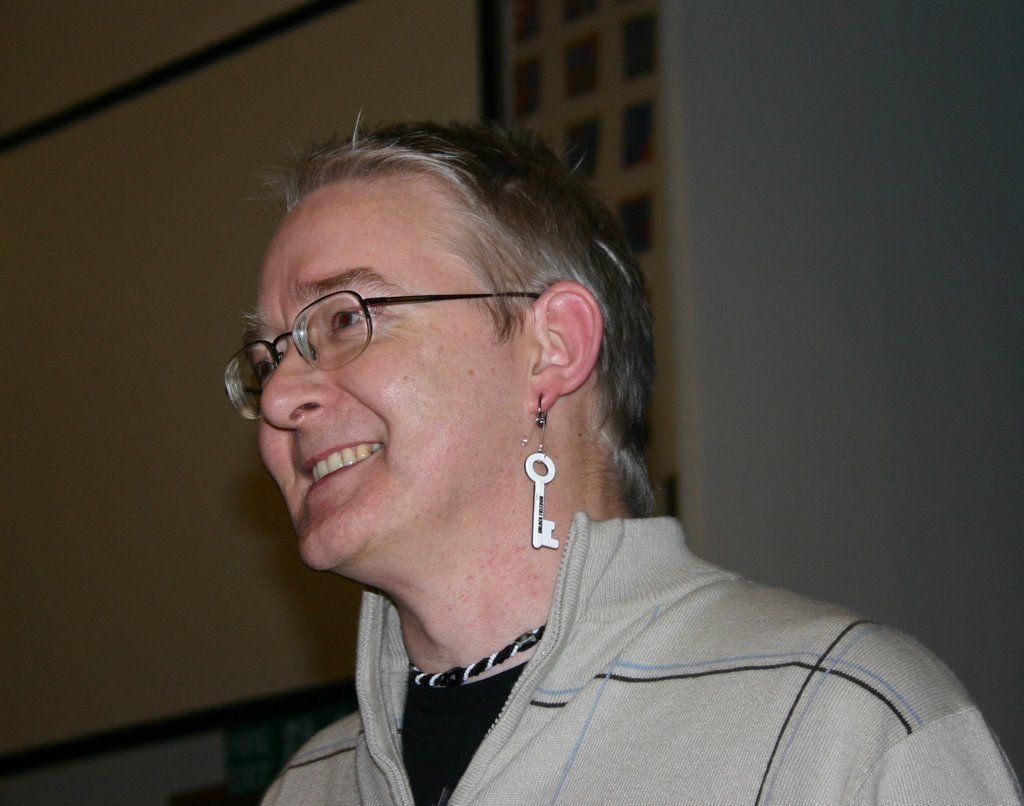
Last night we attached the keys to our earrings to complete the look destined to take the fashion world by storm.....
It felt odd and gets caught on my scarf. But over a quarter a million children are trafficked into West African cocoa production areas to harvest the raw material for our lunchtime chocolate treat.
According to the US State department
many of these children are under 12 years-of-age, sold into indentured servitude for $140 and
work 12-hour days for $135 to $189 per year.
Like the flow of migrants across our planet, these statistics show how desperate families are to scrape a living in some parts of the world. Stop the Traffik is lifting the lid on this in a way that might get people changing their behaviour in the west to make a token difference for some of those lives and put pressure on governments to make real and substantial changes in the terms of trade between rich and poor nations.
I think my ear can stand a little discomfort for that (not wanting to sound too po-faced and juster-than-thou about it!)
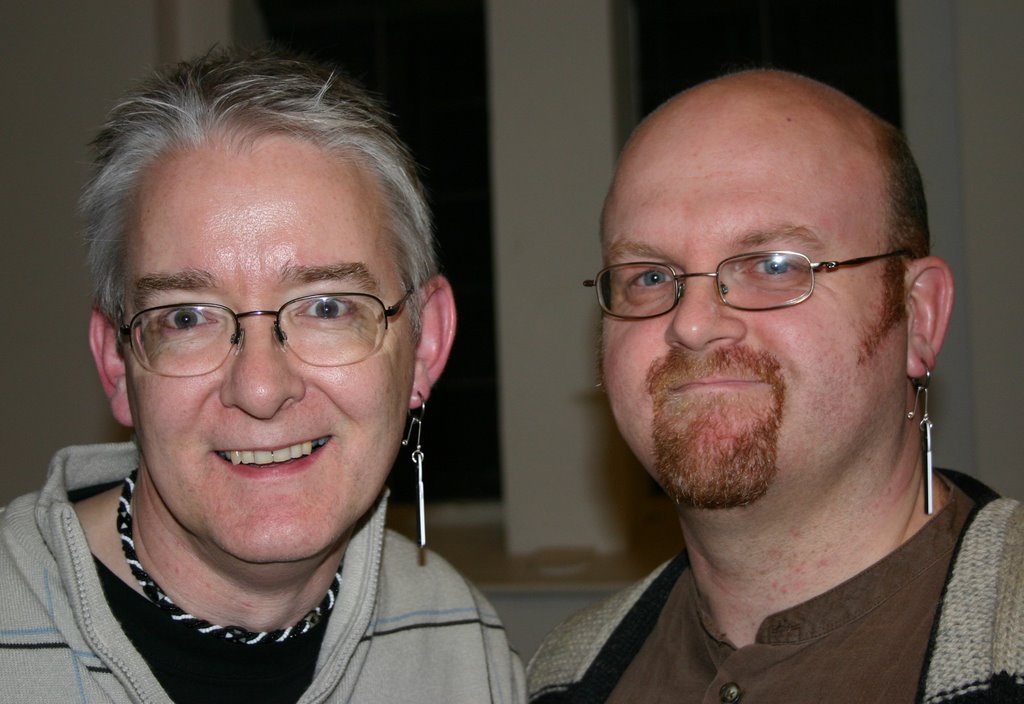
Oh and here's me and Jonathan together:
Sunday, February 11, 2007
Photographic evidence
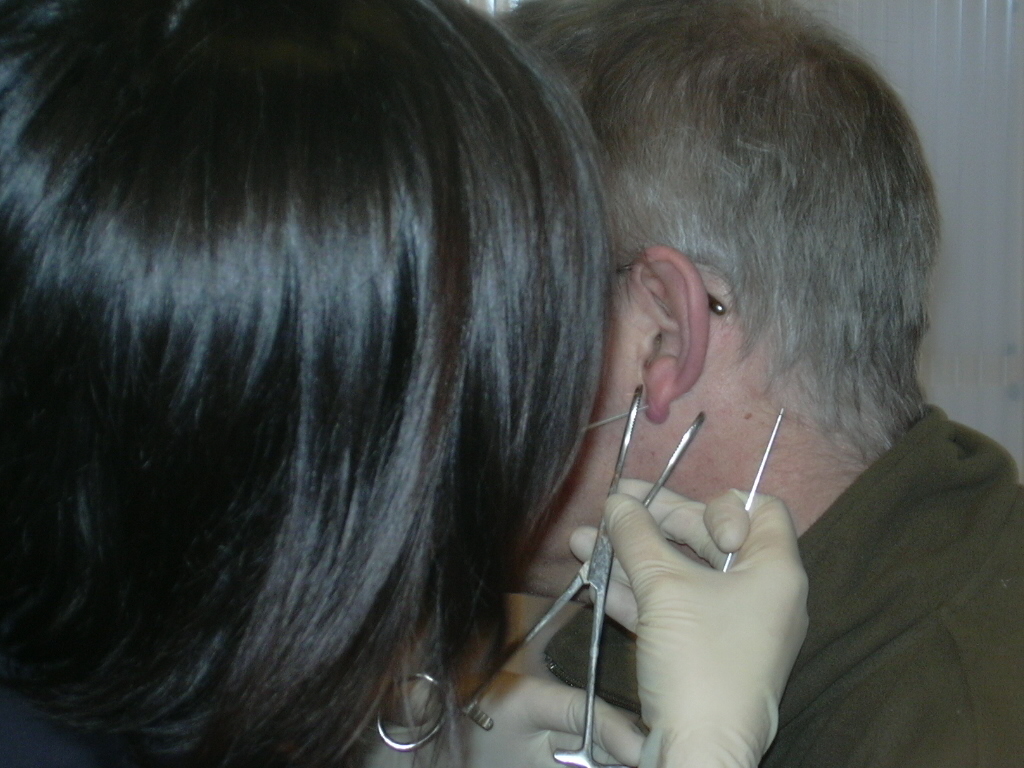
Stuart asked for a picture of my piercing...
Here's one of the needle being run through my left lobe - surprisingly, no pain was felt at this point!
The idea for this came from seeing 58 year old Ken Raynard, minister of Belper Baptist getting it done. Thanks Ken.
And below is my new left profile - what a dash i cut! This morning it doesn't feel sore at all so I'm pretty confident that we'll be hanging the Unlock Freedom keys this evening. Watch this space!

Friday, February 09, 2007
Stop the traffik
Over the weekend I'll respond to some of the comments on my previous post which are stimulating all sorts of thoughts.
Today Jonathan (our minister for youth and young adults) and I had our ears pierced as a prelude to launching our Stop the Traffik Freedom Day activities. Having had a ring inserted by a highly competent young lady piercer, we hope to attach the Stop the Traffik keys to them on Sunday at our evening service.
We'll then wear them to advertise the fact that on 25 March we'll be celebrating the end 200 years ago of the transatlantic slave trade, lamenting the fact that we still benefit from this iniquitous trade and drawing attention to the fact that more people are trafficked today than were transported at the height of the trade that Wilberforce opposed and attempted to stop by Parliamentary action.
On 25 March we'll be on the High Street in Bromley drawing attention to the use of trafficked children in the production of chocolate, giving away fair trade bars and selling others. We'll be playing music, giving out leaflets, talking to people and welcoming a group walking from Keston - where the oak tree that Wilberforce sat under to seek inspiration - to our stand in the High Street. We're hoping that this small group will walk chained together for the four and half miles and hand out information explaining why they're doing it.
If you want to find out more about Stop the Traffik, visit their website at www.stopthetraffik.org
Today Jonathan (our minister for youth and young adults) and I had our ears pierced as a prelude to launching our Stop the Traffik Freedom Day activities. Having had a ring inserted by a highly competent young lady piercer, we hope to attach the Stop the Traffik keys to them on Sunday at our evening service.
We'll then wear them to advertise the fact that on 25 March we'll be celebrating the end 200 years ago of the transatlantic slave trade, lamenting the fact that we still benefit from this iniquitous trade and drawing attention to the fact that more people are trafficked today than were transported at the height of the trade that Wilberforce opposed and attempted to stop by Parliamentary action.
On 25 March we'll be on the High Street in Bromley drawing attention to the use of trafficked children in the production of chocolate, giving away fair trade bars and selling others. We'll be playing music, giving out leaflets, talking to people and welcoming a group walking from Keston - where the oak tree that Wilberforce sat under to seek inspiration - to our stand in the High Street. We're hoping that this small group will walk chained together for the four and half miles and hand out information explaining why they're doing it.
If you want to find out more about Stop the Traffik, visit their website at www.stopthetraffik.org
Monday, February 05, 2007
First thoughts on our discussions
Time to reflect on our discussions in church about belonging and stuff. It's been a good conversation so far for a couple of very simple reasons.
The first is that a lot of people are joining in. More are attending our mid-week central gathering than usual, others are emailing ideas or collaring us at church on Sunday to express a view or ask a question. This is all great - though collating it all and getting that disseminated to others is a challenge!
The second is that people are talking and listening to each other. There was a healthy degree of honesty last week and even disagreement that didn't descend into rancour. I had the sense of people expressing their view and then, on hearing a contrary view reasonably stated, pausing to reflect on whether they should amend their view. This is progress, I feel.
Over on Stuart Blythe's excellent Word at the Barricades, he reflects on whether we should count as members those who turn up to discuss and discern what God is saying to the church. I like this bottom-up, non-institutional approach. Stuart says:
I like his phrase 'communal discernment'. It strikes me that this is what congregational government ought to be about. It seems to me to be what Paul argues on 1 Corinthians 2 about us having the mind of Christ.
I do have an observation/question about it, however, and it's this: people seem to have a default position that they do not want to things they find comfortable and familiar to change. We want new people to join the church but we don't want the way we do church to be affected by that. So when those people gather to 'communally discern' they tend to think that God is interested in maintaining the status quo, the way we do things here. After all, at some point in our history, we have communally discerned that this is the right way to do things.
So it seems to me that the role leaders have in congregational government is to bring the bigger picture against which communal discernment now must take place. And that bigger picture is especially informed by scripture and culture and particularly the reading of scripture in the light of the cultural situation in which we must embody, incarnate our gathering called church.
So it seems to be that communal discernment has to be about hearing Christ in the scriptures and the wider world as well as about hearing Christ through one another gathered to chart a way forward.
The first is that a lot of people are joining in. More are attending our mid-week central gathering than usual, others are emailing ideas or collaring us at church on Sunday to express a view or ask a question. This is all great - though collating it all and getting that disseminated to others is a challenge!
The second is that people are talking and listening to each other. There was a healthy degree of honesty last week and even disagreement that didn't descend into rancour. I had the sense of people expressing their view and then, on hearing a contrary view reasonably stated, pausing to reflect on whether they should amend their view. This is progress, I feel.
Over on Stuart Blythe's excellent Word at the Barricades, he reflects on whether we should count as members those who turn up to discuss and discern what God is saying to the church. I like this bottom-up, non-institutional approach. Stuart says:
maybe members should be recognised as those who attend the meetings to share in
the discussing and discerning! To put that differently, if we consider that
the practice of communal discernment is important, if that is a conviction, let
us make it more important in practice not less.
I like his phrase 'communal discernment'. It strikes me that this is what congregational government ought to be about. It seems to me to be what Paul argues on 1 Corinthians 2 about us having the mind of Christ.
I do have an observation/question about it, however, and it's this: people seem to have a default position that they do not want to things they find comfortable and familiar to change. We want new people to join the church but we don't want the way we do church to be affected by that. So when those people gather to 'communally discern' they tend to think that God is interested in maintaining the status quo, the way we do things here. After all, at some point in our history, we have communally discerned that this is the right way to do things.
So it seems to me that the role leaders have in congregational government is to bring the bigger picture against which communal discernment now must take place. And that bigger picture is especially informed by scripture and culture and particularly the reading of scripture in the light of the cultural situation in which we must embody, incarnate our gathering called church.
So it seems to be that communal discernment has to be about hearing Christ in the scriptures and the wider world as well as about hearing Christ through one another gathered to chart a way forward.
Wednesday, January 31, 2007
Did Paul visit the flock?
I've also been listening to Sam's Town by the Killers and discovering a real depth to it.
I'm reading a book by James Thompson called Pastoral Ministry according to Paul: A Biblical Vision (Baker 2006). It came highly recommended, though I've never heard of Thompson. So far, it's pretty good. He's an NT man so it's a scholarly trawl of pastoral themes in the undisputed Paulines (don't you just love that phrase?! It really is high time someone disputed it - it's one of those givens of NT scholarship that is ripe for demolition.)
It's informed by the New Perspective on Paul (which is good) and majors on Paul's pastoral goal being transformation (a solid idea). I find myself reading it and saying 'yes, I agree with all this, but what I want to know is how did Paul do it - except by writing letters? What did his day look like? Did he visit people, lead Bible studies, preach sermons and chair church meetings?' I'm not sure Thompson is going to answer any of these questions. It's probably not fair to expect him to because that's not the purpose of the book.
But I'd love to know whether anyone has tackled these questions or whether (as I suspect) they are completely unanswerable. Post a comment if you can help or have more questions to add to my list.
AAAhhh ... 'The Kingdom of Doom' on The Good, the Bad and the Queen has just started. What a great track; fabulous strummed acoustic at the start, then the swirl of organ and 'Friday night in the Kingdom of Doom.' It contains the line 'drink all day/coz the country's at war/you'll be falling off the palace wall/I can't be anymore than I say/Oh in the flood we all get washed away.' Sublime.
Hoping to see the Anselm Kiefer exhibition at the White Cube next week or the week after.
I'm reading a book by James Thompson called Pastoral Ministry according to Paul: A Biblical Vision (Baker 2006). It came highly recommended, though I've never heard of Thompson. So far, it's pretty good. He's an NT man so it's a scholarly trawl of pastoral themes in the undisputed Paulines (don't you just love that phrase?! It really is high time someone disputed it - it's one of those givens of NT scholarship that is ripe for demolition.)
It's informed by the New Perspective on Paul (which is good) and majors on Paul's pastoral goal being transformation (a solid idea). I find myself reading it and saying 'yes, I agree with all this, but what I want to know is how did Paul do it - except by writing letters? What did his day look like? Did he visit people, lead Bible studies, preach sermons and chair church meetings?' I'm not sure Thompson is going to answer any of these questions. It's probably not fair to expect him to because that's not the purpose of the book.
But I'd love to know whether anyone has tackled these questions or whether (as I suspect) they are completely unanswerable. Post a comment if you can help or have more questions to add to my list.
AAAhhh ... 'The Kingdom of Doom' on The Good, the Bad and the Queen has just started. What a great track; fabulous strummed acoustic at the start, then the swirl of organ and 'Friday night in the Kingdom of Doom.' It contains the line 'drink all day/coz the country's at war/you'll be falling off the palace wall/I can't be anymore than I say/Oh in the flood we all get washed away.' Sublime.
Hoping to see the Anselm Kiefer exhibition at the White Cube next week or the week after.
Monday, January 29, 2007
Reading, listening and thinking
I'm listening to the Good the Bad and the queen - otherwise known as Damon Albarn's splendid solo album. Backed by some legendary musicians - Paul Simonon of the Clash, Simon Tong of the Verve and Blur's touring band and the great African drummer, Tony Allen - Albarn has served up a suite of songs about London past and present that are inspired and lovely, fragile and robust in equal measure. Great stuff. The man's by far the best British pop/rock artist of the last decade.
I'm reading The Passionate Church by Mike Breen as I think LifeShapes offers the best hope of getting discipleship and discipling written into the fabric of how we are church here. I'm also dipping into the wonderful Robert Jewett commentary on Romans now that a non-damaged copy has arrived. It's fabulous - well informed, provocative and beautifully written.
We're having a series of mid-week conversations about belonging and membership. The first was last week and went really well. We're inviting three home groups at a time to come and share their thoughts and insights.
I've become increasingly conscious over the past week of how linked all these things are (I know, I'm a slow learner but bear with me..!): belonging, discipleship, leadership, the worship life of the church and mission. The trouble is that we tend to treat them as discrete areas to be tackled by different groups at different meetings and I'm not sure which one to address first... And then I discover that actually they're all different sides of the same multi-sided (and therefore illegal) coin and we have top try to address them together.
In the lull between Christmas and New year, I drew up a list of things to address this year and all of those items were on it - along with get new chairs for the worship area so I don't keep putting my back out setting up for cafe church!
I shall sit back and let the lovely music wash over me....
I'm reading The Passionate Church by Mike Breen as I think LifeShapes offers the best hope of getting discipleship and discipling written into the fabric of how we are church here. I'm also dipping into the wonderful Robert Jewett commentary on Romans now that a non-damaged copy has arrived. It's fabulous - well informed, provocative and beautifully written.
We're having a series of mid-week conversations about belonging and membership. The first was last week and went really well. We're inviting three home groups at a time to come and share their thoughts and insights.
I've become increasingly conscious over the past week of how linked all these things are (I know, I'm a slow learner but bear with me..!): belonging, discipleship, leadership, the worship life of the church and mission. The trouble is that we tend to treat them as discrete areas to be tackled by different groups at different meetings and I'm not sure which one to address first... And then I discover that actually they're all different sides of the same multi-sided (and therefore illegal) coin and we have top try to address them together.
In the lull between Christmas and New year, I drew up a list of things to address this year and all of those items were on it - along with get new chairs for the worship area so I don't keep putting my back out setting up for cafe church!
I shall sit back and let the lovely music wash over me....
Tuesday, January 23, 2007
More on the picture on my cover
A friend who is well informed on art matters tells me that the image on my forthcoming book is by William Morris, the great Victorian designer. It's called The strawberry Thief and is based on drawings he made of birds stealing strawberries in the grounds of his home at Kelmscott Manor.
My informant, AJ, adds:
So, it's true that every picture tells a story.
My informant, AJ, adds:
So - what's the significance for your book? Well, as one of the founder membersI like that emphasis on honesty and the thought that good design can help create a better society. Maybe an honestly written book that takes the bible and those who struggle with the church seriously can help make better churches.
of the social and aesthetic Arts and Crafts Movement, Morris' passion was to
champion good design and craftsmanship at a time of increasing mechanisation and
mass production. For some, the movement involved fundamental issues about human society and there was a huge emphasis on 'honesty', on producing products that showed clearly what they were made of and how they worked. The whole movement believed in advocating simplicity and integrity, often emphasising plain
materials and good design...an approach which was to have a lasting influence on
modern design.
The Arts and Crafts movement also traced its origins back to John Ruskin's ideas. He believed that the beauty of medieval art sprang from pride in individual craftsmanship. Developing Ruskin's thoughts, Morris wrote that art was 'man's expression of his joy in labour' and believed that good design could help create a better society.
So, it's true that every picture tells a story.
Monday, January 22, 2007
New books
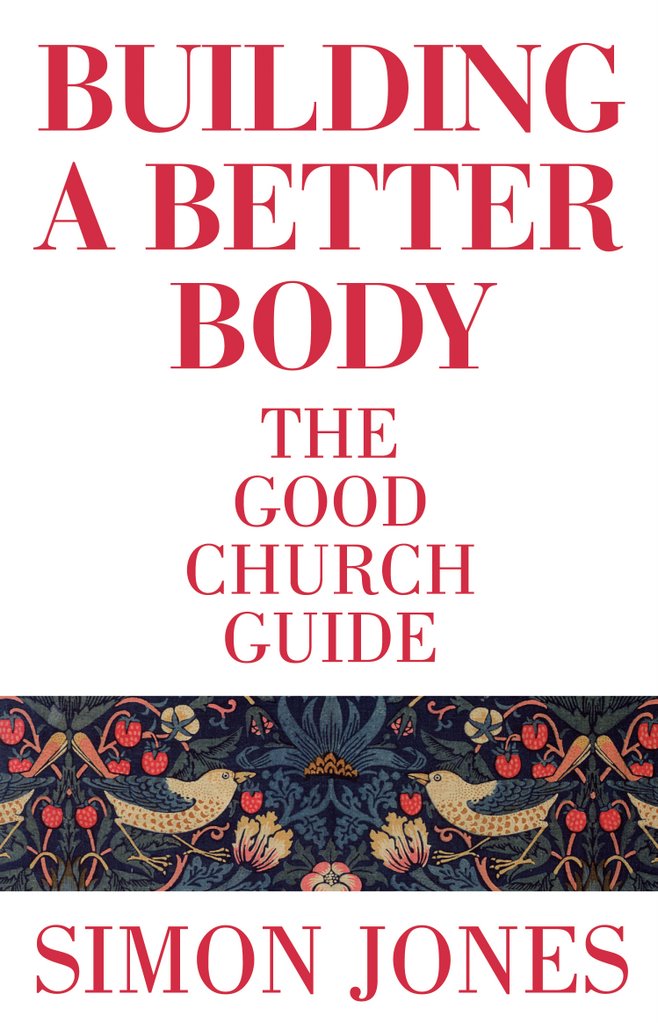
I've just heard from Authentic Media that my reworked Why Bother with Church? will be published on March 31 under the title of Building a Better Body: the Good church guide. Just in time for Spring Harvest.
And my Galatians book - Discovering Galatians in the Crossway Bible Guide series, a sister to Discovering Luke and Discovering the New Testament - ought to be available this week. I'm looking forward to seeing it...
And my Galatians book - Discovering Galatians in the Crossway Bible Guide series, a sister to Discovering Luke and Discovering the New Testament - ought to be available this week. I'm looking forward to seeing it...
Questions always come in threes
These conversations are helping to clarify my thinking - and at the same time raise even more questions (ah well, who said anything to do with church was simple?).
Into the belonging/membership/baptism matrix related questions to do with decision-making and legitimacy, the allocation of resources and the future shape of the church come creeping with all their potential to derail neat ideas.
BillyB -not the first member of my church to add his voice to this (but an astute observer all the same) - asks who has the hang up here - members, leaders or newcomers? The answer, I guess, is all three in different ways (though I'm not sure it's a hang up; I think it's a set of questions worth asking).
As a leader, the question for me arises in two specific areas. The first has to do with how we make decisions as a church. If most decisions rest with the church meeting which is attended by at best 20% of the membership, itself about 60% of the active and giving attenders of the church, what is the status of any of the decisions it makes?
How do we do congregational government in a way that takes account of the pressures on mortgage-paying, commuting, family raising Bromley people? I know that many will not be able to be able to make Wednesday evening gatherings - hence the Sunday meeting (but that only attracted a third of members).
So, I'd love to know how we can make use of new technology to have conversations between people who can't make a meeting in real space but can participate in cyberspace. Ideas on a post card or comment here, please.
The second reason it matters to me is that I've had conversations with non-members about joining where I've not been able to justify the intrusive interviewing method and reporting blind to a church meeting before we vote someone in. As one suggested to me, 'they get the right to see whether I measure up but I don't get to assess them in that personal way.' Others are reluctant to expose their life choices to the scrutiny of strangers for perfectly understandable reasons.
I think these are important questions to be asking and answering. It's not about replacing one tired and threadbare system of church organisation with one more attuned to our era that in turn will itself wear out. It's about asking what shape the church should be if it lives by the values of the gospel: how do we create community in a way that enables everyone who wants to be a follower of Jesus to feel welcome and at home, able to to get the resources they need to sustain their Christian discipleship in an increasingly complex environment?
The thought of getting an answer to these questions makes the conversation exciting and worthwhile.
Into the belonging/membership/baptism matrix related questions to do with decision-making and legitimacy, the allocation of resources and the future shape of the church come creeping with all their potential to derail neat ideas.
BillyB -not the first member of my church to add his voice to this (but an astute observer all the same) - asks who has the hang up here - members, leaders or newcomers? The answer, I guess, is all three in different ways (though I'm not sure it's a hang up; I think it's a set of questions worth asking).
As a leader, the question for me arises in two specific areas. The first has to do with how we make decisions as a church. If most decisions rest with the church meeting which is attended by at best 20% of the membership, itself about 60% of the active and giving attenders of the church, what is the status of any of the decisions it makes?
How do we do congregational government in a way that takes account of the pressures on mortgage-paying, commuting, family raising Bromley people? I know that many will not be able to be able to make Wednesday evening gatherings - hence the Sunday meeting (but that only attracted a third of members).
So, I'd love to know how we can make use of new technology to have conversations between people who can't make a meeting in real space but can participate in cyberspace. Ideas on a post card or comment here, please.
The second reason it matters to me is that I've had conversations with non-members about joining where I've not been able to justify the intrusive interviewing method and reporting blind to a church meeting before we vote someone in. As one suggested to me, 'they get the right to see whether I measure up but I don't get to assess them in that personal way.' Others are reluctant to expose their life choices to the scrutiny of strangers for perfectly understandable reasons.
I think these are important questions to be asking and answering. It's not about replacing one tired and threadbare system of church organisation with one more attuned to our era that in turn will itself wear out. It's about asking what shape the church should be if it lives by the values of the gospel: how do we create community in a way that enables everyone who wants to be a follower of Jesus to feel welcome and at home, able to to get the resources they need to sustain their Christian discipleship in an increasingly complex environment?
The thought of getting an answer to these questions makes the conversation exciting and worthwhile.
Friday, January 19, 2007
So, who are we?
One of the comments being made about our last family gathering is that there were very few non-members there - a handful at best. A couple of people have suggested that non-members probably wouldn't come unless they were given a personal invite - and there might be some truth in this, though I invited a couple of couples and neither of them came!
I wonder whether there is a residual feeling among those not in formal membership that it's not their place to participate in members' meetings. This suggests that perhaps there is something about our way of doing things that is distinctively baptist and that if you aren't a baptist, you don't feel safe or welcome coming to a members' meeting; and if you are a baptist from another church, you know not to come until you are a member.
There's been lots of intelligent stuff on the other baptist blogs - namely stuart's and Brodie's - that's been teasing out whether there is anything left of a distinctive baptist identity. Douglas McBain used to talk of many of the new churches being baptistic - in that they were largely independent, practiced believers' baptism and were low on liturgy.
One thing, of course, they were weaker on was any notion of congregationalism. And perhaps that is at the core of whatever we mean by baptist identity. I was intrigued top read Bishop Tom Wright's withering attack on a group of evangelicals in the church of England who have recently issued a covenant (the details of which are too complicated to go into!). Suffice to say that a key plank of Tom's attack is that the covenant is congregationalist which is not an Anglican value!
Sean Winter has written about this in his reflection on Baptist/Anglican conversations that have taken place over recent years. He argues that baptism is not the key divider between our traditions but the baptist insistence on congregational government and opposition to episcopacy (you'll have to check out Sean's beautifully nuanced argument on his blog and in his article on ambiguous genitives in Romans).
I wonder whether a key distinctive of our way of being church is that we seek to move forward together, having discerned the mind of Christ as a community (along the lines outlined in 1 Cor 2). This, of course, is why there always seems to be a tension in baptist churches around the roles of leaders and possibly why some baptists - whose sympathies lie more with the new churches - struggle with the church meeting.
I have a more practical struggle with the church meeting and that's attendance, representation and finding a model that works. Undoubtedly, our lunchtime gathering worked. We'll do it again. But it was still less than 50% of the membership. How do we hear the voices of those who are members but who do not come to church meetings? Have they excluded themselves from decision-making by not attending? But if we take that attitude, how will we persuade them to come on board with the direction the church has discerned from there Lord as it gathered?
Some of our younger families have expressed the view that we have too many church meetings, that leaders have been elected to lead and that only big decisions (not clearly defined) need to come to the church meeting. Maybe this has something going for it.
I also wonder how we might use the website for conversations about what the church is doing and where it's going. Maybe there's a place for virtual conversations in getting ideas aired and viewpoints expressed ahead of the church coming together to decide something. Perhaps ideas expressed online could be fed into the discussion when we gather.
We are certainly using our mid-week programme between now and Easter to talk about this whole issue of belonging, membership and baptism (I'll blog about that sometime soon) and those conversations will be recorded in some way so that wisdom expressed there is not lost to the wider discussions.
I wonder whether there is a residual feeling among those not in formal membership that it's not their place to participate in members' meetings. This suggests that perhaps there is something about our way of doing things that is distinctively baptist and that if you aren't a baptist, you don't feel safe or welcome coming to a members' meeting; and if you are a baptist from another church, you know not to come until you are a member.
There's been lots of intelligent stuff on the other baptist blogs - namely stuart's and Brodie's - that's been teasing out whether there is anything left of a distinctive baptist identity. Douglas McBain used to talk of many of the new churches being baptistic - in that they were largely independent, practiced believers' baptism and were low on liturgy.
One thing, of course, they were weaker on was any notion of congregationalism. And perhaps that is at the core of whatever we mean by baptist identity. I was intrigued top read Bishop Tom Wright's withering attack on a group of evangelicals in the church of England who have recently issued a covenant (the details of which are too complicated to go into!). Suffice to say that a key plank of Tom's attack is that the covenant is congregationalist which is not an Anglican value!
Sean Winter has written about this in his reflection on Baptist/Anglican conversations that have taken place over recent years. He argues that baptism is not the key divider between our traditions but the baptist insistence on congregational government and opposition to episcopacy (you'll have to check out Sean's beautifully nuanced argument on his blog and in his article on ambiguous genitives in Romans).
I wonder whether a key distinctive of our way of being church is that we seek to move forward together, having discerned the mind of Christ as a community (along the lines outlined in 1 Cor 2). This, of course, is why there always seems to be a tension in baptist churches around the roles of leaders and possibly why some baptists - whose sympathies lie more with the new churches - struggle with the church meeting.
I have a more practical struggle with the church meeting and that's attendance, representation and finding a model that works. Undoubtedly, our lunchtime gathering worked. We'll do it again. But it was still less than 50% of the membership. How do we hear the voices of those who are members but who do not come to church meetings? Have they excluded themselves from decision-making by not attending? But if we take that attitude, how will we persuade them to come on board with the direction the church has discerned from there Lord as it gathered?
Some of our younger families have expressed the view that we have too many church meetings, that leaders have been elected to lead and that only big decisions (not clearly defined) need to come to the church meeting. Maybe this has something going for it.
I also wonder how we might use the website for conversations about what the church is doing and where it's going. Maybe there's a place for virtual conversations in getting ideas aired and viewpoints expressed ahead of the church coming together to decide something. Perhaps ideas expressed online could be fed into the discussion when we gather.
We are certainly using our mid-week programme between now and Easter to talk about this whole issue of belonging, membership and baptism (I'll blog about that sometime soon) and those conversations will be recorded in some way so that wisdom expressed there is not lost to the wider discussions.
Monday, January 15, 2007
Further reflections on our lunchtime gathering
I think there's a limit to how many we can accommodate in the format we used on Sunday. About 130 sat down to soup and bread. We could probably have 30 or 40 more comfortably included. So this suggests that we could only get half our membership together for this sort of gathering.
So, could we do two sittings - one on one Sunday, the other the next? It's a possibility. What does it do to our concepts of the gathered body discerning the mind of Christ. On top of that, how do we accommodate friends and other committed people who aren't members.
One surprising aspect of the meeting was that only half a dozen folk who are not members in the formal baptist sense of that word came along, despite our stressing that everyone was welcome and there being quite a few active, committed people who aren't members.
I'd like to know why this was. I suspect that many felt they wouldn't have been welcome, would not really understand what was going on, wouldn't feel as though they could join. This is a shame because I'd have valued their contribution.
Out of yesterday's gathering, we have a scroll of belonging about ten feet long comprising lots of sheets of paper with jottings, notes and pictures glued on it, the fruit of the discussions over lunch that details people's thoughts on why they feel they belong at our church, what they like and dislike. Over the next couple of weeks, we'll collate all this data and feed it into our on-going discussions.
So, could we do two sittings - one on one Sunday, the other the next? It's a possibility. What does it do to our concepts of the gathered body discerning the mind of Christ. On top of that, how do we accommodate friends and other committed people who aren't members.
One surprising aspect of the meeting was that only half a dozen folk who are not members in the formal baptist sense of that word came along, despite our stressing that everyone was welcome and there being quite a few active, committed people who aren't members.
I'd like to know why this was. I suspect that many felt they wouldn't have been welcome, would not really understand what was going on, wouldn't feel as though they could join. This is a shame because I'd have valued their contribution.
Out of yesterday's gathering, we have a scroll of belonging about ten feet long comprising lots of sheets of paper with jottings, notes and pictures glued on it, the fruit of the discussions over lunch that details people's thoughts on why they feel they belong at our church, what they like and dislike. Over the next couple of weeks, we'll collate all this data and feed it into our on-going discussions.
Sunday, January 14, 2007
The meaning of life
Just left the BBC's ghastly new show The Meaning of Life - lots of air-headed celebs trying to make us think they know something about anything that matters. It makes grumpy old men look intelligent and bursting with insight!
Anyway, today we had our lunchtime church meeting and here are a couple of reflections on it.
firstly, it went really well. About 130 sat down to eat lunch and chat. The atmosphere was really good - people chatting with people they'd not spoken to before. In fact one table didn't get around to talking about the subject in hand because they were having such a good time getting to know each other.
Secondly, it was great to have a couple being voted into membership who were actually present at the meeting. It meant that everyone voting to have them as members knew what they looked like because they were standing there in front of them! In fact when I asked whether we should welcome them aboard, everyone applauded - which I took to be 'yes'.
I've had one email so far which was overwhelmingly ecstatic about the whole thing. So I think we'd have to say it was a success.
I think we made one basic error and that was moving from the hall where we had lunch into the worship area for the second half of the meeting. When we do it again, we won't do that; we'll stay put in the hall and have the whole meeting sitting round the tables - there's something about facing each other in small groups that opens people up and fuels conversation.
No doubt, I'll reflect some more during the week, but I'd say it was a really positive experience and I urge you to try it at your churches.
Anyway, today we had our lunchtime church meeting and here are a couple of reflections on it.
firstly, it went really well. About 130 sat down to eat lunch and chat. The atmosphere was really good - people chatting with people they'd not spoken to before. In fact one table didn't get around to talking about the subject in hand because they were having such a good time getting to know each other.
Secondly, it was great to have a couple being voted into membership who were actually present at the meeting. It meant that everyone voting to have them as members knew what they looked like because they were standing there in front of them! In fact when I asked whether we should welcome them aboard, everyone applauded - which I took to be 'yes'.
I've had one email so far which was overwhelmingly ecstatic about the whole thing. So I think we'd have to say it was a success.
I think we made one basic error and that was moving from the hall where we had lunch into the worship area for the second half of the meeting. When we do it again, we won't do that; we'll stay put in the hall and have the whole meeting sitting round the tables - there's something about facing each other in small groups that opens people up and fuels conversation.
No doubt, I'll reflect some more during the week, but I'd say it was a really positive experience and I urge you to try it at your churches.
The big day arrives
I was at the Mainstream conference this week in rain-swept Swanwick. We had a good time. Mike Breen and Ken McGreavy did the main sessions and were, on the whole, excellent. The seminar strand focused on discipleship and particularly Lifeshapes and, again, they were full of useful stuff. I'll blog about Lifeshapes later.
Since returning on Wednesday, I've found getting ready for today a bit like pulling teeth. It's taken ages for the sermon to come together - even though I have known in broad outline for a week or more what I want to say!
Today is also the day when we are holding our lunchtime church meeting. Around 150 people have signed up for lunch - and no doubt others will stay who have forgotten to do so. This means that there'll probably be twice as many adults there this lunchtime as there are at a normal Wednesday gathering. This in itself suggests it might be worthwhile repeating.
It'll be interesting to see the quality of conversation that happens and how many people who aren't yet members in the formal sense but who feel some sense of attachment or belonging to our community attend and participate. It'll be even more interesting to see how members - especially members of long-standing - respond to their contribution.
I think I'm looking forward to it - though I'm nervous too.
On another - tangentially related note - I see on Maggi Dawn's blog (www.maggidawn.typepad.com) that some Anglicans are getting nervous about their church leaders or employees blogging. As she says, blogs are a good place to float ideas and have conversations. They also give interesting insights into the character and interests of the blogger. I agree. They are not places where anything gets decided. I'm not sure I've said anything here that I haven't said to people in other contexts face-to-face. Since when has conversation been a bad idea?!
Since returning on Wednesday, I've found getting ready for today a bit like pulling teeth. It's taken ages for the sermon to come together - even though I have known in broad outline for a week or more what I want to say!
Today is also the day when we are holding our lunchtime church meeting. Around 150 people have signed up for lunch - and no doubt others will stay who have forgotten to do so. This means that there'll probably be twice as many adults there this lunchtime as there are at a normal Wednesday gathering. This in itself suggests it might be worthwhile repeating.
It'll be interesting to see the quality of conversation that happens and how many people who aren't yet members in the formal sense but who feel some sense of attachment or belonging to our community attend and participate. It'll be even more interesting to see how members - especially members of long-standing - respond to their contribution.
I think I'm looking forward to it - though I'm nervous too.
On another - tangentially related note - I see on Maggi Dawn's blog (www.maggidawn.typepad.com) that some Anglicans are getting nervous about their church leaders or employees blogging. As she says, blogs are a good place to float ideas and have conversations. They also give interesting insights into the character and interests of the blogger. I agree. They are not places where anything gets decided. I'm not sure I've said anything here that I haven't said to people in other contexts face-to-face. Since when has conversation been a bad idea?!
Subscribe to:
Posts (Atom)

