I'm now focusing on our church conference - in ten days time - and Prism - the alternative stream of the Baptist Assembly in Brighton over the May Bank Holiday Weekend that I am co-ordinating with others.
In fact, I've had a good day lining people up to be involved in various of the evening celebrations at Prism - as well as raising last minute queries about the layout of the venue.
Mostly today, though, I've been catching up with an old friend and talking about prayer. She's doing a project for the 24/7 prayer boiler room in Guildford and asked me about any really great times of prayer I could remember, times when I saw God move in a particular way. I mentioned one or two things and then told her a story that I nearly included in Building A Better Body, but couldn't find the words for at the time.
It concerns the time back in the mid-90s when Britain was swept by the so-called Toronto Blessing. Our church wanted some of whatever God was doing. So we had a week of meetings in the early autumn - it must have been September or October 1993 or 94. Each evening we met to pray and see what happened. We sang, looked at the Bible and waited on God. Some people fell over; others brought words of prophecy and insight; all of us felt God come close at various times through the week.
I'm not sure what we were expecting, but I don't think it happened (if that makes sense). But we ended the week feeling it had been worthwhile.
A couple of weeks later, a young woman, Ellie, expecting her first child, died and the church was rocked to its core. I tell this story in Building A Body. In many ways this story marks my time at that church and has shaped my ministry since more than I probably realise.
Looking back on those events, I see God working in that week of prayer to prepare us for the wave of grief that broke over us later that autumn. I don't think I'd have coped if we hadn't had those moments of closeness with God; I don't think the church would have come together in the wake of the tragedy but for our week of praying.
I wish I'd put the story in the book because in many ways it illustrates one of the things that church is about - being there for one another in the presence of our awesome, mysterious God.
Wednesday, April 18, 2007

Seminar at Spring Harvest
Spring Harvest went really well - including my seminar on the church. A good group turned up despite the sunshine and we talked a lot about why people struggle with church and how we can help them find a place.
In the course of the seminar we drew up an ecclesial minimum - a brief list of things a group has to have to be church. Here's what we came up with - see what you think:
The presence of Jesus
teaching and learning
sacraments - especially communion
relationships
catholicity - that is relationships with other groups of Christians (I think this one came up because it had been the aspect of the church that was the theme of the previous day!)
Able to face tough times as well as good ones
Worship did not appear because I ruled it out before I set them compiling their lists in small groups. I suggested that the early Christians didn't meet to worship because that was a 24/7 activity along the lines of Romans 12:1. My full argument about this is in chapter 2 of Building A Better Body.
What I was really impressed by was that no one suggested that any of these activities had to happen in a special building or involve large numbers of people.
That gives me hope for the future of the church.
In the course of the seminar we drew up an ecclesial minimum - a brief list of things a group has to have to be church. Here's what we came up with - see what you think:
The presence of Jesus
teaching and learning
sacraments - especially communion
relationships
catholicity - that is relationships with other groups of Christians (I think this one came up because it had been the aspect of the church that was the theme of the previous day!)
Able to face tough times as well as good ones
Worship did not appear because I ruled it out before I set them compiling their lists in small groups. I suggested that the early Christians didn't meet to worship because that was a 24/7 activity along the lines of Romans 12:1. My full argument about this is in chapter 2 of Building A Better Body.
What I was really impressed by was that no one suggested that any of these activities had to happen in a special building or involve large numbers of people.
That gives me hope for the future of the church.
Monday, April 09, 2007
Off to the seaside
Off to Spring Harvest in the morning for five days on the pastoral team.
The weather forecast for Skegness is sunny and warm - a first for us up there! So we're looking forward to a good week with a great team.
back blogging next week....
The weather forecast for Skegness is sunny and warm - a first for us up there! So we're looking forward to a good week with a great team.
back blogging next week....
Sunday, April 08, 2007
meeting Jesus
On the road to Emmaus this morning - a good place to be. We were definitely joined by Jesus who came to walk with us and share in our conversation as he did on that first Easter afternoon.
I was struck again by how gentle and unassuming Jesus was. I'd have bounced up behind Cleopas and his companion (almost certainly, I reckon, Mary his wife) and said 'ta! da! it's me!!' but Jesus didn't. He quietly joined them and listened in to their conversation.
Have you noticed the glorious irony in Luke 24:24 where they tell Jesus that though people have heard stories, no one has seen him alive!
I love the way Jesus handles this. He listens, allowing Cleopas and Mary to tell him how they feel and what they think the events of the past months and especially the past few days might mean. He doesn't leap in to correct but gives them space to tell him what they think is going on.
I wonder how we often we do this with people we're chatting to about faith. We evangelicals are so quick to get to the answers, we ride roughshod over the questions. People might 'get the gospel', but often they don't hear it because the people telling them obviously don't care enough about to listen to their concerns and struggles before leaping in with a spiritual band aid.
Jesus did.
When he'd heard, he shared his view of events. We know that his interpretation is the accurate one - but Cleopas and Mary would have had to weigh it up. Yes, some of it would have felt familiar; Jesus had indeed talked about death and resurrection - but they didn't really get what he was on about (we are all slow learners - patience is the key fruit evangelists need to manifest!).
Clearly, they wanted to hear more because they urged him to stay with them. It was at the meal table - so often in Luke the place of revelation - that Jesus completes his showing them the truth of what he's been sharing by showing them that it is Jesus - alive and eating - who is offering the explanations. Then he vanishes, leaving them to work out the implications and enormity of what's just happened.
That's why I love this story.
But I love it too because we're often on the Emmaus road, feeling unsure, battered, baffled by life, searching for the scraps of our hopes in the debris of our sins and failures. And Jesus joins us gently offering a listening ear and sharp observations about life, the world and everything. And our hearts begin to burn and we want him to stay. As he speaks, we know it's him - not just a vague presence, but the risen saviour and lord, come to our aid, come to show us his hands and side, come to point the way to the renewal of all things and invite us to be his partners in the adventure.
I was struck again by how gentle and unassuming Jesus was. I'd have bounced up behind Cleopas and his companion (almost certainly, I reckon, Mary his wife) and said 'ta! da! it's me!!' but Jesus didn't. He quietly joined them and listened in to their conversation.
Have you noticed the glorious irony in Luke 24:24 where they tell Jesus that though people have heard stories, no one has seen him alive!
I love the way Jesus handles this. He listens, allowing Cleopas and Mary to tell him how they feel and what they think the events of the past months and especially the past few days might mean. He doesn't leap in to correct but gives them space to tell him what they think is going on.
I wonder how we often we do this with people we're chatting to about faith. We evangelicals are so quick to get to the answers, we ride roughshod over the questions. People might 'get the gospel', but often they don't hear it because the people telling them obviously don't care enough about to listen to their concerns and struggles before leaping in with a spiritual band aid.
Jesus did.
When he'd heard, he shared his view of events. We know that his interpretation is the accurate one - but Cleopas and Mary would have had to weigh it up. Yes, some of it would have felt familiar; Jesus had indeed talked about death and resurrection - but they didn't really get what he was on about (we are all slow learners - patience is the key fruit evangelists need to manifest!).
Clearly, they wanted to hear more because they urged him to stay with them. It was at the meal table - so often in Luke the place of revelation - that Jesus completes his showing them the truth of what he's been sharing by showing them that it is Jesus - alive and eating - who is offering the explanations. Then he vanishes, leaving them to work out the implications and enormity of what's just happened.
That's why I love this story.
But I love it too because we're often on the Emmaus road, feeling unsure, battered, baffled by life, searching for the scraps of our hopes in the debris of our sins and failures. And Jesus joins us gently offering a listening ear and sharp observations about life, the world and everything. And our hearts begin to burn and we want him to stay. As he speaks, we know it's him - not just a vague presence, but the risen saviour and lord, come to our aid, come to show us his hands and side, come to point the way to the renewal of all things and invite us to be his partners in the adventure.
Friday, April 06, 2007
Good Friday thoughts
Here's a thought prompted by Jars of Clay Liquid, the Vigilantes of Love When you're blinded by the Light and 2 Corinthians 5:21...
No one noticed that first Good Friday – except a handful of angry priests, a rent-a-mob crowd and a few baffled soldiers on crucifixion detail. It was just an ordinary day in the Roman Empire, not written up in the annals of the Caesars and histories of the elites – no one pays attention to obscure corners and unimportant people.
Likewise, today so many are oblivious to its significance – the grace of God slips in under the radar; God reconciling the world to himself and no one notices; Jesus who knew no sin, quietly and resolutely becoming sin for us and the world so that we might have a shot at righteousness – and the world carries on shopping and gardening and planning BBQs if the weather holds
But for us who are paying attention, he invites us to come and see, to gaze in wonder at these events, to bring our fears, pretence and sorrows and find them melting away in his embrace.
This is the one thing, the one thing that I know – he didn’t die for nothing; he died for me and you; he died to put things right; to reverse the unravelling of creation caused by human sin and rebellion; he died for the small sins – our greed, bitterness and unkind words; he died for the big sins – the slave trade, the holocaust, the world system that means someone dies of poverty every three seconds.
Somehow – in a way only God can fathom and organise – in that obscure corner of the Roman empire, a man on a stick was God putting things right; Jesus became sin – with all its ugly consequences – so that we might become like Jesus – the righteousness of God and part of his wave for putting things right breaking across the world.
No one noticed that first Good Friday – except a handful of angry priests, a rent-a-mob crowd and a few baffled soldiers on crucifixion detail. It was just an ordinary day in the Roman Empire, not written up in the annals of the Caesars and histories of the elites – no one pays attention to obscure corners and unimportant people.
Likewise, today so many are oblivious to its significance – the grace of God slips in under the radar; God reconciling the world to himself and no one notices; Jesus who knew no sin, quietly and resolutely becoming sin for us and the world so that we might have a shot at righteousness – and the world carries on shopping and gardening and planning BBQs if the weather holds
But for us who are paying attention, he invites us to come and see, to gaze in wonder at these events, to bring our fears, pretence and sorrows and find them melting away in his embrace.
This is the one thing, the one thing that I know – he didn’t die for nothing; he died for me and you; he died to put things right; to reverse the unravelling of creation caused by human sin and rebellion; he died for the small sins – our greed, bitterness and unkind words; he died for the big sins – the slave trade, the holocaust, the world system that means someone dies of poverty every three seconds.
Somehow – in a way only God can fathom and organise – in that obscure corner of the Roman empire, a man on a stick was God putting things right; Jesus became sin – with all its ugly consequences – so that we might become like Jesus – the righteousness of God and part of his wave for putting things right breaking across the world.
Wednesday, April 04, 2007
Easter thoughts
I love Easter; it gives us an opportunity to be creative in ways normal weekends don't. So over the next four days we're having a tanebrae, a reflective Good Friday gathering and two services on Sunday, one of which promises to be very different from anything we've done in previous years (though Jonathan is piloting that one...)
Thinking of fresh angles, looking for film clips and music helps one to appreciate the core Easter message in a new way.
Tomorrow at our lunch time service I'm reflecting on how much the gospels show us Jesus praying in the run up to his arrest and what a contrast that is with the disciples, especially Peter. Jesus is calm and focused, Peter is all over the place. Jesus is able to embrace the unfolding reality and achieve God's purpose in it; Peter is overwhelmed by events, taken by surprise and unable to get his act together. And it's all down to prayer. Simple and hugely difficult at the same time.
I've found some really good stuff in the Jonny Baker Doug Gay collection Alternative Worship and am using a great Vigilantes of Love Song - When you're blinded by the Light - as part of Good Friday's reflection. Having lamented how pear-shaped his love-life has gone, Bill Mallonee sings 'Lord, show to me your face/Lord, show to me your skin/Lord show to me the places/ where the nails went in/gonna crawl in there with all my fears/introduce them to my pretends/ introduce 'em to my sorrows/who've become the best of friends.' Wonderful.
I'm using Jars of Clay's Liquid as the call to worship and a Steve Stockman poem - so there's plenty to help people think about the cross from a variety of fresh angles. Let's hope they do.
I couldn't find a way of including anything from the new Arcade Fire album, however - maybe next year.
Thinking of fresh angles, looking for film clips and music helps one to appreciate the core Easter message in a new way.
Tomorrow at our lunch time service I'm reflecting on how much the gospels show us Jesus praying in the run up to his arrest and what a contrast that is with the disciples, especially Peter. Jesus is calm and focused, Peter is all over the place. Jesus is able to embrace the unfolding reality and achieve God's purpose in it; Peter is overwhelmed by events, taken by surprise and unable to get his act together. And it's all down to prayer. Simple and hugely difficult at the same time.
I've found some really good stuff in the Jonny Baker Doug Gay collection Alternative Worship and am using a great Vigilantes of Love Song - When you're blinded by the Light - as part of Good Friday's reflection. Having lamented how pear-shaped his love-life has gone, Bill Mallonee sings 'Lord, show to me your face/Lord, show to me your skin/Lord show to me the places/ where the nails went in/gonna crawl in there with all my fears/introduce them to my pretends/ introduce 'em to my sorrows/who've become the best of friends.' Wonderful.
I'm using Jars of Clay's Liquid as the call to worship and a Steve Stockman poem - so there's plenty to help people think about the cross from a variety of fresh angles. Let's hope they do.
I couldn't find a way of including anything from the new Arcade Fire album, however - maybe next year.
Monday, April 02, 2007
Introducing Roxburgh
Stuart's comment about Alan Roxburgh made me think an introduction is in order for those of you who haven't come across him.
Roxburgh is a Canadian Baptist and, I think, one of the key missional church thinkers working today. Author of a number of books - one of which, Crossing the Bridge, is available free, gratis and for nothing at the following website: http://www.percept.info/pacific/PDF/CrossingBridge.pdf and is well worth getting into.
The Misisonary Congregation, Leadership and Liminality (Trinity Press International 1997) is essential reading for understanding our calling as ministers who offer missional leadership. The book at just 70 pages is fabulously over-priced and yet curiously worth every penny.
The Sky is Falling: Leaders Lost in Transition (ACI Publishing 2005) is a perceptive and engaging discussion of the nature of the changes we face in culture and church and how leaders could be responding to them. It's available only from the missional website Allelon, where you'll also find a ton of his essays and articles by a range of other stimulating thinkers. You'll find it all at http://www.allelon.org/
He's also written - with colleague Fred Romanuk - The Missional Leader: Equipping your church to reach a changing world (Jossey-Bass, 2006 in the Leadership Network series) which I am working my way through at the moment.
There's lots to like about Roxburgh. He's widely and well-read - in particular, he analyses the changing nature of the world we inhabit through business books and sociology texts and not just theologians. He's as likely to cite Beck, Castells, Giddens and Handy as he is Gunton, Hauerwas and Willimon.
But I guess the reason I have warmed to him afresh over recent weeks is his emphasis that those who want the church to change completely and those who created the churches we're mostly all part of need to talk to each other. The church of the future will be an evolution from the church of the present because the church in all times needs to embody core and key Kingdom values.
And he also stresses the need for leaders to look at where God is at work in and on the edge of our congregations so that we might get behind what God's already doing. Often leaders spend their time trying to refocus the congregation, move folk away from what they're doing to things we want them to do. Roxburgh urges us to look and listen and recognise and support what's already happening. Our role becomes one of creating the environment for mission to happen rather than coming up with detailed blueprints for that mission.
Finally, he has an unnerving singularity of vision - something he shares with Michael Frost in his new book Exiles: Living Missionally in a Post-Christian Culture (Hendrickson/Strand 2006). He argues that the conversation about how we get from the old world to the new world is over because whether we like it or not we are living in that new world. Our task is to map its shape and work out how to be church in it. At the same, however, he stresses that the place we find we find ourselves in is not our final destination. this is why the metaphor of liminality recurs in his writings. We are truly people living between times, not just theologically, but also sociologically.
Do check him out.
Roxburgh is a Canadian Baptist and, I think, one of the key missional church thinkers working today. Author of a number of books - one of which, Crossing the Bridge, is available free, gratis and for nothing at the following website: http://www.percept.info/pacific/PDF/CrossingBridge.pdf and is well worth getting into.
The Misisonary Congregation, Leadership and Liminality (Trinity Press International 1997) is essential reading for understanding our calling as ministers who offer missional leadership. The book at just 70 pages is fabulously over-priced and yet curiously worth every penny.
The Sky is Falling: Leaders Lost in Transition (ACI Publishing 2005) is a perceptive and engaging discussion of the nature of the changes we face in culture and church and how leaders could be responding to them. It's available only from the missional website Allelon, where you'll also find a ton of his essays and articles by a range of other stimulating thinkers. You'll find it all at http://www.allelon.org/
He's also written - with colleague Fred Romanuk - The Missional Leader: Equipping your church to reach a changing world (Jossey-Bass, 2006 in the Leadership Network series) which I am working my way through at the moment.
There's lots to like about Roxburgh. He's widely and well-read - in particular, he analyses the changing nature of the world we inhabit through business books and sociology texts and not just theologians. He's as likely to cite Beck, Castells, Giddens and Handy as he is Gunton, Hauerwas and Willimon.
But I guess the reason I have warmed to him afresh over recent weeks is his emphasis that those who want the church to change completely and those who created the churches we're mostly all part of need to talk to each other. The church of the future will be an evolution from the church of the present because the church in all times needs to embody core and key Kingdom values.
And he also stresses the need for leaders to look at where God is at work in and on the edge of our congregations so that we might get behind what God's already doing. Often leaders spend their time trying to refocus the congregation, move folk away from what they're doing to things we want them to do. Roxburgh urges us to look and listen and recognise and support what's already happening. Our role becomes one of creating the environment for mission to happen rather than coming up with detailed blueprints for that mission.
Finally, he has an unnerving singularity of vision - something he shares with Michael Frost in his new book Exiles: Living Missionally in a Post-Christian Culture (Hendrickson/Strand 2006). He argues that the conversation about how we get from the old world to the new world is over because whether we like it or not we are living in that new world. Our task is to map its shape and work out how to be church in it. At the same, however, he stresses that the place we find we find ourselves in is not our final destination. this is why the metaphor of liminality recurs in his writings. We are truly people living between times, not just theologically, but also sociologically.
Do check him out.
Friday, March 30, 2007
It's good to talk

Just returned from recording a programme at Premier Christian Radio with Jeff Lucas and Ruth Dearnley which was fun. I was there to talk about - and frankly, rather mercilessly plug - my new book.
Called Building a Better Body: A Good Church Guide, it's published by Authentic and is in the shops next week. It's the third incarnation of a book that started life as Struggling to Belong in 1998, doubled in size to become Why Bother with Church at the turn of the millennium and has been mildly revised and updated and given a sparkly new cover for this outing.
I'm quite pleased with it and found myself warming to its central theme as I chatted with Jeff and Ruth. That theme is that leaders of churches must take those who struggle with church much more seriously, listen to their concerns, make room for their gifts and interests; and that strugglers must find ways to remain engaged with church.
The reason I'm sticking with this theme - much to my surprise, I have to say - is that Alan Roxburgh's The Sky is Falling: Leaders lost in Transition takes a similar line. Roxburgh has been hugely influential on my thinking over the past decade. His The Missionary Congregation, Leadership and Liminality is one of the books that has defined my understanding of my ministry and the call of the church. If you've not read it, I urge you to.
In the The Sky is Falling, Roxburgh talks about liminals and emergents - which he defines really helpfully - needing to work and walk together in order to create churches that work for all concerned. He argues everyone struggles with the world of discontinuous and perpetual change we are living in - but for different reasons. Only through dialogue with each other will we create churches that embody Kingdom values to our neighbours and colleagues at work.
As well as Arcade Fire, I've been listening to Josh Groban this week. He's an American singer that my younger daughter has introduced me to. He's intriguing, half his stuff is in Spanish but there are a couple of English songs that are absolute blinders. He sings big emotional ballads that pack a punch. I've also been reliving my youth - well, childhood actually! - listening to the Doors. What a band! And I've got tickets to see the Who in June - how cool is that?
Monday, March 26, 2007
stopping the traffik
We had an excellent Freedom Day yesterday. A group of us marched from Wilberforce's oak in Keston in chains to the High street in Bromley where another group of us were manning a stall highlighting the issue of children being traffiked into the cocoa harvest.
As well as selling fair trade chocolate, we were giving away free and getting people to sign the Stop the Traffik petition.
All in all, it went really well. But I am absolutely cream-crackered this morning (I also preached yesterday morning and led the worship at church yesterday evening, so it was a pretty full day).
Still finding Tobias Jones' book on Utopia's fascinating and jammed full of insights into community and the shape of contemporary culture. In particular his observations about Christians and Christian teaching are provocative (in a good way). I'll blog properly about it later in the week.
As well as selling fair trade chocolate, we were giving away free and getting people to sign the Stop the Traffik petition.
All in all, it went really well. But I am absolutely cream-crackered this morning (I also preached yesterday morning and led the worship at church yesterday evening, so it was a pretty full day).
Still finding Tobias Jones' book on Utopia's fascinating and jammed full of insights into community and the shape of contemporary culture. In particular his observations about Christians and Christian teaching are provocative (in a good way). I'll blog properly about it later in the week.
Friday, March 23, 2007
More from Acts
Continuing our journey in Acts, my student is meant to taking us to Thessalonica (17:1-9), but sadly he's taken to his bed with a heavy cold instead. So it falls to me to wrestle with this lovely story.
I have been greatly helped in this by an excellent article by a baptist NT scholar called Justin K Hardin who teaches at Oklahoma Baptist University. His essay 'Decrees and Drachmas at Thessalonica: An illegal assembly in Jason's house' (New Testament Studies 52, 2006 and available on-line at his page on his university's website) makes sense of this story in a way the commentaries up till now haven't.
His argument is that Jason and the other believers are the ones on trial in Acts 17:6-9, not Paul and Silas in absentia - which is kinda obvious if you read it but most of the commentaries suggest it's Paul and Silas who are being tried here. More importantly, Hardin argues that the law Jason has breached has to do with voluntary associations. Because associations were associated with political trouble-making, Julius Caesar and Augustus after him enacted decrees outlawing them unless they had dispensation from the senate in Rome.
Hardin suggests that Jason was prosecuted for holding an illegal voluntary association in his home and was fined and effectively bound over to keep the peace (i.e. don't do it again on pain of losing this sum of money). For this reason Paul and Silas - though notice not Timothy - left pretty sharpish, so as not to put Jason at more risk than he already faced.
It's the first article I've read that tackles this issue of Rome's antipathy to political associations head-on and it's full of good things (if anyone knows of any others, please let me know...).
I'm reminded of the situation in many parts of the world where the followers of Jesus meet in homes and face the wrath of civil authorities if they are discovered. I'm impressed by Jason's commitment, too. He puts his liberty and resources on the line for the travelling missionaries and his Lord, so that the work of spreading the good news of Jesus can continue.
Of course, what this story emphasises again to me is that the followers of Jesus were not seen as a religious movement by their contemporaries but rather as a political one. Jesus is seen as a rival king to Caesar by those who dragged Jason and his friends in front of the beak, suggesting that this had been part of Paul's preaching in the synagogues and elsewhere.
The other thing Hardin's paper does is help with assessing the length of Paul's stay in Thessalonica. Read quickly, Acts suggests that Paul stays barely a month. But in Philippians 4:16 and in 1 Thessalonians, Paul gives the impression that his stay was longer. It seems clear that there is a big time gap between 17:4 and 17:5. It must have taken some time for the jealousies described to form. So many weeks probably elapsed between the missionaries initial preaching, their growing success at attracting converts (the list hinted at in 17:4 wouldn't necessarily have come at once) and the head of steam that built up behind the opposition.
But even more interesting is that Jason is introduced very abruptly. It is clear that when he enters the story in the second half of v5, he is already hosting a gathering of Jesus followers and his neighbours knew it. indeed, he is seen as a key leader in the new movement - hence the raid on his home. Both Roger Gehring in his book on house church and mission and Rainer Riesner's tome on Pauline Chronology make the same case.
Now what angle do I take on Sunday....? There's a sermon in all that, somewhere.
I have been greatly helped in this by an excellent article by a baptist NT scholar called Justin K Hardin who teaches at Oklahoma Baptist University. His essay 'Decrees and Drachmas at Thessalonica: An illegal assembly in Jason's house' (New Testament Studies 52, 2006 and available on-line at his page on his university's website) makes sense of this story in a way the commentaries up till now haven't.
His argument is that Jason and the other believers are the ones on trial in Acts 17:6-9, not Paul and Silas in absentia - which is kinda obvious if you read it but most of the commentaries suggest it's Paul and Silas who are being tried here. More importantly, Hardin argues that the law Jason has breached has to do with voluntary associations. Because associations were associated with political trouble-making, Julius Caesar and Augustus after him enacted decrees outlawing them unless they had dispensation from the senate in Rome.
Hardin suggests that Jason was prosecuted for holding an illegal voluntary association in his home and was fined and effectively bound over to keep the peace (i.e. don't do it again on pain of losing this sum of money). For this reason Paul and Silas - though notice not Timothy - left pretty sharpish, so as not to put Jason at more risk than he already faced.
It's the first article I've read that tackles this issue of Rome's antipathy to political associations head-on and it's full of good things (if anyone knows of any others, please let me know...).
I'm reminded of the situation in many parts of the world where the followers of Jesus meet in homes and face the wrath of civil authorities if they are discovered. I'm impressed by Jason's commitment, too. He puts his liberty and resources on the line for the travelling missionaries and his Lord, so that the work of spreading the good news of Jesus can continue.
Of course, what this story emphasises again to me is that the followers of Jesus were not seen as a religious movement by their contemporaries but rather as a political one. Jesus is seen as a rival king to Caesar by those who dragged Jason and his friends in front of the beak, suggesting that this had been part of Paul's preaching in the synagogues and elsewhere.
The other thing Hardin's paper does is help with assessing the length of Paul's stay in Thessalonica. Read quickly, Acts suggests that Paul stays barely a month. But in Philippians 4:16 and in 1 Thessalonians, Paul gives the impression that his stay was longer. It seems clear that there is a big time gap between 17:4 and 17:5. It must have taken some time for the jealousies described to form. So many weeks probably elapsed between the missionaries initial preaching, their growing success at attracting converts (the list hinted at in 17:4 wouldn't necessarily have come at once) and the head of steam that built up behind the opposition.
But even more interesting is that Jason is introduced very abruptly. It is clear that when he enters the story in the second half of v5, he is already hosting a gathering of Jesus followers and his neighbours knew it. indeed, he is seen as a key leader in the new movement - hence the raid on his home. Both Roger Gehring in his book on house church and mission and Rainer Riesner's tome on Pauline Chronology make the same case.
Now what angle do I take on Sunday....? There's a sermon in all that, somewhere.
Sunday, March 18, 2007
Christian groups in Acts (part 2)
I'm back from church now....
I think Stuart is right to raise questions about how we should see the house gatherings in acts 2 and 4 - of course, I'd add that the Jerusalem community is odd because it continued meeting at the temple as well as in homes.
we can be very sloppy in our use of labels and i think we need to be really careful if we are going to learn useful lesson from Acts for us in our context as we try to create and maintain communities of people who want to follow Jesus.
This morning we were looking at Acts 16 and the arrival of the gospel in Philippi. The believers met in the home of the richest woman (Lydia) convert. is this a good model? It seemed to work well for Paul. he used it in many of the cities he evangelised. we, of course, wouldn't dream of adopting it as a model for us today - though I'm not really sure it's any worse than any of the models we do use!
There is a fluidity about the movement of Jesus followers at this time, any structure appears to have been contingent on what was needed at the time. so when the leaders of the groups in Jerusalem and Antioch met in 49AD(ish) as recorded in Acts 15, they were trying to thrash out the answer to a key question - did you need to be a Jew to be a fully-fledged Jesus follower? The answer they arrived at was 'no' - Jews and Gentiles were welcome on an equal footing.
I'm not sure what kind of contemporary gathering this meeting is like - a church meeting? an association gathering? BU council? It's often described as the first church council - but was it anything like the gathering at Nicea or Chalcedon? I don't think so.
So, Acts 15 contains useful principles for us in settling differences, in deciding issues that might divide us unnecessarily, in moving forward together, accepting one another as equals whatever our cultural or racial background. In terms of structure and organisation, I'm not sure it's any help to us at all.
Does any of this make sense? I'll return to it in the week - and I haven't forgotten some mature thoughts about Tobias Jones' fascinating book on utopia; they'll come this week, too
I think Stuart is right to raise questions about how we should see the house gatherings in acts 2 and 4 - of course, I'd add that the Jerusalem community is odd because it continued meeting at the temple as well as in homes.
we can be very sloppy in our use of labels and i think we need to be really careful if we are going to learn useful lesson from Acts for us in our context as we try to create and maintain communities of people who want to follow Jesus.
This morning we were looking at Acts 16 and the arrival of the gospel in Philippi. The believers met in the home of the richest woman (Lydia) convert. is this a good model? It seemed to work well for Paul. he used it in many of the cities he evangelised. we, of course, wouldn't dream of adopting it as a model for us today - though I'm not really sure it's any worse than any of the models we do use!
There is a fluidity about the movement of Jesus followers at this time, any structure appears to have been contingent on what was needed at the time. so when the leaders of the groups in Jerusalem and Antioch met in 49AD(ish) as recorded in Acts 15, they were trying to thrash out the answer to a key question - did you need to be a Jew to be a fully-fledged Jesus follower? The answer they arrived at was 'no' - Jews and Gentiles were welcome on an equal footing.
I'm not sure what kind of contemporary gathering this meeting is like - a church meeting? an association gathering? BU council? It's often described as the first church council - but was it anything like the gathering at Nicea or Chalcedon? I don't think so.
So, Acts 15 contains useful principles for us in settling differences, in deciding issues that might divide us unnecessarily, in moving forward together, accepting one another as equals whatever our cultural or racial background. In terms of structure and organisation, I'm not sure it's any help to us at all.
Does any of this make sense? I'll return to it in the week - and I haven't forgotten some mature thoughts about Tobias Jones' fascinating book on utopia; they'll come this week, too
Christian groups in Acts
Stuart is right to raise the question of terminology in Acts (see the post 'Shoved into Action' and Stuart's comment). In particular, I am increasingly uncomfortable using the term 'church' to describe any of the groups we encounter there.
The reason for this is simple (though the explanation sometimes gets a bit convoluted). When we use the word 'church' we interpret it with 1500 years of Christian history in these Islands where 'church' has come to mean a pretty fixed community, with a structure of belonging and leadership, a geographical location and boundaries that mean it can be easily identified by friend and stranger alike.
None of these things were true of the groups of Jesus followers that we encounter in Acts. They didn't call themselves Christians (the Romans did that - look at E. A. Judge or Bruce Winter for the evidence there) and the term ekklesia which they settled on as a label for their gatherings was not a religious badge but a political or business one, a label drawn from the world of associations so prevalent in the Roman Empire.
This means, at the very least, when the outside world looked at the gatherings of the followers of Jesus, they weren't sure whether they were seeing something political, something like a network of like-minded business people or something religious. Of course, the likelihood is that they didn't make such neat separations in their thinking as we do.
So when we get to Acts 15 and the meeting that took place in Jerusalem, what are we seeing? And how would other folk in Jerusalem have seen it? I think what we're looking at is two very loose groups of Jesus followers - one more settled and more structured and resident in Jerusalem; the other more fluid but increasingly taking shape and resident in Antioch. I'm not sure anyone else is there; I'm not sure anyone else is invited.
It's not that others weren't interested. If I am right about Galatians (see the introduction and a couple of Digging Deeper sections of my Crossway Bible Guide for my view), then Paul wrote it ahead of the meeting in Jerusalem because the issue of whether Gentiles needed to be circumcised to be followers of Jesus was affecting the believers in Lystra, Derbe, Pisidian Antioch and the other places in Galatia where Paul and Barnabas had planted groups on their first missionary adventure (Acts 13:1-14:28). And Paul returns to those places - interestingly with Silas as part of his team; Silas, one of the prophets from Jerusalem sent to Antioch to explain the outcome of the conference - to report that what he'd said in his letter to them was what was agreed at the conference in Jerusalem.
So, I'm not sure that we can take our baptist local congregation and association language and place neatly over the Acts story and expect to see a fit that makes any sense.
I've got to go to church now, so I'll finish this later....
The reason for this is simple (though the explanation sometimes gets a bit convoluted). When we use the word 'church' we interpret it with 1500 years of Christian history in these Islands where 'church' has come to mean a pretty fixed community, with a structure of belonging and leadership, a geographical location and boundaries that mean it can be easily identified by friend and stranger alike.
None of these things were true of the groups of Jesus followers that we encounter in Acts. They didn't call themselves Christians (the Romans did that - look at E. A. Judge or Bruce Winter for the evidence there) and the term ekklesia which they settled on as a label for their gatherings was not a religious badge but a political or business one, a label drawn from the world of associations so prevalent in the Roman Empire.
This means, at the very least, when the outside world looked at the gatherings of the followers of Jesus, they weren't sure whether they were seeing something political, something like a network of like-minded business people or something religious. Of course, the likelihood is that they didn't make such neat separations in their thinking as we do.
So when we get to Acts 15 and the meeting that took place in Jerusalem, what are we seeing? And how would other folk in Jerusalem have seen it? I think what we're looking at is two very loose groups of Jesus followers - one more settled and more structured and resident in Jerusalem; the other more fluid but increasingly taking shape and resident in Antioch. I'm not sure anyone else is there; I'm not sure anyone else is invited.
It's not that others weren't interested. If I am right about Galatians (see the introduction and a couple of Digging Deeper sections of my Crossway Bible Guide for my view), then Paul wrote it ahead of the meeting in Jerusalem because the issue of whether Gentiles needed to be circumcised to be followers of Jesus was affecting the believers in Lystra, Derbe, Pisidian Antioch and the other places in Galatia where Paul and Barnabas had planted groups on their first missionary adventure (Acts 13:1-14:28). And Paul returns to those places - interestingly with Silas as part of his team; Silas, one of the prophets from Jerusalem sent to Antioch to explain the outcome of the conference - to report that what he'd said in his letter to them was what was agreed at the conference in Jerusalem.
So, I'm not sure that we can take our baptist local congregation and association language and place neatly over the Acts story and expect to see a fit that makes any sense.
I've got to go to church now, so I'll finish this later....
Sunday, March 11, 2007
What's belief like?
Last night I started reading Tobias Jones' Utopian Dreams (the night before I'd finished Bruce Longenecker's excellent the Lost Letters of Pergamum)
Jones' book is a travelogue of his journey to a number of intentional communities in the UK and Italy - the two places he knows best - in a bid to see whether such alternative communities offer a way of living in today's world.
I've only read the introduction so far but it contained a sentence which I thought cast interesting light on our mission as intentional disciples in today's world.
Having said that he grew up at a time when there were micro-beliefs but no macroscopic, cosmic creed, he said: 'I was fascinated simply to find out what it feels like to believe in something, actually to believe that the world could get better rather than worse.'
That set me thinking. And will set me blogging once I've had time to see where my thinking leads. I share it as a thought for Sunday. have a good one.
Jones' book is a travelogue of his journey to a number of intentional communities in the UK and Italy - the two places he knows best - in a bid to see whether such alternative communities offer a way of living in today's world.
I've only read the introduction so far but it contained a sentence which I thought cast interesting light on our mission as intentional disciples in today's world.
Having said that he grew up at a time when there were micro-beliefs but no macroscopic, cosmic creed, he said: 'I was fascinated simply to find out what it feels like to believe in something, actually to believe that the world could get better rather than worse.'
That set me thinking. And will set me blogging once I've had time to see where my thinking leads. I share it as a thought for Sunday. have a good one.
Friday, March 09, 2007
Shoved into action
Have you noticed the frequency in Acts of God taking the initiative? This shouldn't surprise me really, but I confess it still does. It's why our current morning series is called shoved by the Spirit because I like those early followers of Jesus needed a good push from time to time to get on with the task at hand.
In the story of the conversion of Cornelius, Peter's still speaking when the Holy Spirit falls on the assembled company. In fact when Peter is reporting this to the leaders in Jerusalem, he says, 'as I began to speak, the Holy spirit came on them.' As a result of the Spirit's action, peter had no choice but to accept these Gentiles into the church.
It's the same at Antioch - people (probably Hellenistic Jews converted on the day of Pentecost, part of the group influenced by Stephen) shared the gospel with Gentiles and they believed. When Barnabas arrived possibly with instructions to calm the excesses, he sees the grace of God at work and gets stuck in (11:23).
So when we get to Acts 15 and the gathering in Jerusalem, experience tells them that the Gentiles are coming into God's people because they are responding to the Gospel and the Holy Spirit is bringing them alive entirely separately from the cultural boundary markers that have distinguished God's people from everyone else for a thousand years.
It was a momentous change
I can't help thinking that we facing a pretty momentous change at the moment - certainly in the relationship of the church to western culture. Christendom is decaying rapidly. The church is an increasingly marginal presence in our culture, jockeying for a place with a load of other beliefs and philosophies all clamouring for the attention of an increasingly apathetic populace.
Where's God? What's the Spirit up to? Which conversation is he going to rudely interrupt by falling on everyone in the room/pub/cafe/cinema/street corner/shop/whatever?
The other awkward issue for a baptist about Acts 15 is that it's the leaders of the church who gather to thrash out the response to this new situation they find themselves in. 15:2, 4, 6, 13, 22, 23 indicate that it's apostles and elders discerning God's leading and communicating that to the church. I guess it would be unrealistic to gather everyone together - you'd never find a time they could all make, not everyone would feel able to speak, not everyone who wanted to speak would get a hearing.
So, I guess this is a good model for us. Have the leaders thrash things out and then communicate it to the rest of the congregation. there's a hint in 15:22 that the decision was owned by the whole church in Jerusalem as they seem to endorse the sending of the letter and then the church at Antioch were over the moon at the outcome (15:31). It's interesting that we think of this as a council of the whole church but in fact it was a dispute between Jerusalem and Antioch - though as Paul's letter to the Galatians (written, I think, just before Paul sets off to the meeting - see my Crossway Bible Guide for justification of this) it affected every church that Paul planted.
In the story of the conversion of Cornelius, Peter's still speaking when the Holy Spirit falls on the assembled company. In fact when Peter is reporting this to the leaders in Jerusalem, he says, 'as I began to speak, the Holy spirit came on them.' As a result of the Spirit's action, peter had no choice but to accept these Gentiles into the church.
It's the same at Antioch - people (probably Hellenistic Jews converted on the day of Pentecost, part of the group influenced by Stephen) shared the gospel with Gentiles and they believed. When Barnabas arrived possibly with instructions to calm the excesses, he sees the grace of God at work and gets stuck in (11:23).
So when we get to Acts 15 and the gathering in Jerusalem, experience tells them that the Gentiles are coming into God's people because they are responding to the Gospel and the Holy Spirit is bringing them alive entirely separately from the cultural boundary markers that have distinguished God's people from everyone else for a thousand years.
It was a momentous change
I can't help thinking that we facing a pretty momentous change at the moment - certainly in the relationship of the church to western culture. Christendom is decaying rapidly. The church is an increasingly marginal presence in our culture, jockeying for a place with a load of other beliefs and philosophies all clamouring for the attention of an increasingly apathetic populace.
Where's God? What's the Spirit up to? Which conversation is he going to rudely interrupt by falling on everyone in the room/pub/cafe/cinema/street corner/shop/whatever?
The other awkward issue for a baptist about Acts 15 is that it's the leaders of the church who gather to thrash out the response to this new situation they find themselves in. 15:2, 4, 6, 13, 22, 23 indicate that it's apostles and elders discerning God's leading and communicating that to the church. I guess it would be unrealistic to gather everyone together - you'd never find a time they could all make, not everyone would feel able to speak, not everyone who wanted to speak would get a hearing.
So, I guess this is a good model for us. Have the leaders thrash things out and then communicate it to the rest of the congregation. there's a hint in 15:22 that the decision was owned by the whole church in Jerusalem as they seem to endorse the sending of the letter and then the church at Antioch were over the moon at the outcome (15:31). It's interesting that we think of this as a council of the whole church but in fact it was a dispute between Jerusalem and Antioch - though as Paul's letter to the Galatians (written, I think, just before Paul sets off to the meeting - see my Crossway Bible Guide for justification of this) it affected every church that Paul planted.
Catching up
I'm becoming a once a week blogger - bad boy!
Listening to Arcade Fire's new album, Neon Bible. Can't decide whether I like it as much as Funeral, but it's got some storming tracks on it.
I've also been thinking about our church conference in April when our discussions about membership and belonging will reach some sort of conclusion. At the moment I can't really get my head round how this is going to work but I'm sure inspiration will strike.
I've been reading Bruce Longenecker's The Lost Letters of Pergamum which is surprisingly convincing and very informative and some stuff on the social position of early Christians, particularly poverty levels in Pauline communities. An article by Steve Friesen in JSNT is worth checking out if you're interested in these things - though I think he's a little too prone to reduce everything to economics and dismiss discussions of social status. He'd align himself more with Justin Meggitt than Wayne Meeks, I suspect. It's a fascinating area of NT study.
This Sunday we'll be looking at the Jerusalem Conference as told to us by Luke in Acts 15. I'll be suggesting to our people that we need to face the changing circumstances of our ministry and mission with the same boldness as everyone in Luke's story did. In particular, just as it was the Jewish Christians, the in-group, who had to change to accommodate the late-coming Gentiles, so too we have to change to welcome those outside the church into our communities. Often we expect new Christians to take on our culture - derived more from the 1950s than the bible - along with our version of the gospel.
I've also been putting together the Spring edition of Talk, the Mainstream magazine. This one is devoted to missional church - what is it? And it features an interview with Jonathan Edwards, an excellent piece of Baptist church planting by Stuart Murray Williams and great reflections on Christian youth work by Clare Hooper. A rich and heady mix!
Actually, I quite enjoy editing it - but the week when I put it together (three a year) get to be a bit fraught and hectic.
I'm also loving the new Kaiser Chief's album.
So, it's been a good, though somewhat busy week
Listening to Arcade Fire's new album, Neon Bible. Can't decide whether I like it as much as Funeral, but it's got some storming tracks on it.
I've also been thinking about our church conference in April when our discussions about membership and belonging will reach some sort of conclusion. At the moment I can't really get my head round how this is going to work but I'm sure inspiration will strike.
I've been reading Bruce Longenecker's The Lost Letters of Pergamum which is surprisingly convincing and very informative and some stuff on the social position of early Christians, particularly poverty levels in Pauline communities. An article by Steve Friesen in JSNT is worth checking out if you're interested in these things - though I think he's a little too prone to reduce everything to economics and dismiss discussions of social status. He'd align himself more with Justin Meggitt than Wayne Meeks, I suspect. It's a fascinating area of NT study.
This Sunday we'll be looking at the Jerusalem Conference as told to us by Luke in Acts 15. I'll be suggesting to our people that we need to face the changing circumstances of our ministry and mission with the same boldness as everyone in Luke's story did. In particular, just as it was the Jewish Christians, the in-group, who had to change to accommodate the late-coming Gentiles, so too we have to change to welcome those outside the church into our communities. Often we expect new Christians to take on our culture - derived more from the 1950s than the bible - along with our version of the gospel.
I've also been putting together the Spring edition of Talk, the Mainstream magazine. This one is devoted to missional church - what is it? And it features an interview with Jonathan Edwards, an excellent piece of Baptist church planting by Stuart Murray Williams and great reflections on Christian youth work by Clare Hooper. A rich and heady mix!
Actually, I quite enjoy editing it - but the week when I put it together (three a year) get to be a bit fraught and hectic.
I'm also loving the new Kaiser Chief's album.
So, it's been a good, though somewhat busy week
Friday, March 02, 2007
Relations with the powers that be
As our group of churches staggers into a partnership with our local authority, I've been reflecting on Paul's relationship with power.
We're used to thinking of him being arrested for causing a breach of the peace - in Thessalonica, for example (Acts 17:1-9) - but what about him using a relationship with the powers-that-be to further his mission.
This Sunday I'm preaching on the first missionary journey in particular homing in on Paul and the proconsul Sergius Paullinus (Acts 13:4-12). It seems that there's good evidence that this Roman official had strong links not only on Cyprus where Paul meets him but more particularly in Pisidian Antioch and its environs. Certain inscriptions have been found that suggest a pretty firm and significant link over a number of generations (look at Rainer Riesner's thorough examination of the evidence in Paul's early Period: Chronology, Mission Strategy, Theology [Eerdmanns 1998] - I really hope he's working on a follow up on Paul's later period!)
So when we ask the question why did Paul go to Pisidian Antioch and the not the towns and cities nearer to Cyprus on his first missionary journey, one answer that many scholars suggest is that Sergius Paullus sent him on his way with letters of introduction from him to family members and others (including officials) in that city. It's possible that this accounts for the favourable reception from the Gentiles after Paul and Barnabas are rejected by the synagogue community.
It could account for why, when the Jewish community rejected them, Paul and Barnabas were not immediately arrested by the secular authorities for causing trouble, introducing foreign gods, disturbing the peace, etc. Does this and other experiences along the way also account for Paul's relatively sanguine attitude to the Empire in Romans 13? Though he believes unequivocally that Jesus is Lord, not Caesar, that the only empire that will last is Christ's not Nero's, he does seem to think that the secular authorities can hold the ring in a sinful world in a way that can be advantageous for the gospel.
So, can we find a model for our seeking partnership with local and national government in Paul? It's a nice thought. Perhaps all you biblical scholars can put me right!
We're used to thinking of him being arrested for causing a breach of the peace - in Thessalonica, for example (Acts 17:1-9) - but what about him using a relationship with the powers-that-be to further his mission.
This Sunday I'm preaching on the first missionary journey in particular homing in on Paul and the proconsul Sergius Paullinus (Acts 13:4-12). It seems that there's good evidence that this Roman official had strong links not only on Cyprus where Paul meets him but more particularly in Pisidian Antioch and its environs. Certain inscriptions have been found that suggest a pretty firm and significant link over a number of generations (look at Rainer Riesner's thorough examination of the evidence in Paul's early Period: Chronology, Mission Strategy, Theology [Eerdmanns 1998] - I really hope he's working on a follow up on Paul's later period!)
So when we ask the question why did Paul go to Pisidian Antioch and the not the towns and cities nearer to Cyprus on his first missionary journey, one answer that many scholars suggest is that Sergius Paullus sent him on his way with letters of introduction from him to family members and others (including officials) in that city. It's possible that this accounts for the favourable reception from the Gentiles after Paul and Barnabas are rejected by the synagogue community.
It could account for why, when the Jewish community rejected them, Paul and Barnabas were not immediately arrested by the secular authorities for causing trouble, introducing foreign gods, disturbing the peace, etc. Does this and other experiences along the way also account for Paul's relatively sanguine attitude to the Empire in Romans 13? Though he believes unequivocally that Jesus is Lord, not Caesar, that the only empire that will last is Christ's not Nero's, he does seem to think that the secular authorities can hold the ring in a sinful world in a way that can be advantageous for the gospel.
So, can we find a model for our seeking partnership with local and national government in Paul? It's a nice thought. Perhaps all you biblical scholars can put me right!
Tuesday, February 27, 2007
Making community
I came across this lovely Henri Nouwen quote this morning:
‘In solitude we remember that community is not a common ideology, but a response to a common call. In solitude we realize that community is not made but given.’
This coupled with my reading of Roxburgh and Romanuk is helping to think about the balance between the leader as maker of things and the leader as cultivator of an environment in which things grow.
We hatch all kinds of strategies to make community but, as Nouwen says, community is given. I take that to mean, given by God. I further reckon that it happens as people grow to love one another.
As a leader I can't get my people to love one another any more than I can push water uphill with a fork. As a leader all I can do - with others - is create the environment in which that love, and hence that community, can grow.
I guess this is about preaching and modelling, allowing God's Word to shape people's lives through the faithful unpacking of it Sunday by Sunday and being an example of how that Word shapes my life and the lives of those around me.
Hence Paul's prayer in Philippians 1:3-11: I wonder how often and how honestly we can pray these words for our churches?!
‘In solitude we remember that community is not a common ideology, but a response to a common call. In solitude we realize that community is not made but given.’
This coupled with my reading of Roxburgh and Romanuk is helping to think about the balance between the leader as maker of things and the leader as cultivator of an environment in which things grow.
We hatch all kinds of strategies to make community but, as Nouwen says, community is given. I take that to mean, given by God. I further reckon that it happens as people grow to love one another.
As a leader I can't get my people to love one another any more than I can push water uphill with a fork. As a leader all I can do - with others - is create the environment in which that love, and hence that community, can grow.
I guess this is about preaching and modelling, allowing God's Word to shape people's lives through the faithful unpacking of it Sunday by Sunday and being an example of how that Word shapes my life and the lives of those around me.
Hence Paul's prayer in Philippians 1:3-11: I wonder how often and how honestly we can pray these words for our churches?!
Of the making of books
Having just had a birthday, I have even more things on my growing pile of books to read.
I'm currently reading Reggie Kidd's Wealth and Beneficence in the Pastoral Epistles as part of my preparation for my MA (I have an interview about that on Thursday, so here's hoping...)
I am also reading Alan Roxburgh and Fred Romanuk's The Missional Leader: Equipping your church to reach a changing world. Roxburgh's slim volume on mission and liminality is a key text in my understanding of my ministry, so this beefier tome is proving to be pretty stimulating.
I'm also reading CJ Sansom's Winter in Madrid - not as compelling as his Matthew Shardlake novels but good all the same.
I'm also dipping into Richard Bauckham's Jesus and the Eyewitnesses from time to time (in those quiet moments I have so many of!)
Now onto my pile has come Eamon Duffy's Marking the Hours: English People and their prayers 1240-1570. Duffy is the author of the wonderful Voices of Morebeth, one of the best studies of the Reformation in England published over the past 25 years. So I'm looking forward to this new one. He has a great eye for detail and is able to show how those details fit the broad sweep of a historical narrative.
And I also got Toby Jones' Utopian Dreams, his story of travels among various intentional communities in search of the good life. I heard him talking about it on Start the Week on radio 4 and he strongly suggested that it was the Christian communities that seemed to offer most to troubled people in a confusing world. So I'm looking forward to that as well.
Ah, i just need six weeks with my feet up by a pool, a waiter bringing long cooling drinks and the sun setting over a palm fringed beach.....
I'm currently reading Reggie Kidd's Wealth and Beneficence in the Pastoral Epistles as part of my preparation for my MA (I have an interview about that on Thursday, so here's hoping...)
I am also reading Alan Roxburgh and Fred Romanuk's The Missional Leader: Equipping your church to reach a changing world. Roxburgh's slim volume on mission and liminality is a key text in my understanding of my ministry, so this beefier tome is proving to be pretty stimulating.
I'm also reading CJ Sansom's Winter in Madrid - not as compelling as his Matthew Shardlake novels but good all the same.
I'm also dipping into Richard Bauckham's Jesus and the Eyewitnesses from time to time (in those quiet moments I have so many of!)
Now onto my pile has come Eamon Duffy's Marking the Hours: English People and their prayers 1240-1570. Duffy is the author of the wonderful Voices of Morebeth, one of the best studies of the Reformation in England published over the past 25 years. So I'm looking forward to this new one. He has a great eye for detail and is able to show how those details fit the broad sweep of a historical narrative.
And I also got Toby Jones' Utopian Dreams, his story of travels among various intentional communities in search of the good life. I heard him talking about it on Start the Week on radio 4 and he strongly suggested that it was the Christian communities that seemed to offer most to troubled people in a confusing world. So I'm looking forward to that as well.
Ah, i just need six weeks with my feet up by a pool, a waiter bringing long cooling drinks and the sun setting over a palm fringed beach.....
The sermon passing near you....
On Sunday evening, I had one of those moments that preachers frequently have while delivering a sermon: a better sermon crossed my path, winked and said 'you ought to be preaching me!'
I was mid-way through some reflections on kindness based on the story of David and Mephibosheth. Most of us know this story from 2 Samuel 9. I was tracing the story from where Saul's grandson enters the narrative in 2 Samuel (4:4) through chapter 9 and on into 16:1-4 and 19:24-30.
It's a wonderful and subtle piece of writing and I managed to make some valid points along the way - things such as kindness is about welcoming people into our community, is willing to take risks and is what God wants. Furthermore, the narrative in 2 Samuel is a great illustration of what Paul is talking about in Galatians 5. There the apostle is arguing that if we keep in step with the Spirit we will display the social qualities needed to ensure that our differences don't tear our communities apart.
All well and good - and people said so afterwards.
The reason I felt a better sermon was drifting just beyond my reach was that I should have stayed rooted in the Samuel narrative showing how our kindness is a political and social act that has the power to change the context in which we do our politics. More than that, David's kindness to Mephibosheth is contrasted with the way he treated other people - notably Uriah, Bathsheba and members of his immediate family.
We see a hint of it in 2 Samuel 16 where David, under pressure and desperate to save his own skin, acts in an unkind way towards Mephibosheth because another person has interpreted Mephibosheth's behaviour unfavourably to the fleeing king.
Here we have an illustration of how the pressures of life and circumstances affect our ability to be kind.
It, of course, raises the question of what kindness is. In one sense it's about being faithful to one another - the word used in 2 Samuel 9 is hesed which means covenant loyalty. To honour a promise to his friend, David takes risks with his safety and his political advantage to show kindness to a potential rival for his throne.
We often see kindness as a bit of a warm and fuzzy quality, offering tea and sympathy to those who need it but hardly world-changing. What this narrative reveals is that being kind to one another is the basis for a social ethic that could make the difference between young people carrying guns on our streets and those same young people being steered into productive and fulfilling lives.
I was mid-way through some reflections on kindness based on the story of David and Mephibosheth. Most of us know this story from 2 Samuel 9. I was tracing the story from where Saul's grandson enters the narrative in 2 Samuel (4:4) through chapter 9 and on into 16:1-4 and 19:24-30.
It's a wonderful and subtle piece of writing and I managed to make some valid points along the way - things such as kindness is about welcoming people into our community, is willing to take risks and is what God wants. Furthermore, the narrative in 2 Samuel is a great illustration of what Paul is talking about in Galatians 5. There the apostle is arguing that if we keep in step with the Spirit we will display the social qualities needed to ensure that our differences don't tear our communities apart.
All well and good - and people said so afterwards.
The reason I felt a better sermon was drifting just beyond my reach was that I should have stayed rooted in the Samuel narrative showing how our kindness is a political and social act that has the power to change the context in which we do our politics. More than that, David's kindness to Mephibosheth is contrasted with the way he treated other people - notably Uriah, Bathsheba and members of his immediate family.
We see a hint of it in 2 Samuel 16 where David, under pressure and desperate to save his own skin, acts in an unkind way towards Mephibosheth because another person has interpreted Mephibosheth's behaviour unfavourably to the fleeing king.
Here we have an illustration of how the pressures of life and circumstances affect our ability to be kind.
It, of course, raises the question of what kindness is. In one sense it's about being faithful to one another - the word used in 2 Samuel 9 is hesed which means covenant loyalty. To honour a promise to his friend, David takes risks with his safety and his political advantage to show kindness to a potential rival for his throne.
We often see kindness as a bit of a warm and fuzzy quality, offering tea and sympathy to those who need it but hardly world-changing. What this narrative reveals is that being kind to one another is the basis for a social ethic that could make the difference between young people carrying guns on our streets and those same young people being steered into productive and fulfilling lives.
Tuesday, February 20, 2007
New improved
My blogger account has changed to a new improved version - so I hope you can tell the difference! One thing it allows me to do is to label my posts which sounds fun.
When I went to it this morning I had to log in twice which was a pain but apart from that it seems pretty similar to the previous version. I'll explore its features and hopefully find exciting new ways to convery my shallow thinking.
I've been listening to the new album by Taureg band Tinariwen. Called Aman Iman (meaning Water is Life) it's a wonderful mixture of jangling guitars and haunting vocals.
When I went to it this morning I had to log in twice which was a pain but apart from that it seems pretty similar to the previous version. I'll explore its features and hopefully find exciting new ways to convery my shallow thinking.
I've been listening to the new album by Taureg band Tinariwen. Called Aman Iman (meaning Water is Life) it's a wonderful mixture of jangling guitars and haunting vocals.
Monday, February 19, 2007
Fondling Galatians
I'm finally holding my copy of Discovering Galatians - it arrived last Thursday. A colleague asked me this morning how I felt about getting it, was I excited. And I guess the answer to that is 'yes'.
A book like this - 140 pages of mid-level biblical exegesis - takes a fair amount of time to put together. This one was road tested on our men's Bible study group, tweaked and honed over time and subjected to some pretty thorough editing once the manuscript was delivered.
There's a sense that once you've sent the proofs back, you never want to see it again! But holding it in my hand just now does give a little frisson of achievement.
Now I just need herds of you to go out and buy it and recommend it to all your home groups, cells, coffee bar discussion groups, pub-based bible studies....
A book like this - 140 pages of mid-level biblical exegesis - takes a fair amount of time to put together. This one was road tested on our men's Bible study group, tweaked and honed over time and subjected to some pretty thorough editing once the manuscript was delivered.
There's a sense that once you've sent the proofs back, you never want to see it again! But holding it in my hand just now does give a little frisson of achievement.
Now I just need herds of you to go out and buy it and recommend it to all your home groups, cells, coffee bar discussion groups, pub-based bible studies....
Friday, February 16, 2007
A welcome in the pews?
Making people welcome at church is seen as part of Christianity 101; it's so basic, you hardly feel the need to remind people that it matters. Yet, of course, all the surveys of why people leave church agree that top of the list of factors causing people's attendance to drop off is that they found churches feel pretty unwelcoming places.
This is not new. We're working our way through Acts at the moment. And as well as discovering just how theologically and sociologically central the sharing of possessions and pooling of resources was to the early Christians - you can imagine how popular that is round here(!) - I also notice that making people feel welcome was high up the list of qualities the early Christians had to learn - just like us.
In Acts 9 we read the familiar story of the calling of Saul to be apostle to the gentiles. Less familiar in this chapter is just how much of a struggle it was for Paul to find acceptance in the Christian community in both Damascus and Jerusalem. Not for these believers the crowing over gaining such a high profile scalp. No, Paul was about as welcome as barbecued ribs at a Bar Mitvah.
Ananias told the Lord what Paul had done - as if God didn't know(!) - which should have been sufficient to change God's mind about welcoming into his people. The apostles preached a gospel of life transforming good news through the cross of Christ, but weren't sure its life-changing properties were any match for the sins of the arch persecutor.
Doesn't this sound familiar? We're told to avoid people whose lifestyles are dodgy because they might corrupt us; we find it hard to welcome those who are being drawn to our churches through social ministries because their lifestyles are iffy, their personal habits questionable and their pasts dark and dirty.
So, do we believe the gospel changes people's lives? Do we believe it is good news for everyone? Do we, therefore, believe, that we should be putting out the red carpet for everyone, regardless of their background or body odour, who crosses our threshold?
Is that Osama Bin Laden crossing the car park?
Oh... and I've discovered John Meyer. It appears that five million Americans aren't wrong (hard to believe, I know). His album, Continuum, is an hour of mellow, funky, bluesy grooves and intelligent writing. He even does a cover of Hendrix's Bold as Love that is truly magnificent. There's sermons aplenty in Waiting on the World to change, the album's turbo-charged opener, and Belief, a soulful and coruscating attack on the war on terror and the religious culture wars in the States. But why preach, just listen and chat afterwards...
This is not new. We're working our way through Acts at the moment. And as well as discovering just how theologically and sociologically central the sharing of possessions and pooling of resources was to the early Christians - you can imagine how popular that is round here(!) - I also notice that making people feel welcome was high up the list of qualities the early Christians had to learn - just like us.
In Acts 9 we read the familiar story of the calling of Saul to be apostle to the gentiles. Less familiar in this chapter is just how much of a struggle it was for Paul to find acceptance in the Christian community in both Damascus and Jerusalem. Not for these believers the crowing over gaining such a high profile scalp. No, Paul was about as welcome as barbecued ribs at a Bar Mitvah.
Ananias told the Lord what Paul had done - as if God didn't know(!) - which should have been sufficient to change God's mind about welcoming into his people. The apostles preached a gospel of life transforming good news through the cross of Christ, but weren't sure its life-changing properties were any match for the sins of the arch persecutor.
Doesn't this sound familiar? We're told to avoid people whose lifestyles are dodgy because they might corrupt us; we find it hard to welcome those who are being drawn to our churches through social ministries because their lifestyles are iffy, their personal habits questionable and their pasts dark and dirty.
So, do we believe the gospel changes people's lives? Do we believe it is good news for everyone? Do we, therefore, believe, that we should be putting out the red carpet for everyone, regardless of their background or body odour, who crosses our threshold?
Is that Osama Bin Laden crossing the car park?
Oh... and I've discovered John Meyer. It appears that five million Americans aren't wrong (hard to believe, I know). His album, Continuum, is an hour of mellow, funky, bluesy grooves and intelligent writing. He even does a cover of Hendrix's Bold as Love that is truly magnificent. There's sermons aplenty in Waiting on the World to change, the album's turbo-charged opener, and Belief, a soulful and coruscating attack on the war on terror and the religious culture wars in the States. But why preach, just listen and chat afterwards...
Monday, February 12, 2007
A pin-prick for justice

Last night we attached the keys to our earrings to complete the look destined to take the fashion world by storm.....
It felt odd and gets caught on my scarf. But over a quarter a million children are trafficked into West African cocoa production areas to harvest the raw material for our lunchtime chocolate treat.
According to the US State department
many of these children are under 12 years-of-age, sold into indentured servitude for $140 and
work 12-hour days for $135 to $189 per year.
Like the flow of migrants across our planet, these statistics show how desperate families are to scrape a living in some parts of the world. Stop the Traffik is lifting the lid on this in a way that might get people changing their behaviour in the west to make a token difference for some of those lives and put pressure on governments to make real and substantial changes in the terms of trade between rich and poor nations.
I think my ear can stand a little discomfort for that (not wanting to sound too po-faced and juster-than-thou about it!)
Oh and here's me and Jonathan together:
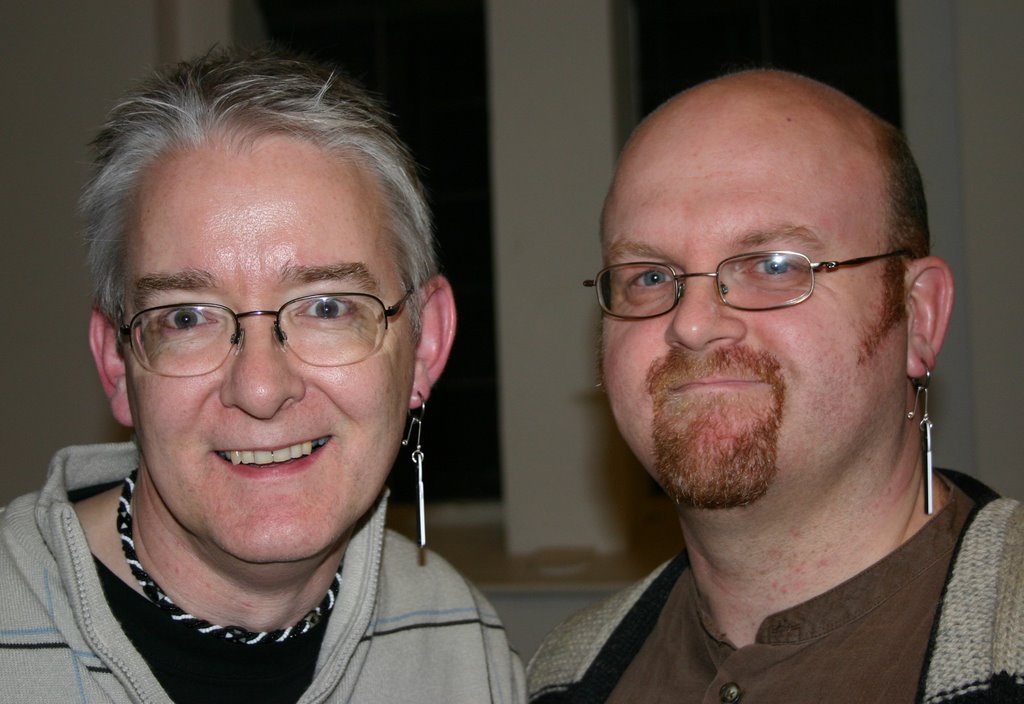
Sunday, February 11, 2007
Photographic evidence
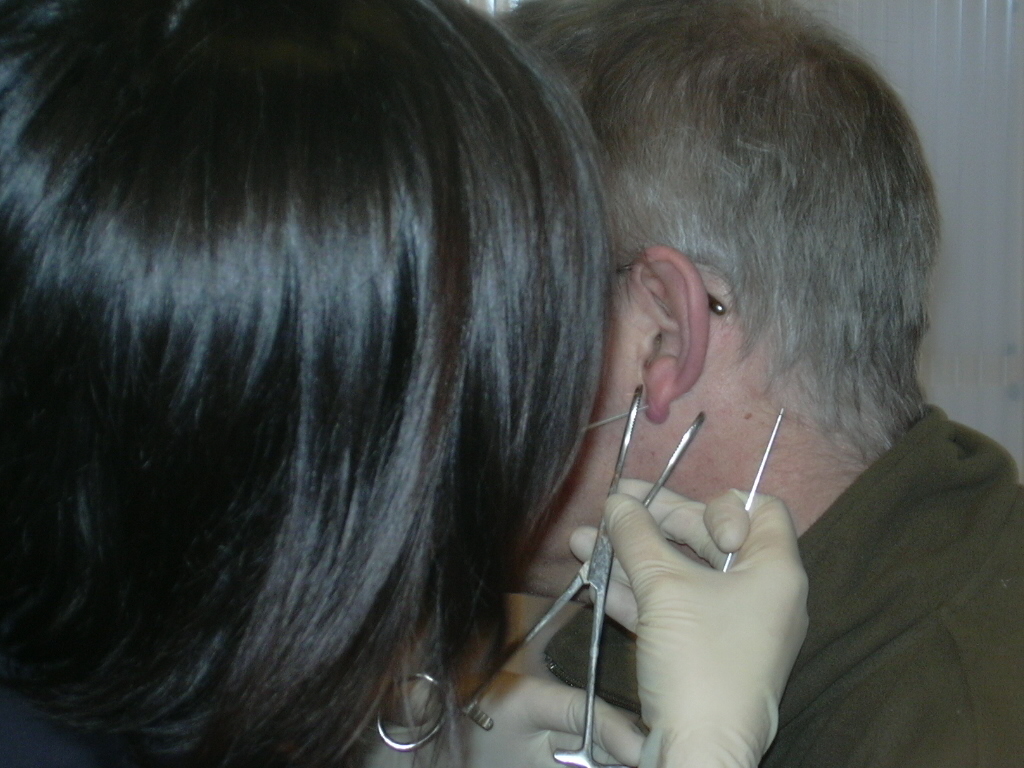
Stuart asked for a picture of my piercing...
Here's one of the needle being run through my left lobe - surprisingly, no pain was felt at this point!
The idea for this came from seeing 58 year old Ken Raynard, minister of Belper Baptist getting it done. Thanks Ken.
And below is my new left profile - what a dash i cut! This morning it doesn't feel sore at all so I'm pretty confident that we'll be hanging the Unlock Freedom keys this evening. Watch this space!

Friday, February 09, 2007
Stop the traffik
Over the weekend I'll respond to some of the comments on my previous post which are stimulating all sorts of thoughts.
Today Jonathan (our minister for youth and young adults) and I had our ears pierced as a prelude to launching our Stop the Traffik Freedom Day activities. Having had a ring inserted by a highly competent young lady piercer, we hope to attach the Stop the Traffik keys to them on Sunday at our evening service.
We'll then wear them to advertise the fact that on 25 March we'll be celebrating the end 200 years ago of the transatlantic slave trade, lamenting the fact that we still benefit from this iniquitous trade and drawing attention to the fact that more people are trafficked today than were transported at the height of the trade that Wilberforce opposed and attempted to stop by Parliamentary action.
On 25 March we'll be on the High Street in Bromley drawing attention to the use of trafficked children in the production of chocolate, giving away fair trade bars and selling others. We'll be playing music, giving out leaflets, talking to people and welcoming a group walking from Keston - where the oak tree that Wilberforce sat under to seek inspiration - to our stand in the High Street. We're hoping that this small group will walk chained together for the four and half miles and hand out information explaining why they're doing it.
If you want to find out more about Stop the Traffik, visit their website at www.stopthetraffik.org
Today Jonathan (our minister for youth and young adults) and I had our ears pierced as a prelude to launching our Stop the Traffik Freedom Day activities. Having had a ring inserted by a highly competent young lady piercer, we hope to attach the Stop the Traffik keys to them on Sunday at our evening service.
We'll then wear them to advertise the fact that on 25 March we'll be celebrating the end 200 years ago of the transatlantic slave trade, lamenting the fact that we still benefit from this iniquitous trade and drawing attention to the fact that more people are trafficked today than were transported at the height of the trade that Wilberforce opposed and attempted to stop by Parliamentary action.
On 25 March we'll be on the High Street in Bromley drawing attention to the use of trafficked children in the production of chocolate, giving away fair trade bars and selling others. We'll be playing music, giving out leaflets, talking to people and welcoming a group walking from Keston - where the oak tree that Wilberforce sat under to seek inspiration - to our stand in the High Street. We're hoping that this small group will walk chained together for the four and half miles and hand out information explaining why they're doing it.
If you want to find out more about Stop the Traffik, visit their website at www.stopthetraffik.org
Monday, February 05, 2007
First thoughts on our discussions
Time to reflect on our discussions in church about belonging and stuff. It's been a good conversation so far for a couple of very simple reasons.
The first is that a lot of people are joining in. More are attending our mid-week central gathering than usual, others are emailing ideas or collaring us at church on Sunday to express a view or ask a question. This is all great - though collating it all and getting that disseminated to others is a challenge!
The second is that people are talking and listening to each other. There was a healthy degree of honesty last week and even disagreement that didn't descend into rancour. I had the sense of people expressing their view and then, on hearing a contrary view reasonably stated, pausing to reflect on whether they should amend their view. This is progress, I feel.
Over on Stuart Blythe's excellent Word at the Barricades, he reflects on whether we should count as members those who turn up to discuss and discern what God is saying to the church. I like this bottom-up, non-institutional approach. Stuart says:
I like his phrase 'communal discernment'. It strikes me that this is what congregational government ought to be about. It seems to me to be what Paul argues on 1 Corinthians 2 about us having the mind of Christ.
I do have an observation/question about it, however, and it's this: people seem to have a default position that they do not want to things they find comfortable and familiar to change. We want new people to join the church but we don't want the way we do church to be affected by that. So when those people gather to 'communally discern' they tend to think that God is interested in maintaining the status quo, the way we do things here. After all, at some point in our history, we have communally discerned that this is the right way to do things.
So it seems to me that the role leaders have in congregational government is to bring the bigger picture against which communal discernment now must take place. And that bigger picture is especially informed by scripture and culture and particularly the reading of scripture in the light of the cultural situation in which we must embody, incarnate our gathering called church.
So it seems to be that communal discernment has to be about hearing Christ in the scriptures and the wider world as well as about hearing Christ through one another gathered to chart a way forward.
The first is that a lot of people are joining in. More are attending our mid-week central gathering than usual, others are emailing ideas or collaring us at church on Sunday to express a view or ask a question. This is all great - though collating it all and getting that disseminated to others is a challenge!
The second is that people are talking and listening to each other. There was a healthy degree of honesty last week and even disagreement that didn't descend into rancour. I had the sense of people expressing their view and then, on hearing a contrary view reasonably stated, pausing to reflect on whether they should amend their view. This is progress, I feel.
Over on Stuart Blythe's excellent Word at the Barricades, he reflects on whether we should count as members those who turn up to discuss and discern what God is saying to the church. I like this bottom-up, non-institutional approach. Stuart says:
maybe members should be recognised as those who attend the meetings to share in
the discussing and discerning! To put that differently, if we consider that
the practice of communal discernment is important, if that is a conviction, let
us make it more important in practice not less.
I like his phrase 'communal discernment'. It strikes me that this is what congregational government ought to be about. It seems to me to be what Paul argues on 1 Corinthians 2 about us having the mind of Christ.
I do have an observation/question about it, however, and it's this: people seem to have a default position that they do not want to things they find comfortable and familiar to change. We want new people to join the church but we don't want the way we do church to be affected by that. So when those people gather to 'communally discern' they tend to think that God is interested in maintaining the status quo, the way we do things here. After all, at some point in our history, we have communally discerned that this is the right way to do things.
So it seems to me that the role leaders have in congregational government is to bring the bigger picture against which communal discernment now must take place. And that bigger picture is especially informed by scripture and culture and particularly the reading of scripture in the light of the cultural situation in which we must embody, incarnate our gathering called church.
So it seems to be that communal discernment has to be about hearing Christ in the scriptures and the wider world as well as about hearing Christ through one another gathered to chart a way forward.
Wednesday, January 31, 2007
Did Paul visit the flock?
I've also been listening to Sam's Town by the Killers and discovering a real depth to it.
I'm reading a book by James Thompson called Pastoral Ministry according to Paul: A Biblical Vision (Baker 2006). It came highly recommended, though I've never heard of Thompson. So far, it's pretty good. He's an NT man so it's a scholarly trawl of pastoral themes in the undisputed Paulines (don't you just love that phrase?! It really is high time someone disputed it - it's one of those givens of NT scholarship that is ripe for demolition.)
It's informed by the New Perspective on Paul (which is good) and majors on Paul's pastoral goal being transformation (a solid idea). I find myself reading it and saying 'yes, I agree with all this, but what I want to know is how did Paul do it - except by writing letters? What did his day look like? Did he visit people, lead Bible studies, preach sermons and chair church meetings?' I'm not sure Thompson is going to answer any of these questions. It's probably not fair to expect him to because that's not the purpose of the book.
But I'd love to know whether anyone has tackled these questions or whether (as I suspect) they are completely unanswerable. Post a comment if you can help or have more questions to add to my list.
AAAhhh ... 'The Kingdom of Doom' on The Good, the Bad and the Queen has just started. What a great track; fabulous strummed acoustic at the start, then the swirl of organ and 'Friday night in the Kingdom of Doom.' It contains the line 'drink all day/coz the country's at war/you'll be falling off the palace wall/I can't be anymore than I say/Oh in the flood we all get washed away.' Sublime.
Hoping to see the Anselm Kiefer exhibition at the White Cube next week or the week after.
I'm reading a book by James Thompson called Pastoral Ministry according to Paul: A Biblical Vision (Baker 2006). It came highly recommended, though I've never heard of Thompson. So far, it's pretty good. He's an NT man so it's a scholarly trawl of pastoral themes in the undisputed Paulines (don't you just love that phrase?! It really is high time someone disputed it - it's one of those givens of NT scholarship that is ripe for demolition.)
It's informed by the New Perspective on Paul (which is good) and majors on Paul's pastoral goal being transformation (a solid idea). I find myself reading it and saying 'yes, I agree with all this, but what I want to know is how did Paul do it - except by writing letters? What did his day look like? Did he visit people, lead Bible studies, preach sermons and chair church meetings?' I'm not sure Thompson is going to answer any of these questions. It's probably not fair to expect him to because that's not the purpose of the book.
But I'd love to know whether anyone has tackled these questions or whether (as I suspect) they are completely unanswerable. Post a comment if you can help or have more questions to add to my list.
AAAhhh ... 'The Kingdom of Doom' on The Good, the Bad and the Queen has just started. What a great track; fabulous strummed acoustic at the start, then the swirl of organ and 'Friday night in the Kingdom of Doom.' It contains the line 'drink all day/coz the country's at war/you'll be falling off the palace wall/I can't be anymore than I say/Oh in the flood we all get washed away.' Sublime.
Hoping to see the Anselm Kiefer exhibition at the White Cube next week or the week after.
Monday, January 29, 2007
Reading, listening and thinking
I'm listening to the Good the Bad and the queen - otherwise known as Damon Albarn's splendid solo album. Backed by some legendary musicians - Paul Simonon of the Clash, Simon Tong of the Verve and Blur's touring band and the great African drummer, Tony Allen - Albarn has served up a suite of songs about London past and present that are inspired and lovely, fragile and robust in equal measure. Great stuff. The man's by far the best British pop/rock artist of the last decade.
I'm reading The Passionate Church by Mike Breen as I think LifeShapes offers the best hope of getting discipleship and discipling written into the fabric of how we are church here. I'm also dipping into the wonderful Robert Jewett commentary on Romans now that a non-damaged copy has arrived. It's fabulous - well informed, provocative and beautifully written.
We're having a series of mid-week conversations about belonging and membership. The first was last week and went really well. We're inviting three home groups at a time to come and share their thoughts and insights.
I've become increasingly conscious over the past week of how linked all these things are (I know, I'm a slow learner but bear with me..!): belonging, discipleship, leadership, the worship life of the church and mission. The trouble is that we tend to treat them as discrete areas to be tackled by different groups at different meetings and I'm not sure which one to address first... And then I discover that actually they're all different sides of the same multi-sided (and therefore illegal) coin and we have top try to address them together.
In the lull between Christmas and New year, I drew up a list of things to address this year and all of those items were on it - along with get new chairs for the worship area so I don't keep putting my back out setting up for cafe church!
I shall sit back and let the lovely music wash over me....
I'm reading The Passionate Church by Mike Breen as I think LifeShapes offers the best hope of getting discipleship and discipling written into the fabric of how we are church here. I'm also dipping into the wonderful Robert Jewett commentary on Romans now that a non-damaged copy has arrived. It's fabulous - well informed, provocative and beautifully written.
We're having a series of mid-week conversations about belonging and membership. The first was last week and went really well. We're inviting three home groups at a time to come and share their thoughts and insights.
I've become increasingly conscious over the past week of how linked all these things are (I know, I'm a slow learner but bear with me..!): belonging, discipleship, leadership, the worship life of the church and mission. The trouble is that we tend to treat them as discrete areas to be tackled by different groups at different meetings and I'm not sure which one to address first... And then I discover that actually they're all different sides of the same multi-sided (and therefore illegal) coin and we have top try to address them together.
In the lull between Christmas and New year, I drew up a list of things to address this year and all of those items were on it - along with get new chairs for the worship area so I don't keep putting my back out setting up for cafe church!
I shall sit back and let the lovely music wash over me....
Tuesday, January 23, 2007
More on the picture on my cover
A friend who is well informed on art matters tells me that the image on my forthcoming book is by William Morris, the great Victorian designer. It's called The strawberry Thief and is based on drawings he made of birds stealing strawberries in the grounds of his home at Kelmscott Manor.
My informant, AJ, adds:
So, it's true that every picture tells a story.
My informant, AJ, adds:
So - what's the significance for your book? Well, as one of the founder membersI like that emphasis on honesty and the thought that good design can help create a better society. Maybe an honestly written book that takes the bible and those who struggle with the church seriously can help make better churches.
of the social and aesthetic Arts and Crafts Movement, Morris' passion was to
champion good design and craftsmanship at a time of increasing mechanisation and
mass production. For some, the movement involved fundamental issues about human society and there was a huge emphasis on 'honesty', on producing products that showed clearly what they were made of and how they worked. The whole movement believed in advocating simplicity and integrity, often emphasising plain
materials and good design...an approach which was to have a lasting influence on
modern design.
The Arts and Crafts movement also traced its origins back to John Ruskin's ideas. He believed that the beauty of medieval art sprang from pride in individual craftsmanship. Developing Ruskin's thoughts, Morris wrote that art was 'man's expression of his joy in labour' and believed that good design could help create a better society.
So, it's true that every picture tells a story.
Monday, January 22, 2007
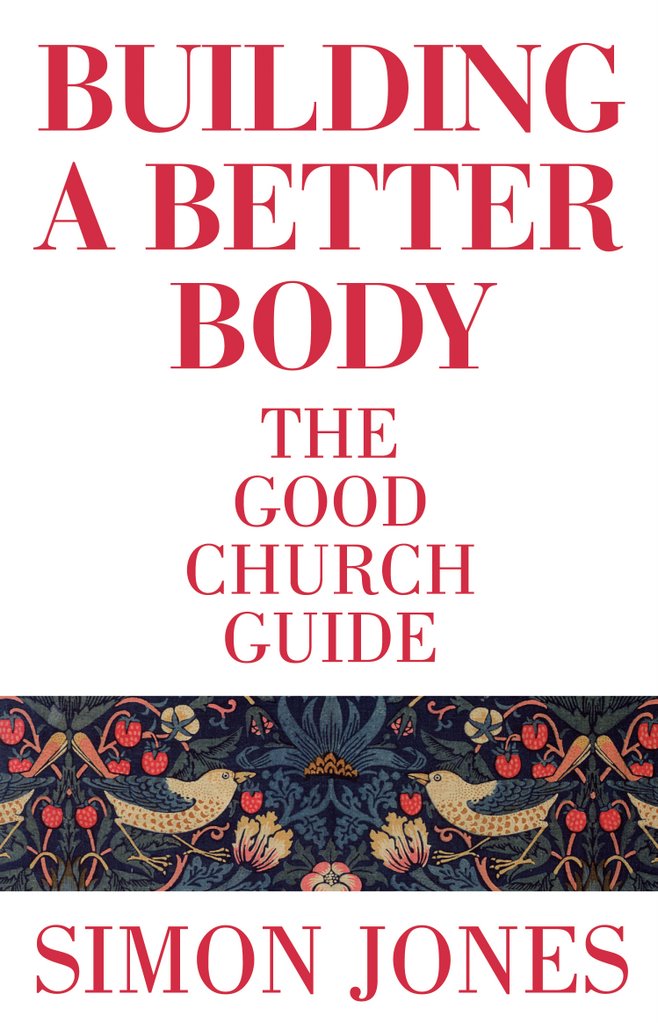
New books
I've just heard from Authentic Media that my reworked Why Bother with Church? will be published on March 31 under the title of Building a Better Body: the Good church guide. Just in time for Spring Harvest.
And my Galatians book - Discovering Galatians in the Crossway Bible Guide series, a sister to Discovering Luke and Discovering the New Testament - ought to be available this week. I'm looking forward to seeing it...
And my Galatians book - Discovering Galatians in the Crossway Bible Guide series, a sister to Discovering Luke and Discovering the New Testament - ought to be available this week. I'm looking forward to seeing it...
Questions always come in threes
These conversations are helping to clarify my thinking - and at the same time raise even more questions (ah well, who said anything to do with church was simple?).
Into the belonging/membership/baptism matrix related questions to do with decision-making and legitimacy, the allocation of resources and the future shape of the church come creeping with all their potential to derail neat ideas.
BillyB -not the first member of my church to add his voice to this (but an astute observer all the same) - asks who has the hang up here - members, leaders or newcomers? The answer, I guess, is all three in different ways (though I'm not sure it's a hang up; I think it's a set of questions worth asking).
As a leader, the question for me arises in two specific areas. The first has to do with how we make decisions as a church. If most decisions rest with the church meeting which is attended by at best 20% of the membership, itself about 60% of the active and giving attenders of the church, what is the status of any of the decisions it makes?
How do we do congregational government in a way that takes account of the pressures on mortgage-paying, commuting, family raising Bromley people? I know that many will not be able to be able to make Wednesday evening gatherings - hence the Sunday meeting (but that only attracted a third of members).
So, I'd love to know how we can make use of new technology to have conversations between people who can't make a meeting in real space but can participate in cyberspace. Ideas on a post card or comment here, please.
The second reason it matters to me is that I've had conversations with non-members about joining where I've not been able to justify the intrusive interviewing method and reporting blind to a church meeting before we vote someone in. As one suggested to me, 'they get the right to see whether I measure up but I don't get to assess them in that personal way.' Others are reluctant to expose their life choices to the scrutiny of strangers for perfectly understandable reasons.
I think these are important questions to be asking and answering. It's not about replacing one tired and threadbare system of church organisation with one more attuned to our era that in turn will itself wear out. It's about asking what shape the church should be if it lives by the values of the gospel: how do we create community in a way that enables everyone who wants to be a follower of Jesus to feel welcome and at home, able to to get the resources they need to sustain their Christian discipleship in an increasingly complex environment?
The thought of getting an answer to these questions makes the conversation exciting and worthwhile.
Into the belonging/membership/baptism matrix related questions to do with decision-making and legitimacy, the allocation of resources and the future shape of the church come creeping with all their potential to derail neat ideas.
BillyB -not the first member of my church to add his voice to this (but an astute observer all the same) - asks who has the hang up here - members, leaders or newcomers? The answer, I guess, is all three in different ways (though I'm not sure it's a hang up; I think it's a set of questions worth asking).
As a leader, the question for me arises in two specific areas. The first has to do with how we make decisions as a church. If most decisions rest with the church meeting which is attended by at best 20% of the membership, itself about 60% of the active and giving attenders of the church, what is the status of any of the decisions it makes?
How do we do congregational government in a way that takes account of the pressures on mortgage-paying, commuting, family raising Bromley people? I know that many will not be able to be able to make Wednesday evening gatherings - hence the Sunday meeting (but that only attracted a third of members).
So, I'd love to know how we can make use of new technology to have conversations between people who can't make a meeting in real space but can participate in cyberspace. Ideas on a post card or comment here, please.
The second reason it matters to me is that I've had conversations with non-members about joining where I've not been able to justify the intrusive interviewing method and reporting blind to a church meeting before we vote someone in. As one suggested to me, 'they get the right to see whether I measure up but I don't get to assess them in that personal way.' Others are reluctant to expose their life choices to the scrutiny of strangers for perfectly understandable reasons.
I think these are important questions to be asking and answering. It's not about replacing one tired and threadbare system of church organisation with one more attuned to our era that in turn will itself wear out. It's about asking what shape the church should be if it lives by the values of the gospel: how do we create community in a way that enables everyone who wants to be a follower of Jesus to feel welcome and at home, able to to get the resources they need to sustain their Christian discipleship in an increasingly complex environment?
The thought of getting an answer to these questions makes the conversation exciting and worthwhile.
Friday, January 19, 2007
So, who are we?
One of the comments being made about our last family gathering is that there were very few non-members there - a handful at best. A couple of people have suggested that non-members probably wouldn't come unless they were given a personal invite - and there might be some truth in this, though I invited a couple of couples and neither of them came!
I wonder whether there is a residual feeling among those not in formal membership that it's not their place to participate in members' meetings. This suggests that perhaps there is something about our way of doing things that is distinctively baptist and that if you aren't a baptist, you don't feel safe or welcome coming to a members' meeting; and if you are a baptist from another church, you know not to come until you are a member.
There's been lots of intelligent stuff on the other baptist blogs - namely stuart's and Brodie's - that's been teasing out whether there is anything left of a distinctive baptist identity. Douglas McBain used to talk of many of the new churches being baptistic - in that they were largely independent, practiced believers' baptism and were low on liturgy.
One thing, of course, they were weaker on was any notion of congregationalism. And perhaps that is at the core of whatever we mean by baptist identity. I was intrigued top read Bishop Tom Wright's withering attack on a group of evangelicals in the church of England who have recently issued a covenant (the details of which are too complicated to go into!). Suffice to say that a key plank of Tom's attack is that the covenant is congregationalist which is not an Anglican value!
Sean Winter has written about this in his reflection on Baptist/Anglican conversations that have taken place over recent years. He argues that baptism is not the key divider between our traditions but the baptist insistence on congregational government and opposition to episcopacy (you'll have to check out Sean's beautifully nuanced argument on his blog and in his article on ambiguous genitives in Romans).
I wonder whether a key distinctive of our way of being church is that we seek to move forward together, having discerned the mind of Christ as a community (along the lines outlined in 1 Cor 2). This, of course, is why there always seems to be a tension in baptist churches around the roles of leaders and possibly why some baptists - whose sympathies lie more with the new churches - struggle with the church meeting.
I have a more practical struggle with the church meeting and that's attendance, representation and finding a model that works. Undoubtedly, our lunchtime gathering worked. We'll do it again. But it was still less than 50% of the membership. How do we hear the voices of those who are members but who do not come to church meetings? Have they excluded themselves from decision-making by not attending? But if we take that attitude, how will we persuade them to come on board with the direction the church has discerned from there Lord as it gathered?
Some of our younger families have expressed the view that we have too many church meetings, that leaders have been elected to lead and that only big decisions (not clearly defined) need to come to the church meeting. Maybe this has something going for it.
I also wonder how we might use the website for conversations about what the church is doing and where it's going. Maybe there's a place for virtual conversations in getting ideas aired and viewpoints expressed ahead of the church coming together to decide something. Perhaps ideas expressed online could be fed into the discussion when we gather.
We are certainly using our mid-week programme between now and Easter to talk about this whole issue of belonging, membership and baptism (I'll blog about that sometime soon) and those conversations will be recorded in some way so that wisdom expressed there is not lost to the wider discussions.
I wonder whether there is a residual feeling among those not in formal membership that it's not their place to participate in members' meetings. This suggests that perhaps there is something about our way of doing things that is distinctively baptist and that if you aren't a baptist, you don't feel safe or welcome coming to a members' meeting; and if you are a baptist from another church, you know not to come until you are a member.
There's been lots of intelligent stuff on the other baptist blogs - namely stuart's and Brodie's - that's been teasing out whether there is anything left of a distinctive baptist identity. Douglas McBain used to talk of many of the new churches being baptistic - in that they were largely independent, practiced believers' baptism and were low on liturgy.
One thing, of course, they were weaker on was any notion of congregationalism. And perhaps that is at the core of whatever we mean by baptist identity. I was intrigued top read Bishop Tom Wright's withering attack on a group of evangelicals in the church of England who have recently issued a covenant (the details of which are too complicated to go into!). Suffice to say that a key plank of Tom's attack is that the covenant is congregationalist which is not an Anglican value!
Sean Winter has written about this in his reflection on Baptist/Anglican conversations that have taken place over recent years. He argues that baptism is not the key divider between our traditions but the baptist insistence on congregational government and opposition to episcopacy (you'll have to check out Sean's beautifully nuanced argument on his blog and in his article on ambiguous genitives in Romans).
I wonder whether a key distinctive of our way of being church is that we seek to move forward together, having discerned the mind of Christ as a community (along the lines outlined in 1 Cor 2). This, of course, is why there always seems to be a tension in baptist churches around the roles of leaders and possibly why some baptists - whose sympathies lie more with the new churches - struggle with the church meeting.
I have a more practical struggle with the church meeting and that's attendance, representation and finding a model that works. Undoubtedly, our lunchtime gathering worked. We'll do it again. But it was still less than 50% of the membership. How do we hear the voices of those who are members but who do not come to church meetings? Have they excluded themselves from decision-making by not attending? But if we take that attitude, how will we persuade them to come on board with the direction the church has discerned from there Lord as it gathered?
Some of our younger families have expressed the view that we have too many church meetings, that leaders have been elected to lead and that only big decisions (not clearly defined) need to come to the church meeting. Maybe this has something going for it.
I also wonder how we might use the website for conversations about what the church is doing and where it's going. Maybe there's a place for virtual conversations in getting ideas aired and viewpoints expressed ahead of the church coming together to decide something. Perhaps ideas expressed online could be fed into the discussion when we gather.
We are certainly using our mid-week programme between now and Easter to talk about this whole issue of belonging, membership and baptism (I'll blog about that sometime soon) and those conversations will be recorded in some way so that wisdom expressed there is not lost to the wider discussions.
Monday, January 15, 2007
Further reflections on our lunchtime gathering
I think there's a limit to how many we can accommodate in the format we used on Sunday. About 130 sat down to soup and bread. We could probably have 30 or 40 more comfortably included. So this suggests that we could only get half our membership together for this sort of gathering.
So, could we do two sittings - one on one Sunday, the other the next? It's a possibility. What does it do to our concepts of the gathered body discerning the mind of Christ. On top of that, how do we accommodate friends and other committed people who aren't members.
One surprising aspect of the meeting was that only half a dozen folk who are not members in the formal baptist sense of that word came along, despite our stressing that everyone was welcome and there being quite a few active, committed people who aren't members.
I'd like to know why this was. I suspect that many felt they wouldn't have been welcome, would not really understand what was going on, wouldn't feel as though they could join. This is a shame because I'd have valued their contribution.
Out of yesterday's gathering, we have a scroll of belonging about ten feet long comprising lots of sheets of paper with jottings, notes and pictures glued on it, the fruit of the discussions over lunch that details people's thoughts on why they feel they belong at our church, what they like and dislike. Over the next couple of weeks, we'll collate all this data and feed it into our on-going discussions.
So, could we do two sittings - one on one Sunday, the other the next? It's a possibility. What does it do to our concepts of the gathered body discerning the mind of Christ. On top of that, how do we accommodate friends and other committed people who aren't members.
One surprising aspect of the meeting was that only half a dozen folk who are not members in the formal baptist sense of that word came along, despite our stressing that everyone was welcome and there being quite a few active, committed people who aren't members.
I'd like to know why this was. I suspect that many felt they wouldn't have been welcome, would not really understand what was going on, wouldn't feel as though they could join. This is a shame because I'd have valued their contribution.
Out of yesterday's gathering, we have a scroll of belonging about ten feet long comprising lots of sheets of paper with jottings, notes and pictures glued on it, the fruit of the discussions over lunch that details people's thoughts on why they feel they belong at our church, what they like and dislike. Over the next couple of weeks, we'll collate all this data and feed it into our on-going discussions.
Sunday, January 14, 2007
The meaning of life
Just left the BBC's ghastly new show The Meaning of Life - lots of air-headed celebs trying to make us think they know something about anything that matters. It makes grumpy old men look intelligent and bursting with insight!
Anyway, today we had our lunchtime church meeting and here are a couple of reflections on it.
firstly, it went really well. About 130 sat down to eat lunch and chat. The atmosphere was really good - people chatting with people they'd not spoken to before. In fact one table didn't get around to talking about the subject in hand because they were having such a good time getting to know each other.
Secondly, it was great to have a couple being voted into membership who were actually present at the meeting. It meant that everyone voting to have them as members knew what they looked like because they were standing there in front of them! In fact when I asked whether we should welcome them aboard, everyone applauded - which I took to be 'yes'.
I've had one email so far which was overwhelmingly ecstatic about the whole thing. So I think we'd have to say it was a success.
I think we made one basic error and that was moving from the hall where we had lunch into the worship area for the second half of the meeting. When we do it again, we won't do that; we'll stay put in the hall and have the whole meeting sitting round the tables - there's something about facing each other in small groups that opens people up and fuels conversation.
No doubt, I'll reflect some more during the week, but I'd say it was a really positive experience and I urge you to try it at your churches.
Anyway, today we had our lunchtime church meeting and here are a couple of reflections on it.
firstly, it went really well. About 130 sat down to eat lunch and chat. The atmosphere was really good - people chatting with people they'd not spoken to before. In fact one table didn't get around to talking about the subject in hand because they were having such a good time getting to know each other.
Secondly, it was great to have a couple being voted into membership who were actually present at the meeting. It meant that everyone voting to have them as members knew what they looked like because they were standing there in front of them! In fact when I asked whether we should welcome them aboard, everyone applauded - which I took to be 'yes'.
I've had one email so far which was overwhelmingly ecstatic about the whole thing. So I think we'd have to say it was a success.
I think we made one basic error and that was moving from the hall where we had lunch into the worship area for the second half of the meeting. When we do it again, we won't do that; we'll stay put in the hall and have the whole meeting sitting round the tables - there's something about facing each other in small groups that opens people up and fuels conversation.
No doubt, I'll reflect some more during the week, but I'd say it was a really positive experience and I urge you to try it at your churches.
The big day arrives
I was at the Mainstream conference this week in rain-swept Swanwick. We had a good time. Mike Breen and Ken McGreavy did the main sessions and were, on the whole, excellent. The seminar strand focused on discipleship and particularly Lifeshapes and, again, they were full of useful stuff. I'll blog about Lifeshapes later.
Since returning on Wednesday, I've found getting ready for today a bit like pulling teeth. It's taken ages for the sermon to come together - even though I have known in broad outline for a week or more what I want to say!
Today is also the day when we are holding our lunchtime church meeting. Around 150 people have signed up for lunch - and no doubt others will stay who have forgotten to do so. This means that there'll probably be twice as many adults there this lunchtime as there are at a normal Wednesday gathering. This in itself suggests it might be worthwhile repeating.
It'll be interesting to see the quality of conversation that happens and how many people who aren't yet members in the formal sense but who feel some sense of attachment or belonging to our community attend and participate. It'll be even more interesting to see how members - especially members of long-standing - respond to their contribution.
I think I'm looking forward to it - though I'm nervous too.
On another - tangentially related note - I see on Maggi Dawn's blog (www.maggidawn.typepad.com) that some Anglicans are getting nervous about their church leaders or employees blogging. As she says, blogs are a good place to float ideas and have conversations. They also give interesting insights into the character and interests of the blogger. I agree. They are not places where anything gets decided. I'm not sure I've said anything here that I haven't said to people in other contexts face-to-face. Since when has conversation been a bad idea?!
Since returning on Wednesday, I've found getting ready for today a bit like pulling teeth. It's taken ages for the sermon to come together - even though I have known in broad outline for a week or more what I want to say!
Today is also the day when we are holding our lunchtime church meeting. Around 150 people have signed up for lunch - and no doubt others will stay who have forgotten to do so. This means that there'll probably be twice as many adults there this lunchtime as there are at a normal Wednesday gathering. This in itself suggests it might be worthwhile repeating.
It'll be interesting to see the quality of conversation that happens and how many people who aren't yet members in the formal sense but who feel some sense of attachment or belonging to our community attend and participate. It'll be even more interesting to see how members - especially members of long-standing - respond to their contribution.
I think I'm looking forward to it - though I'm nervous too.
On another - tangentially related note - I see on Maggi Dawn's blog (www.maggidawn.typepad.com) that some Anglicans are getting nervous about their church leaders or employees blogging. As she says, blogs are a good place to float ideas and have conversations. They also give interesting insights into the character and interests of the blogger. I agree. They are not places where anything gets decided. I'm not sure I've said anything here that I haven't said to people in other contexts face-to-face. Since when has conversation been a bad idea?!
Thursday, January 11, 2007
Campaigning irony
Stuart Blythe in a quite brilliant post over at word at the barricades (www.thewordatthebarricades.typepad.com/ look for the entry called 'perplexed'), has put his finger on why I have misgivings about the current campaign by some Christians against the sexual orientation regulations. And it has to do with my reading of acts 3 - i love it when things look joined up!
Stuart suggests that it is somewhat weird for Christians to be campaigning for the right not to serve people. Read that sentence again if you haven't picked up the irony. We're called to serve everyone, just as God does, so why should we be looking for exemptions on the basis of our disapproval of certain people's lifestyles?
Remember that Luke's first readers would almost certainly have assumed that the man at the gate of the temple (Acts 3:1-10) was morally deficient as well as disabled. They would have seen his disability as evidence that his lifestyle did not measure up to their high standards, that he did not have a good character.
Peter and John did not look for a reason not to serve him. Rather, despite knowing precious little about him - except that he couldn't walk - Peter swept the man up into the story of God's saving activity in the world.
Shouldn't it be our joy to serve all people of all kinds in the hope that through our service they catch a glimpse of the God who causes his sun to shine on all?
Stuart suggests that it is somewhat weird for Christians to be campaigning for the right not to serve people. Read that sentence again if you haven't picked up the irony. We're called to serve everyone, just as God does, so why should we be looking for exemptions on the basis of our disapproval of certain people's lifestyles?
Remember that Luke's first readers would almost certainly have assumed that the man at the gate of the temple (Acts 3:1-10) was morally deficient as well as disabled. They would have seen his disability as evidence that his lifestyle did not measure up to their high standards, that he did not have a good character.
Peter and John did not look for a reason not to serve him. Rather, despite knowing precious little about him - except that he couldn't walk - Peter swept the man up into the story of God's saving activity in the world.
Shouldn't it be our joy to serve all people of all kinds in the hope that through our service they catch a glimpse of the God who causes his sun to shine on all?
Friday, January 05, 2007
Belonging and standing on our two feet
We're kicking off a new series in Acts next week. Called Shoved by the Spirit, we're looking at how the early followers of Jesus made it up as they went along - made up how to do church, how to do mission, how to live for Jesus in the world in the power of the Spirit.
Of course they were inspired by the Spirit and, of course, they had the teaching of Jesus still ringing in their ears. But all the same, they were doing what no one had done before - creating a community of people based on their common love of Jesus.
I've been reading the first great story in Acts - the healing of the lame man. I've been getting to grips with an article by mikeal C Parsons from the Journal of Biblical Literature (it's on line at the Society of Biblical Literature website if you want to read it - it's in volume 124 number 2, 2005. The whole issue is downloadable for free)
Parsons shows how Luke plays with our ideas of disability and inclusion. In the ancient world it was assumed that disabled and disfigured people showed in their outward appearance a moral disfigurement or weakness. All the philosophers thought this - even Plato and Aristotle. It was an idea that hung around for a long time. In C J Sansom's wonderful Shardlake novels, his hero - Matthew Shardlake - is a hunchback and frequent reference is made to the fact that many in Tudor England assumed he was in some way cursed or not to be trusted.
It interests me - this story has long been one of my favourites - because what Peter does is so instinctive. You get no sense of him and John chatting over the implications of reaching out to this man. Peter just does it - he picks him up, heals him in Jesus' name and welcomes him into his company. Parsons reminds us that the lame man does not speak at all; he is the recipient of mercy and inclusion.
So what does this story say about belonging and mission? Lots. I guess key among them is that Luke is telling us that through Jesus a new community is being created where everyone, regardless of their background and moral or physical state, is welcome.
As Parsons says: 'The lame man moves from inactivity to walking, from paralysis to praise. He also moves from sitting to clinging (Acts 3:11) to standing unassisted, alongside Peter and John. Thus he shares in the 'boldness' of the apostles (4:13)...Even though he does not speak, the lame man's boldness is seen in his 'body language' as he boldly takes his stand in solidarity with the persecuted apostles.'
To the crowd gathered as a result of the miracle, was the formerly lame man part of the community Peter and John led? They'd certainly have seen it that way. He belonged to the followers of the way of Jesus. Yet Luke tells us nothing about his faith other than he praised God for his healing.
I have long used this story to talk about social ministries that I've been involved in over the past 15 years or so. Everyone is welcome to taste the benefits of the Kingdom of God - the early Christians were living equal opportunities long before anyone else had thought of it! Can we live up to their example?
The story for me puts the issue of belonging (and membership and all that stuff) firmly into the context of mission. Who belongs? Anybody who wants to - indeed considering Peter and John's action, anyone that we reach out to and pull into our community!
More thoughts along soon.
Of course they were inspired by the Spirit and, of course, they had the teaching of Jesus still ringing in their ears. But all the same, they were doing what no one had done before - creating a community of people based on their common love of Jesus.
I've been reading the first great story in Acts - the healing of the lame man. I've been getting to grips with an article by mikeal C Parsons from the Journal of Biblical Literature (it's on line at the Society of Biblical Literature website if you want to read it - it's in volume 124 number 2, 2005. The whole issue is downloadable for free)
Parsons shows how Luke plays with our ideas of disability and inclusion. In the ancient world it was assumed that disabled and disfigured people showed in their outward appearance a moral disfigurement or weakness. All the philosophers thought this - even Plato and Aristotle. It was an idea that hung around for a long time. In C J Sansom's wonderful Shardlake novels, his hero - Matthew Shardlake - is a hunchback and frequent reference is made to the fact that many in Tudor England assumed he was in some way cursed or not to be trusted.
It interests me - this story has long been one of my favourites - because what Peter does is so instinctive. You get no sense of him and John chatting over the implications of reaching out to this man. Peter just does it - he picks him up, heals him in Jesus' name and welcomes him into his company. Parsons reminds us that the lame man does not speak at all; he is the recipient of mercy and inclusion.
So what does this story say about belonging and mission? Lots. I guess key among them is that Luke is telling us that through Jesus a new community is being created where everyone, regardless of their background and moral or physical state, is welcome.
As Parsons says: 'The lame man moves from inactivity to walking, from paralysis to praise. He also moves from sitting to clinging (Acts 3:11) to standing unassisted, alongside Peter and John. Thus he shares in the 'boldness' of the apostles (4:13)...Even though he does not speak, the lame man's boldness is seen in his 'body language' as he boldly takes his stand in solidarity with the persecuted apostles.'
To the crowd gathered as a result of the miracle, was the formerly lame man part of the community Peter and John led? They'd certainly have seen it that way. He belonged to the followers of the way of Jesus. Yet Luke tells us nothing about his faith other than he praised God for his healing.
I have long used this story to talk about social ministries that I've been involved in over the past 15 years or so. Everyone is welcome to taste the benefits of the Kingdom of God - the early Christians were living equal opportunities long before anyone else had thought of it! Can we live up to their example?
The story for me puts the issue of belonging (and membership and all that stuff) firmly into the context of mission. Who belongs? Anybody who wants to - indeed considering Peter and John's action, anyone that we reach out to and pull into our community!
More thoughts along soon.
Table talk
Thanks to Wulf for his comments. Stuart's blog can be found at http://www.thewordatthebarricades.typepad.com/ and is well worth checking out.
As to how we're organising our Sunday gathering, the aim is to have lunch and have people talking as they eat in small-ish groups. There'll be some feedback there and then with groups invited to tell everyone else where their conversation's going. We'll also be inviting groups to make notes, draw pictures, etc which we'll gather up at the end so we can produce a record of the conversations to provide stimulus for further conversations.
There will also be a more formal section of the meeting as there are items of business that have to be done - though we're hoping these will be done in the same convivial spirit as the round table chat.
As with all experiments, we're not sure what'll happen. But i'm very excited at the prospect of doing something new that is potentially much more inclusive.
As to how we're organising our Sunday gathering, the aim is to have lunch and have people talking as they eat in small-ish groups. There'll be some feedback there and then with groups invited to tell everyone else where their conversation's going. We'll also be inviting groups to make notes, draw pictures, etc which we'll gather up at the end so we can produce a record of the conversations to provide stimulus for further conversations.
There will also be a more formal section of the meeting as there are items of business that have to be done - though we're hoping these will be done in the same convivial spirit as the round table chat.
As with all experiments, we're not sure what'll happen. But i'm very excited at the prospect of doing something new that is potentially much more inclusive.
Thursday, January 04, 2007
New year, continuing conversations
Happy new year everyone.
Had a great break in Devon - stormy, windy, hail(!) but great company and it was good to be away from the desk and computer.
The pre-Christmas conversations about membership and community have resumed. We are planning to have a series of gatherings to talk about the issue between now and Easter, giving members and friends of the church the chance to express their views and share their insights.
I've been interested to read on Stuart Blythe's blog some thoughts about baptism as this is surfacing as a key issue to consider as we think about membership. Some reckon that baptism is a non-negotiable - by which they mean the immersion of believers - while others think we need to treat other traditions seriously.
I must confess that I am increasingly undecided on tbe issue. I used to be strongly of the view that immersion was essential and baptism was the door through which everyone had to go in order to be a full member of the church.
Questions include - what does the New Testament mean by baptism? what was the practice of the early church? what did our baptist forbears do? what does baptism as a ritual mean to people in today's world? I'm not sure what the answers are to any of these questions - but intend to think about it over the next few weeks.
This Sunday we're having our first lunch time church family meeting at which non-members will be welcome. We're having a conversation over the lunch tables about what belonging means to us which will include the children as well as their parents. I'm looking forward to it.
Had a great break in Devon - stormy, windy, hail(!) but great company and it was good to be away from the desk and computer.
The pre-Christmas conversations about membership and community have resumed. We are planning to have a series of gatherings to talk about the issue between now and Easter, giving members and friends of the church the chance to express their views and share their insights.
I've been interested to read on Stuart Blythe's blog some thoughts about baptism as this is surfacing as a key issue to consider as we think about membership. Some reckon that baptism is a non-negotiable - by which they mean the immersion of believers - while others think we need to treat other traditions seriously.
I must confess that I am increasingly undecided on tbe issue. I used to be strongly of the view that immersion was essential and baptism was the door through which everyone had to go in order to be a full member of the church.
Questions include - what does the New Testament mean by baptism? what was the practice of the early church? what did our baptist forbears do? what does baptism as a ritual mean to people in today's world? I'm not sure what the answers are to any of these questions - but intend to think about it over the next few weeks.
This Sunday we're having our first lunch time church family meeting at which non-members will be welcome. We're having a conversation over the lunch tables about what belonging means to us which will include the children as well as their parents. I'm looking forward to it.
Sunday, December 24, 2006
Christmas thoughts and greetings
It's Christmas Eve - one of my favourite days of the year. This year being a Sunday, it'll also be a busy one. We have two services and this afternoon will be serving mince pies, mulled (non-alcoholic) wine, tea and coffee to shoppers wending their way home, inviting them to pause and worship with us.
This evening I'm reflecting on Joseph - the 'redundant groom' in John Bell's wonderful phrase. I'm looking at what the Christmas story might say to ordinary, decent blokes.
I'd intended to focus on Jo already but my train of thought was sent off in a more focussed direction by Timothy Garton Ash's column in the Guardian last Thursday where he reports going to Christmas services, finding them moving but not believing a word of it. More than that, he finds the story and the person behind it has nothing to say to his life or to the world in which he lives it.
I'll reflect on that this evening. It's worth reading - everything by Garton Ash is.
I'll also be referring to Bill Mallonee's Christmas album. Bill, former front man of the Vigilantes of Love, has penned some beautiful songs over the years; he is the most thoughtful and searching of Christian singer songwriters. Check Yonder Shines the Infant Light out - a snip at £5.50 to download - and especially listen to the beautiful Every Father Knows, a meditation on the power of the Christmas story to reach the lost wherever they are. You'll find it at www.billmallonee.net - you won't be sorry.
I'll return to membership, community and mission in the New Year. In the mean time have a great Christmas everyone. I hope you all meet Jesus in the midst of the celebrations and that you know his presence with you throughout 2007.
This evening I'm reflecting on Joseph - the 'redundant groom' in John Bell's wonderful phrase. I'm looking at what the Christmas story might say to ordinary, decent blokes.
I'd intended to focus on Jo already but my train of thought was sent off in a more focussed direction by Timothy Garton Ash's column in the Guardian last Thursday where he reports going to Christmas services, finding them moving but not believing a word of it. More than that, he finds the story and the person behind it has nothing to say to his life or to the world in which he lives it.
I'll reflect on that this evening. It's worth reading - everything by Garton Ash is.
I'll also be referring to Bill Mallonee's Christmas album. Bill, former front man of the Vigilantes of Love, has penned some beautiful songs over the years; he is the most thoughtful and searching of Christian singer songwriters. Check Yonder Shines the Infant Light out - a snip at £5.50 to download - and especially listen to the beautiful Every Father Knows, a meditation on the power of the Christmas story to reach the lost wherever they are. You'll find it at www.billmallonee.net - you won't be sorry.
I'll return to membership, community and mission in the New Year. In the mean time have a great Christmas everyone. I hope you all meet Jesus in the midst of the celebrations and that you know his presence with you throughout 2007.
Thursday, December 21, 2006
Dark Fire and Happy Feet
I finished C J Sansom's Dark Fire last night. It's his second Matthew Shardlake mystery set in 1540 around the time of the fall of Thomas Cromwell.
It's not only a rivetting thriller, gloriously well written, but it's also based on a sound reading of the events surrounding the demise of the King's right hand man in reform. He has some interesting things to say about faith on the way through as well - which I'll leave you to find out for yourselves.
The family went to see Happy Feet last night - the eco cartoon about a dancing penguin. It's great fun! There are one or two plot gaps but the animation and characterisation are terrific and we all left the cinema wanting to adopt a penguin (it'll pass!)
It's not only a rivetting thriller, gloriously well written, but it's also based on a sound reading of the events surrounding the demise of the King's right hand man in reform. He has some interesting things to say about faith on the way through as well - which I'll leave you to find out for yourselves.
The family went to see Happy Feet last night - the eco cartoon about a dancing penguin. It's great fun! There are one or two plot gaps but the animation and characterisation are terrific and we all left the cinema wanting to adopt a penguin (it'll pass!)
Wednesday, December 20, 2006
Elusive community
Liz, Wulf and Anthony raise the key issue of community. There's been a lot of talk recently around elusive terms such as 'welcome' (what is it? how do we do it well?), 'hospitality' (how and where do we offer it? does the church receive hospitality from those outside it?), 'belonging' (what creates a sense of belonging somewhere?) and 'community' (how do you know when you're part of one?)
I'd love to see more of that research that Anthony talks about. Certainly the Gone but Not Forgotten study published in the late 1990s identified relationships (or lack of them) as a reason why people disengaged from church. A key finding was that in 92% of cases when someone stopped going to a particular church, no one visited them to find out why. Isn't that incredible?
Yet that seems to have been Liz's friend's experience - and I've no doubt we could all recount similar stories.
There are two responses to this, however. One is to set up a structure of pastoral care with everyone on a list, everyone being checked on if they are missing. It's efficient. it probably makes sure that if people do miss a Sunday or two, someone finds out why. But is it enough?
I think it's a big jump from 'a pastoral care structure' to 'a mutually supportive community' and that the former can prevent the latter from being created. I think some churches put a structure in place and invest all their energy in making it work, only to discover that they've no energy left for making relationships, getting to know people, building community. In these churches, we don't have relationships, we have dealings or transactions with other people, much as we do in a bank or supermarket.
I was at the barbers this morning having my pre-Christmas tidy-up. I conversed at a superficial level with the girl with the scissors - just enough to be polite (after all, it's hard to be that close to another human being and say nothing!) - but I do not think for all the banter that goes on, that my barbers is a 'community'; the chat is a by-product of getting a job done.
Church sometimes feels like that. We get the job done - everyone knows where everyone is. But we are not a community - no one really knows how anyone else feels.
It's an interesting exercise to ask members what others do for a living, how many children they have, whether they are married, have they always lived in the area, how long have they been a Christian. The answers tell you a lot about community - whether your church is one.
This is a particular problem for larger churches, I think. I'm pretty sure we don't have relational space for more than 30-50 people. In a large church we're on nodding acquaintance with a much larger number than that, but do we have any kind of relationship with 30-50 of them? And where are those relationships formed? I don't believe they can be formed in our current Sunday services and probably not over coffee afterwards - though that helps.
Perhaps we need to invest in community-building activities - meals, days out, coffee mornings, social events, small group activities.
Of course, there might be people from my church reading this wondering what planet I'm from(!) who could tell me that they are in community relationships with a good group of people, a community that they find fun and supportive - and challenging.
Go on, amaze me!
I'd love to see more of that research that Anthony talks about. Certainly the Gone but Not Forgotten study published in the late 1990s identified relationships (or lack of them) as a reason why people disengaged from church. A key finding was that in 92% of cases when someone stopped going to a particular church, no one visited them to find out why. Isn't that incredible?
Yet that seems to have been Liz's friend's experience - and I've no doubt we could all recount similar stories.
There are two responses to this, however. One is to set up a structure of pastoral care with everyone on a list, everyone being checked on if they are missing. It's efficient. it probably makes sure that if people do miss a Sunday or two, someone finds out why. But is it enough?
I think it's a big jump from 'a pastoral care structure' to 'a mutually supportive community' and that the former can prevent the latter from being created. I think some churches put a structure in place and invest all their energy in making it work, only to discover that they've no energy left for making relationships, getting to know people, building community. In these churches, we don't have relationships, we have dealings or transactions with other people, much as we do in a bank or supermarket.
I was at the barbers this morning having my pre-Christmas tidy-up. I conversed at a superficial level with the girl with the scissors - just enough to be polite (after all, it's hard to be that close to another human being and say nothing!) - but I do not think for all the banter that goes on, that my barbers is a 'community'; the chat is a by-product of getting a job done.
Church sometimes feels like that. We get the job done - everyone knows where everyone is. But we are not a community - no one really knows how anyone else feels.
It's an interesting exercise to ask members what others do for a living, how many children they have, whether they are married, have they always lived in the area, how long have they been a Christian. The answers tell you a lot about community - whether your church is one.
This is a particular problem for larger churches, I think. I'm pretty sure we don't have relational space for more than 30-50 people. In a large church we're on nodding acquaintance with a much larger number than that, but do we have any kind of relationship with 30-50 of them? And where are those relationships formed? I don't believe they can be formed in our current Sunday services and probably not over coffee afterwards - though that helps.
Perhaps we need to invest in community-building activities - meals, days out, coffee mornings, social events, small group activities.
Of course, there might be people from my church reading this wondering what planet I'm from(!) who could tell me that they are in community relationships with a good group of people, a community that they find fun and supportive - and challenging.
Go on, amaze me!
Tuesday, December 19, 2006
Needful provocation
I've been finishing the light revisions to Why bother with church? this afternoon. And apart from being pleasantly surprised at how much I still agree with(!), the thing that struck me was that the model of creative and critical participation in church life depends on the church being of sufficient size to be able to cope with multiple things going on.
So I recognize Stuart's point about smaller churches being disempowered by the models on offer here. And I'm not sure what to do about it either.
I agree 100% with Stuart about creating gatherings that are 'places of challenge and commitment to one another and Christ.' In fact that is a key motive in exploring change. At the moment I think we settle for a middle of the road mush where everyone feels comfortable and any challenge comes through cosy and predictable channels. I'm not just talking about my church; I think this is true up and down the land and possibly accounts for the lacklustre quality of British Christianity.
I think it's probably pretty difficult creating gatherings that scratch where people itch and lead them into a place where their values and lifestyles can be challenged and unsettled. But that's what I want to do, I think.
So, as we unpacked the theme of grace using the movie Chocolat, one of the things we were doing was asking whether we are people of grace and whether our church was a place where people found grace. What we hoped was that the film would provoke attenders to think and feel differently about themselves and their church than they would have done had we just talked about being all things to all people from 1 Corinthians 9 and suggested we need to be a welcoming community.
Some in the congregation warmed to the approach, others didn't. Those who did were clearly challenged and unsettled - even as they enjoyed the evening. Those who don't get films probably left with mixed feelings but majored on disappointment with the way the evening turned out.
The advantage of offering a variety of ways of accessing the same theme through a single day is that people who get a buzz out of talking about the spiritual messages in movies will come to one gathering, while those more comfortable with a more traditional linear approach consisting of singing and sermons will attend a different one. Both groups, hopefully, would be comforted and built up in their faith and challenged to live a more Christ-like life.
And those who were interested in exploring the spiritual life and who came to either gathering - though probably the film evening would suit them better - will be helped to think and feel about life, the world and God in a different and distinctly Christian way. And hopefully they too would find themselves provoked and unsettled.
I guess what I'm arguing for is a set of different entry points to hearing and experiencing the challenge of Jesus' word. But everyone attending whichever gathering ought to experience needful provocation of the kind that might lead to change through the grace of Christ.
I shall respond to the parallel, related and equally important issue of community and how the creation of community - and people feeling a sense of belonging to it - is essential to them being in a place where they are open to the challenge of discipleship.
But that's for another post....
So I recognize Stuart's point about smaller churches being disempowered by the models on offer here. And I'm not sure what to do about it either.
I agree 100% with Stuart about creating gatherings that are 'places of challenge and commitment to one another and Christ.' In fact that is a key motive in exploring change. At the moment I think we settle for a middle of the road mush where everyone feels comfortable and any challenge comes through cosy and predictable channels. I'm not just talking about my church; I think this is true up and down the land and possibly accounts for the lacklustre quality of British Christianity.
I think it's probably pretty difficult creating gatherings that scratch where people itch and lead them into a place where their values and lifestyles can be challenged and unsettled. But that's what I want to do, I think.
So, as we unpacked the theme of grace using the movie Chocolat, one of the things we were doing was asking whether we are people of grace and whether our church was a place where people found grace. What we hoped was that the film would provoke attenders to think and feel differently about themselves and their church than they would have done had we just talked about being all things to all people from 1 Corinthians 9 and suggested we need to be a welcoming community.
Some in the congregation warmed to the approach, others didn't. Those who did were clearly challenged and unsettled - even as they enjoyed the evening. Those who don't get films probably left with mixed feelings but majored on disappointment with the way the evening turned out.
The advantage of offering a variety of ways of accessing the same theme through a single day is that people who get a buzz out of talking about the spiritual messages in movies will come to one gathering, while those more comfortable with a more traditional linear approach consisting of singing and sermons will attend a different one. Both groups, hopefully, would be comforted and built up in their faith and challenged to live a more Christ-like life.
And those who were interested in exploring the spiritual life and who came to either gathering - though probably the film evening would suit them better - will be helped to think and feel about life, the world and God in a different and distinctly Christian way. And hopefully they too would find themselves provoked and unsettled.
I guess what I'm arguing for is a set of different entry points to hearing and experiencing the challenge of Jesus' word. But everyone attending whichever gathering ought to experience needful provocation of the kind that might lead to change through the grace of Christ.
I shall respond to the parallel, related and equally important issue of community and how the creation of community - and people feeling a sense of belonging to it - is essential to them being in a place where they are open to the challenge of discipleship.
But that's for another post....
Monday, December 18, 2006
Fault lines revisited
Great comments on the previous post. Keep them coming...
Yes, it's more work but this can be shared - as Liz said. The teaching component can be done by the same team that currently do two services on a Sunday. For example, the morning 'teaching' could well consist of the same sermon being delivered by the same person albeit in different styles. Doing the same sermon twice is not twice the work.
The work can also be shared by drafting more people into being involved in the services -reading, praying, announcing songs, etc.
Stuart's point about pandering to consumerism is one I wrestle with. It's related to the question 'what is church for?' which I toy with in Why Bother with Church? I think church ought to be a place where people meet God, learn about him and are equipped to live a life that reflects his character. It can happen anywhere - in homes, cafes, pubs and special buildings we call 'churches'. It can involve singing and funky powerpoints and sermons and set-piece liturgies. But it doesn't have to.
My focus is on mission. I want to create opportunities for people to engage with the Christian faith in a way they find acceptable and challenging. I want people to meet and follow Jesus. Church is a place where that can happen. I guess the target for this mission is primarily those who have accessed church but do so no longer - or are in danger of not doing so. So it's young people and young adults who find church increasingly disconnected from the rest of their lives and middle aged people who've done church one way for a lifetime and now find it curiously dissatisfying and unengaging (I think I put myself in this camp - but don't tell my leaders!!!)
So, in one sense my proposal is consumerist in that I am hoping to create opportunities for people engage with church in a way that suits their tastes and sensibilities. But isn't all mission consumerist in that way?
Yes, it's more work but this can be shared - as Liz said. The teaching component can be done by the same team that currently do two services on a Sunday. For example, the morning 'teaching' could well consist of the same sermon being delivered by the same person albeit in different styles. Doing the same sermon twice is not twice the work.
The work can also be shared by drafting more people into being involved in the services -reading, praying, announcing songs, etc.
Stuart's point about pandering to consumerism is one I wrestle with. It's related to the question 'what is church for?' which I toy with in Why Bother with Church? I think church ought to be a place where people meet God, learn about him and are equipped to live a life that reflects his character. It can happen anywhere - in homes, cafes, pubs and special buildings we call 'churches'. It can involve singing and funky powerpoints and sermons and set-piece liturgies. But it doesn't have to.
My focus is on mission. I want to create opportunities for people to engage with the Christian faith in a way they find acceptable and challenging. I want people to meet and follow Jesus. Church is a place where that can happen. I guess the target for this mission is primarily those who have accessed church but do so no longer - or are in danger of not doing so. So it's young people and young adults who find church increasingly disconnected from the rest of their lives and middle aged people who've done church one way for a lifetime and now find it curiously dissatisfying and unengaging (I think I put myself in this camp - but don't tell my leaders!!!)
So, in one sense my proposal is consumerist in that I am hoping to create opportunities for people engage with church in a way that suits their tastes and sensibilities. But isn't all mission consumerist in that way?
Exposing the fault lines
Last night we finished a three week advent series using film as a way into exploring certain big advent words - Signs helped us look at losing and finding faith; Chocolat gave us the opportunity of examining rejecting and finding grace; and The Shawshank Redemption of giving and receiving hope.
It was an interesting series to prepare for - Jonathan and I team-preached the theme and we tried to allow the films to move the argument on. Many people found the approach stimulating with a good number saying that if we do it again, they will bring friends who are exploring faith for themselves.
The series has exposed the fault lines in the church, however, with many older, more traditional members reacting very negatively to the whole approach.
This clearly gives us some questions to ask in the new year. At the top of the list is 'can you meet everyone needs in one service format?' The obvious answer is 'no' (the question really is a no-brainer!) but it's amazing how many churches - including ours - continue to believe the Holy Grail of one-size-fits-all service formats are just within reach. I think this brief series has told me (again) that it's not.
More than that, I think I've learned that everyone is very intolerant of styles they don't like. We all know that the young vote with their feet, going to meetings, services, events that capture their imagination and look as if they'll scratch where they itch rather more than what's on offer at their home church this week.
Indeed, some of our own young people were at an event across town that featured a band and visiting roadshow. I hope it was good.
What I've seen over the past three weeks is that older, more mature Christian people are equally intolerant and picky about what service format they'll put up with. Some have boycotted the advent series saying they don't like movies, that they come to church to hear the bible read and preached on in a traditional way (well, in a way that's been traditional since Victorian times).
One size does not fit all. And churches that try to stick to this model will wither and die. The reason is simple. If we allow what we do to be determined by those who want the traditional menu - albeit tinkered with at the edges - those wanting more radical change will look elsewhere or more likely stop coming to church altogether, reasoning that the Christian faith offers nothing to help them navigate their way through the world they live in from Monday to Friday.
Eventually, those who champion the traditional model, will die and the church will be empty.
So, it seems to me that we need to revisit conversations we had a year or so ago about having a variety of styles of Sunday service, meeting the needs or suiting the tastes (take your pick which) of those who attend.
Our proposal then was that we have four services on a Sunday morning with fewer people attending each - thus enabling greater interaction between attenders. Each service would have a different feel and focus - though the teaching programme would be common across the day. So those who want a classic style service can have one; likewise those who want a swinging from the chandeliers celebration. There'll be opportunity for a quieter, more reflective service and for a more exploratory, liquid worship style.
Inevitably everyone will have to give a little. For example, timings will change, so people will have come to church at a different time on a Sunday. We'll have to think about the needs of families and which service (or services) has Sunday school provision. But hopefully, everyone would gain more than they would have to give up.
Of course, even this amount of change is only a half-way house to a much more flexible, smaller more federal church structure that I think most churches will have to move towards in the coming generation. But it's a start.
Watch this space as the debate kicks off again next year. Pray for us. And join in the discussion.
It was an interesting series to prepare for - Jonathan and I team-preached the theme and we tried to allow the films to move the argument on. Many people found the approach stimulating with a good number saying that if we do it again, they will bring friends who are exploring faith for themselves.
The series has exposed the fault lines in the church, however, with many older, more traditional members reacting very negatively to the whole approach.
This clearly gives us some questions to ask in the new year. At the top of the list is 'can you meet everyone needs in one service format?' The obvious answer is 'no' (the question really is a no-brainer!) but it's amazing how many churches - including ours - continue to believe the Holy Grail of one-size-fits-all service formats are just within reach. I think this brief series has told me (again) that it's not.
More than that, I think I've learned that everyone is very intolerant of styles they don't like. We all know that the young vote with their feet, going to meetings, services, events that capture their imagination and look as if they'll scratch where they itch rather more than what's on offer at their home church this week.
Indeed, some of our own young people were at an event across town that featured a band and visiting roadshow. I hope it was good.
What I've seen over the past three weeks is that older, more mature Christian people are equally intolerant and picky about what service format they'll put up with. Some have boycotted the advent series saying they don't like movies, that they come to church to hear the bible read and preached on in a traditional way (well, in a way that's been traditional since Victorian times).
One size does not fit all. And churches that try to stick to this model will wither and die. The reason is simple. If we allow what we do to be determined by those who want the traditional menu - albeit tinkered with at the edges - those wanting more radical change will look elsewhere or more likely stop coming to church altogether, reasoning that the Christian faith offers nothing to help them navigate their way through the world they live in from Monday to Friday.
Eventually, those who champion the traditional model, will die and the church will be empty.
So, it seems to me that we need to revisit conversations we had a year or so ago about having a variety of styles of Sunday service, meeting the needs or suiting the tastes (take your pick which) of those who attend.
Our proposal then was that we have four services on a Sunday morning with fewer people attending each - thus enabling greater interaction between attenders. Each service would have a different feel and focus - though the teaching programme would be common across the day. So those who want a classic style service can have one; likewise those who want a swinging from the chandeliers celebration. There'll be opportunity for a quieter, more reflective service and for a more exploratory, liquid worship style.
Inevitably everyone will have to give a little. For example, timings will change, so people will have come to church at a different time on a Sunday. We'll have to think about the needs of families and which service (or services) has Sunday school provision. But hopefully, everyone would gain more than they would have to give up.
Of course, even this amount of change is only a half-way house to a much more flexible, smaller more federal church structure that I think most churches will have to move towards in the coming generation. But it's a start.
Watch this space as the debate kicks off again next year. Pray for us. And join in the discussion.
Friday, December 15, 2006
Why is Christmas so busy...?
Christmas is coming and the work is piling up. It doesn't seem to matter how carefully I plan my Christmas preparations, I always seem to run out of time.
This year I want to explore what Christmas says to and about families. What's the significance of the fact that God entrusted his Son to human parents - a teenage(?) mum and a carpenter dad - and what does that tell us about God's commitment to families in today's world?
There's been a lot of talk about families recently - notably the huge Ian Duncan-Smith report that's just come out defending the traditional conservative view that marriage is the best basis for family life and that government should invest in marriage - through tax incentives - and bolster families through various forms of help.
It's always wonderful to see the conversion of politicians late in the day - and usually long after they have any chance of actually doing anything through holding public office (enter Al Gore as the primary witness here)!
I'm not sure IDS has all the answers but 300,000 words worth of analysis and policy ideas ought to be taken very seriously. Clearly something is wrong with the way families are nurtured and supported in Britain today.
I think Christmas is an opportunity to ask what God thinks about families and what resources he makes available for them.
I am also reworking Why Bother with Church for Authentic Media with a view to it being republished next March in time for Spring Harvest. As I've worked my way through the chapters, I've been pleasantly surprised at how well it's stood the test of time - many of its arguments still seem fresh and the issues it addresses are still all too pertinent.
If I was starting the book from scratch, I wouldn't write it the way it's written, but I think one more reprint is worthwhile. I'm pondering turning my reflections on Philippians and McWorld into a book at some stage. I've tested the thinking out over the past three years at various church conferences and might well preach on it at home late next year.
Still loving the new Iona album, The Circling Hour and Beirut's Gulag Orkestar - an album of rare beauty and creativity.
This year I want to explore what Christmas says to and about families. What's the significance of the fact that God entrusted his Son to human parents - a teenage(?) mum and a carpenter dad - and what does that tell us about God's commitment to families in today's world?
There's been a lot of talk about families recently - notably the huge Ian Duncan-Smith report that's just come out defending the traditional conservative view that marriage is the best basis for family life and that government should invest in marriage - through tax incentives - and bolster families through various forms of help.
It's always wonderful to see the conversion of politicians late in the day - and usually long after they have any chance of actually doing anything through holding public office (enter Al Gore as the primary witness here)!
I'm not sure IDS has all the answers but 300,000 words worth of analysis and policy ideas ought to be taken very seriously. Clearly something is wrong with the way families are nurtured and supported in Britain today.
I think Christmas is an opportunity to ask what God thinks about families and what resources he makes available for them.
I am also reworking Why Bother with Church for Authentic Media with a view to it being republished next March in time for Spring Harvest. As I've worked my way through the chapters, I've been pleasantly surprised at how well it's stood the test of time - many of its arguments still seem fresh and the issues it addresses are still all too pertinent.
If I was starting the book from scratch, I wouldn't write it the way it's written, but I think one more reprint is worthwhile. I'm pondering turning my reflections on Philippians and McWorld into a book at some stage. I've tested the thinking out over the past three years at various church conferences and might well preach on it at home late next year.
Still loving the new Iona album, The Circling Hour and Beirut's Gulag Orkestar - an album of rare beauty and creativity.
Friday, December 08, 2006
Enjoying...
I'm enjoying discovering a new writer. He's C J Sansom, author of three crime novels set in the reign of Henry VIII and featuring a lawyer/sleuth called Matthew Shardlake. I've finished Dissolution and am half way through Dark Fire. I can't wait for sovereign to come out in paperback.
These are terrific books. Sansom captures the sense of time and place wonderfully and weaves entirely believable and gripping thriller plots around real events. At £7 a pop, they're a good stocking filler.
I'm also enjoying the new Iona album - usual blend of celtic folk and prog rock with mesmerising vocals from Joanne Hogg. There's a particularly good track - factory of magnificient souls - with lyrics by the peerless Steve Stockman. His words and Dave Bainbridge's guitar were born for each other
And I've been enjoying Chocolat - as we're doing an advent evening service on it - and the Straight Story (which I wish I was doing an advent evening service on!). The latter is a David Lynch film about septuagenarian who crosses Iowa on a lawnmower to be reconciled with his brother who's had a stroke. Seriously, it's a blinder. One of the loveliest, funniest, quirkyist and most satisfying films I've seen, full of insights into what it means to be human and part of a family.
I'm enjoying thinking about membership and what it means to belong. Perhaps we should all watch the Straight story and ponder that says about community and the nature of the church. It would be unusual to view David Lynch as a theologian!
These are terrific books. Sansom captures the sense of time and place wonderfully and weaves entirely believable and gripping thriller plots around real events. At £7 a pop, they're a good stocking filler.
I'm also enjoying the new Iona album - usual blend of celtic folk and prog rock with mesmerising vocals from Joanne Hogg. There's a particularly good track - factory of magnificient souls - with lyrics by the peerless Steve Stockman. His words and Dave Bainbridge's guitar were born for each other
And I've been enjoying Chocolat - as we're doing an advent evening service on it - and the Straight Story (which I wish I was doing an advent evening service on!). The latter is a David Lynch film about septuagenarian who crosses Iowa on a lawnmower to be reconciled with his brother who's had a stroke. Seriously, it's a blinder. One of the loveliest, funniest, quirkyist and most satisfying films I've seen, full of insights into what it means to be human and part of a family.
I'm enjoying thinking about membership and what it means to belong. Perhaps we should all watch the Straight story and ponder that says about community and the nature of the church. It would be unusual to view David Lynch as a theologian!
Tuesday, December 05, 2006
Tear it down ... and build it up
I agree with Wulf that tearing down is a lot easier than building up - though it is the essential prerequisite for building anything.
But tinkering at the edges leaves us with more anomalies and exceptions. So tear the whole thing down - what do we lose?
I think we lose a rigid 'them and us' mentality.
I think we lose a 'first' and 'second' class attender mentality
I think we lose the distinction between joining the Body of Christ through Baptism and joining the church because an unrepresentative minority of members voted you in on a wet Wednesday evening.
I think we lose the impenetrable wall between member and non-member that can only be navigated around by a member helping the non-member to appropriate 'our way of doing things'.
I'm not convinced any of these things are worth keeping anymore.
What we gain is the opportunity to replace our current pattern with something simpler and more flexible.
Early Baptists were people of covenants. They covenanted together to be church in a particular place and at a particular time. Can't we get back to doing that?
I know of one Baptist church that has an annual covenant service at which everyone covenanting together to be in relationship and serve the community in the mission of the church is counted as a member for the following year.
I like the sound of that. This is a model of membership that captures Mike Thomas' principles: it's based on relationships, it recognises that the choice of whether to be a member for the coming year rests solely with the individual - will they commit themselves to fellowship and working with this group of Christians in the church's mission? If yes, then welcome aboard.
It also makes the BUGB body count simple - how many covenanted together to be church? Everyone who signed the covenant. That's how many members we have this year.
There is the issue of how you join the church in June - but I'd have thought it happens by the same principle: give the person the covenant, ask if this is what they're looking for; if they say 'yes' invite them to the next members meeting and give them a mop and bucket and welcome them aboard...
I'm sure it's shot full of flaws and needs a thousand caveats entered, but.... like democracy, it's the worst way of organising a church - except all the other ways.
But tinkering at the edges leaves us with more anomalies and exceptions. So tear the whole thing down - what do we lose?
I think we lose a rigid 'them and us' mentality.
I think we lose a 'first' and 'second' class attender mentality
I think we lose the distinction between joining the Body of Christ through Baptism and joining the church because an unrepresentative minority of members voted you in on a wet Wednesday evening.
I think we lose the impenetrable wall between member and non-member that can only be navigated around by a member helping the non-member to appropriate 'our way of doing things'.
I'm not convinced any of these things are worth keeping anymore.
What we gain is the opportunity to replace our current pattern with something simpler and more flexible.
Early Baptists were people of covenants. They covenanted together to be church in a particular place and at a particular time. Can't we get back to doing that?
I know of one Baptist church that has an annual covenant service at which everyone covenanting together to be in relationship and serve the community in the mission of the church is counted as a member for the following year.
I like the sound of that. This is a model of membership that captures Mike Thomas' principles: it's based on relationships, it recognises that the choice of whether to be a member for the coming year rests solely with the individual - will they commit themselves to fellowship and working with this group of Christians in the church's mission? If yes, then welcome aboard.
It also makes the BUGB body count simple - how many covenanted together to be church? Everyone who signed the covenant. That's how many members we have this year.
There is the issue of how you join the church in June - but I'd have thought it happens by the same principle: give the person the covenant, ask if this is what they're looking for; if they say 'yes' invite them to the next members meeting and give them a mop and bucket and welcome them aboard...
I'm sure it's shot full of flaws and needs a thousand caveats entered, but.... like democracy, it's the worst way of organising a church - except all the other ways.
Yet more membership thoughts
For those of you still thinking about membership issues, there's a great piece in the Baptist Times (30 November issue) by Michael Thomas. How rare it is that 'great' and 'baptist times' appear in the same sentence.
But I recommend you get hold of it. I don't know whether it's available on line.
Mike's argument is that the current way we do things is broke and we need a radical overhaul. I don't know how many will go the whole way with him - I think I do. But I'm certain that his first principle is one that we must seek embody in our membership practices.
It is simply this: 'membership is not something for us to initiate, but to recognise'. In other words - if I read him aright - people come to our churches, join in, make relationships, find support and look for ways of serving alongside us and we recognise them as members.
Mike's key point about the New Testament emphasis being on relationships and not structures is absolutely spot on. 'Where people are relating to each other as brothers and sisters, there is membership,' he says.
And I say amen to that.
But I recommend you get hold of it. I don't know whether it's available on line.
Mike's argument is that the current way we do things is broke and we need a radical overhaul. I don't know how many will go the whole way with him - I think I do. But I'm certain that his first principle is one that we must seek embody in our membership practices.
It is simply this: 'membership is not something for us to initiate, but to recognise'. In other words - if I read him aright - people come to our churches, join in, make relationships, find support and look for ways of serving alongside us and we recognise them as members.
Mike's key point about the New Testament emphasis being on relationships and not structures is absolutely spot on. 'Where people are relating to each other as brothers and sisters, there is membership,' he says.
And I say amen to that.
Subscribe to:
Posts (Atom)

